Division Motto
Rendezvous With Destiny
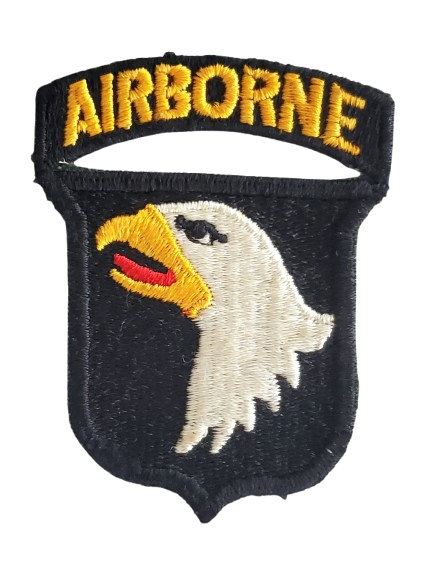
Division Insignia

Division History
The 101st Airborne Division (Air Assault) ("Screaming Eagles")[2] is a light infantry division of the United States Army that specializes in air assault operations.
Established in 1918, the 101st Division was first constituted as an airborne unit in 1942.
On 30 July 1942, the Army Ground Forces ordered the activation of two airborne divisions by 15 August 1942. The 82nd Division, an Organized Reserve division ordered into active military service in March 1942, was ordered to provide cadre to the 101st Division, the other division that was selected for the project, for all elements except parachute infantry. As part of the reorganization of the 101st Division as an airborne division, the unit was disbanded in the Organized Reserve on 15 August 1942 and reconstituted and reactivated in the Army of the United States.
The pathfinders of the 101st Airborne Division led the way on D-Day in the night drop before the invasion. They left from RAF North Witham, having trained there with the 82nd Airborne Division. These night drops caused a lot of trouble for the gliders. Many crashed and equipment and personnel were lost.
The 101st Airborne Division's objectives were to secure the four causeway exits behind Utah Beach between Saint-Martin-de-Varreville and Pouppeville to ensure the exit route for the 4th Infantry Division from the beach later that morning.The other objectives included destroying a German coastal artillery battery at Saint-Martin-de-Varreville, capturing buildings nearby at Mézières believed used as barracks and a command post for the artillery battery, capturing the Douve river lock at La Barquette (opposite Carentan), capturing two footbridges spanning the Douve at La Porte opposite Brévands, destroying the highway bridges over the Douve at Saint-Côme-du-Mont, and securing the Douve River valley. Their secondary mission was to protect the southern flank of VII Corps. They destroyed two bridges along the Carentan highway and a railroad bridge just west of it. They gained control of La Barquette locks, and established a bridgehead over the Douve which was located north-east of Carentan.
In the process, units also disrupted German communications, established roadblocks to hamper the movement of German reinforcements, established a defensive line between the beachhead and Valognes, cleared the area of the drop zones to the unit boundary at Les Forges, and linked up with the 82nd Airborne Division.
On 10 June the division launched an assault to seize the town of Carentan, a major road and rail hub that served as a critical junction between Utah and Omaha beaches. As such Carentan was heavily defended by the 2nd Fallschirmjäger-Division, 91st Luftlande-Infanterie-Division and elements of the 17th SS Panzergrenadier Division. Deliberate flooding of the Douve River floodplain north of the town left the elevated causeway linking Saint-Côme-du-Mont and Carentan, later named Purple Heart Lane, as the most expedient route to Carentan.
On 17 September 1944, the 101st Airborne Division became part of XVIII Airborne Corps, under Major General Matthew Ridgway, part of the First Allied Airborne Army, commanded by Lieutenant General Lewis H. Brereton. The division took part in Operation Market Garden (17–25 September 1944), an unsuccessful Allied military operation under Field Marshal Bernard Montgomery, commander of the Anglo-Canadian 21st Army Group, to capture Dutch bridges over the Rhine. It was fought in the Netherlands, and is the largest airborne operation of any war.
The plan, as outlined by Montgomery, required the seizure by airborne forces of several bridges on the Highway 69 across the Maas (Meuse River) and two arms of the Rhine (the Waal and the Lower Rhine), as well as several smaller canals and tributaries. Crossing these bridges would allow British armoured units to outflank the Siegfried Line, advance into northern Germany, and encircle the Ruhr, Germany's industrial heartland, thus ending the war. This meant the large-scale use of Allied airborne forces, including both the 82nd and 101st Airborne Divisions, along with the British 1st Airborne Division.
The operation was initially successful. Several bridges between Eindhoven and Nijmegen were captured by the 82nd and 101st. The 101st met little resistance and captured most of their initial objectives by the end of 17 September. However, the demolition of the division's primary objective, a bridge over the Wilhelmina Canal at Son, delayed the capture of the main road bridge over the Maas until 20 September. Faced with the loss of the bridge at Son, the 101st unsuccessfully attempted to capture a similar bridge a few kilometers away at Best but found the approach blocked. During the fighting near Best, Private First Class Joe E. Mann of 3rd Battalion, 502nd PIR posthumously earned the division's second and last Medal of Honor during WWII for throwing his body unto a German grenade he was too badly wounded to throw back, saving several of his fellow soldiers. Other units continued moving to the south and eventually reached the northern end of Eindhoven.
Due to Operation Market Garden significantly extending the 21st Army Groups line, the 101st was attached to 21st Army Group to prevent its lines from being undermanned. The 101st reinforced the Nijmegen salient and relieved the British 43rd Wessex Division to defend against the German counter offensive against the salient in early October. The division was relieved in late November 1944 and returned to SHAEF reserve for rest and refit.
The Ardennes Offensive (16 December 1944 – 25 January 1945) was a major German offensive launched towards the end of World War II through the forested Ardennes Mountains region of Belgium. Germany's planned goal for these operations was to split the British and American Allied line in half, capturing Antwerp, Belgium in the process, and then proceeding to encircle and destroy the entire British 21st Army Group and all 12th U.S. Army Group units north of the German advance, forcing the Western Allies to negotiate a peace treaty in the Axis Powers' favor as a result. In order to reach Antwerp before the Allies could regroup and bring their superior air power to bear, German mechanized forces had to seize all the major highways through eastern Belgium. Because all seven of the main roads in the Ardennes converged on the small town of Bastogne, control of its crossroads was vital to the success or failure of the German attack.
The 101st Airborne was routed to Bastogne, located 107 miles (172 km) away on a 1,463 feet (446 m) high plateau, while the 82nd Airborne took up positions further north to block the critical advance of Kampfgruppe Peiper toward Werbomont, Belgium. The 705th Tank Destroyer Battalion, in reserve sixty miles to the north, was ordered to Bastogne to provide anti-tank support to the armorless 101st Airborne on the 18th and arrived late the next evening. The first elements of the 501st PIR entered the division assembly area four miles west of Bastogne shortly after midnight of 19 December, and by 09:00 the entire division had arrived.
By 21 December, the German forces had surrounded Bastogne, which was defended by both the 101st Airborne and Combat Command B of the 10th Armored Division. Conditions inside the perimeter were tough—most of the medical supplies and medical personnel had been captured on 19 December.
Despite several determined German attacks, the perimeter held. The German commander, Generalleutnant Heinrich Freiherr von Lüttwitz, requested Bastogne's surrender.[33] When General Anthony McAuliffe, now acting commander of the 101st, was told, he commented : "Nuts!" After turning to other pressing issues, his staff reminded him that there should be a reply to the German demand. One officer (Harry W. O. Kinnard, then a lieutenant colonel) recommended that McAuliffe's reply would be "tough to beat". Thus, McAuliffe wrote on the paper delivered to the Germans: "NUTS!" That reply had to be explained, both to the Germans and to non-American Allies.
Both of the two panzer divisions of the XLVII Panzer Corps moved forward from Bastogne after 21 December, leaving only one panzergrenadier regiment of the Panzer-Lehr-Division to assist the 26th Volksgrenadier Division in attempting to capture the crossroads. The 26th VG received additional armor and panzergrenadier reinforcements on Christmas Eve to prepare for its final assault, to take place on Christmas Day. Because it lacked sufficient armor and troops and the 26th VG Division was near exhaustion, the XLVII Panzer Corps concentrated the assault on several individual locations on the west side of perimeter in sequence rather than launching one simultaneous attack on all sides. The assault, despite initial success by German tanks in penetrating the American line, was defeated and virtually all of the German tanks involved were destroyed. The next day, 26 December, the spearhead of General George S. Patton's U.S. Third Army relief force, the 4th Armored Division, broke through the German lines and opened a corridor to Bastogne, ending the siege. The division got the nickname "The Battered Bastards of the Bastion of Bastogne".
With the encirclement broken, the men of the 101st expected to be relieved, but were given orders to resume the offensive. The 506th attacked north and recaptured Recogne on 9 January 1945, the Bois des Corbeaux (Corbeaux Wood), to the right of Easy Company, on 10 January, and Foy on 13 January. The 327th attacked towards Bourcy, northeast of Bastogne, on 13 January and encountered stubborn resistance.
By V-E Day the 101st was exhausted. When Taylor asked "We've licked the best that Hitler had in France and Holland and Germany. Now where do we want to go?" his men shouted "Home", part of the demand among soldiers and civilians for rapid demobilization of United States Armed Forces after World War II. On 1 August 1945, the 501st PIR was moved to France, while the rest of the division was based around Zell am See and Kaprun in the Austrian Alps. Some units within the division began training for redeployment to the Pacific Theatre of War, but the war ended before they were needed. The division was inactivated 30 November 1945. For their efforts during World War II, the 101st Airborne Division was awarded four campaign streamers and two Presidential Unit Citations.
Established in 1918, the 101st Division was first constituted as an airborne unit in 1942.
On 30 July 1942, the Army Ground Forces ordered the activation of two airborne divisions by 15 August 1942. The 82nd Division, an Organized Reserve division ordered into active military service in March 1942, was ordered to provide cadre to the 101st Division, the other division that was selected for the project, for all elements except parachute infantry. As part of the reorganization of the 101st Division as an airborne division, the unit was disbanded in the Organized Reserve on 15 August 1942 and reconstituted and reactivated in the Army of the United States.
The pathfinders of the 101st Airborne Division led the way on D-Day in the night drop before the invasion. They left from RAF North Witham, having trained there with the 82nd Airborne Division. These night drops caused a lot of trouble for the gliders. Many crashed and equipment and personnel were lost.
The 101st Airborne Division's objectives were to secure the four causeway exits behind Utah Beach between Saint-Martin-de-Varreville and Pouppeville to ensure the exit route for the 4th Infantry Division from the beach later that morning.The other objectives included destroying a German coastal artillery battery at Saint-Martin-de-Varreville, capturing buildings nearby at Mézières believed used as barracks and a command post for the artillery battery, capturing the Douve river lock at La Barquette (opposite Carentan), capturing two footbridges spanning the Douve at La Porte opposite Brévands, destroying the highway bridges over the Douve at Saint-Côme-du-Mont, and securing the Douve River valley. Their secondary mission was to protect the southern flank of VII Corps. They destroyed two bridges along the Carentan highway and a railroad bridge just west of it. They gained control of La Barquette locks, and established a bridgehead over the Douve which was located north-east of Carentan.
In the process, units also disrupted German communications, established roadblocks to hamper the movement of German reinforcements, established a defensive line between the beachhead and Valognes, cleared the area of the drop zones to the unit boundary at Les Forges, and linked up with the 82nd Airborne Division.
On 10 June the division launched an assault to seize the town of Carentan, a major road and rail hub that served as a critical junction between Utah and Omaha beaches. As such Carentan was heavily defended by the 2nd Fallschirmjäger-Division, 91st Luftlande-Infanterie-Division and elements of the 17th SS Panzergrenadier Division. Deliberate flooding of the Douve River floodplain north of the town left the elevated causeway linking Saint-Côme-du-Mont and Carentan, later named Purple Heart Lane, as the most expedient route to Carentan.
On 17 September 1944, the 101st Airborne Division became part of XVIII Airborne Corps, under Major General Matthew Ridgway, part of the First Allied Airborne Army, commanded by Lieutenant General Lewis H. Brereton. The division took part in Operation Market Garden (17–25 September 1944), an unsuccessful Allied military operation under Field Marshal Bernard Montgomery, commander of the Anglo-Canadian 21st Army Group, to capture Dutch bridges over the Rhine. It was fought in the Netherlands, and is the largest airborne operation of any war.
The plan, as outlined by Montgomery, required the seizure by airborne forces of several bridges on the Highway 69 across the Maas (Meuse River) and two arms of the Rhine (the Waal and the Lower Rhine), as well as several smaller canals and tributaries. Crossing these bridges would allow British armoured units to outflank the Siegfried Line, advance into northern Germany, and encircle the Ruhr, Germany's industrial heartland, thus ending the war. This meant the large-scale use of Allied airborne forces, including both the 82nd and 101st Airborne Divisions, along with the British 1st Airborne Division.
The operation was initially successful. Several bridges between Eindhoven and Nijmegen were captured by the 82nd and 101st. The 101st met little resistance and captured most of their initial objectives by the end of 17 September. However, the demolition of the division's primary objective, a bridge over the Wilhelmina Canal at Son, delayed the capture of the main road bridge over the Maas until 20 September. Faced with the loss of the bridge at Son, the 101st unsuccessfully attempted to capture a similar bridge a few kilometers away at Best but found the approach blocked. During the fighting near Best, Private First Class Joe E. Mann of 3rd Battalion, 502nd PIR posthumously earned the division's second and last Medal of Honor during WWII for throwing his body unto a German grenade he was too badly wounded to throw back, saving several of his fellow soldiers. Other units continued moving to the south and eventually reached the northern end of Eindhoven.
Due to Operation Market Garden significantly extending the 21st Army Groups line, the 101st was attached to 21st Army Group to prevent its lines from being undermanned. The 101st reinforced the Nijmegen salient and relieved the British 43rd Wessex Division to defend against the German counter offensive against the salient in early October. The division was relieved in late November 1944 and returned to SHAEF reserve for rest and refit.
The Ardennes Offensive (16 December 1944 – 25 January 1945) was a major German offensive launched towards the end of World War II through the forested Ardennes Mountains region of Belgium. Germany's planned goal for these operations was to split the British and American Allied line in half, capturing Antwerp, Belgium in the process, and then proceeding to encircle and destroy the entire British 21st Army Group and all 12th U.S. Army Group units north of the German advance, forcing the Western Allies to negotiate a peace treaty in the Axis Powers' favor as a result. In order to reach Antwerp before the Allies could regroup and bring their superior air power to bear, German mechanized forces had to seize all the major highways through eastern Belgium. Because all seven of the main roads in the Ardennes converged on the small town of Bastogne, control of its crossroads was vital to the success or failure of the German attack.
The 101st Airborne was routed to Bastogne, located 107 miles (172 km) away on a 1,463 feet (446 m) high plateau, while the 82nd Airborne took up positions further north to block the critical advance of Kampfgruppe Peiper toward Werbomont, Belgium. The 705th Tank Destroyer Battalion, in reserve sixty miles to the north, was ordered to Bastogne to provide anti-tank support to the armorless 101st Airborne on the 18th and arrived late the next evening. The first elements of the 501st PIR entered the division assembly area four miles west of Bastogne shortly after midnight of 19 December, and by 09:00 the entire division had arrived.
By 21 December, the German forces had surrounded Bastogne, which was defended by both the 101st Airborne and Combat Command B of the 10th Armored Division. Conditions inside the perimeter were tough—most of the medical supplies and medical personnel had been captured on 19 December.
Despite several determined German attacks, the perimeter held. The German commander, Generalleutnant Heinrich Freiherr von Lüttwitz, requested Bastogne's surrender.[33] When General Anthony McAuliffe, now acting commander of the 101st, was told, he commented : "Nuts!" After turning to other pressing issues, his staff reminded him that there should be a reply to the German demand. One officer (Harry W. O. Kinnard, then a lieutenant colonel) recommended that McAuliffe's reply would be "tough to beat". Thus, McAuliffe wrote on the paper delivered to the Germans: "NUTS!" That reply had to be explained, both to the Germans and to non-American Allies.
Both of the two panzer divisions of the XLVII Panzer Corps moved forward from Bastogne after 21 December, leaving only one panzergrenadier regiment of the Panzer-Lehr-Division to assist the 26th Volksgrenadier Division in attempting to capture the crossroads. The 26th VG received additional armor and panzergrenadier reinforcements on Christmas Eve to prepare for its final assault, to take place on Christmas Day. Because it lacked sufficient armor and troops and the 26th VG Division was near exhaustion, the XLVII Panzer Corps concentrated the assault on several individual locations on the west side of perimeter in sequence rather than launching one simultaneous attack on all sides. The assault, despite initial success by German tanks in penetrating the American line, was defeated and virtually all of the German tanks involved were destroyed. The next day, 26 December, the spearhead of General George S. Patton's U.S. Third Army relief force, the 4th Armored Division, broke through the German lines and opened a corridor to Bastogne, ending the siege. The division got the nickname "The Battered Bastards of the Bastion of Bastogne".
With the encirclement broken, the men of the 101st expected to be relieved, but were given orders to resume the offensive. The 506th attacked north and recaptured Recogne on 9 January 1945, the Bois des Corbeaux (Corbeaux Wood), to the right of Easy Company, on 10 January, and Foy on 13 January. The 327th attacked towards Bourcy, northeast of Bastogne, on 13 January and encountered stubborn resistance.
By V-E Day the 101st was exhausted. When Taylor asked "We've licked the best that Hitler had in France and Holland and Germany. Now where do we want to go?" his men shouted "Home", part of the demand among soldiers and civilians for rapid demobilization of United States Armed Forces after World War II. On 1 August 1945, the 501st PIR was moved to France, while the rest of the division was based around Zell am See and Kaprun in the Austrian Alps. Some units within the division began training for redeployment to the Pacific Theatre of War, but the war ended before they were needed. The division was inactivated 30 November 1945. For their efforts during World War II, the 101st Airborne Division was awarded four campaign streamers and two Presidential Unit Citations.
Featured Missions
| Campaign | Mission | Campaign | Mission |
|---|---|---|---|
| Operation Overlord | Battle for Carentan | Battle of the Bulge | The Siege of Bastogne |
| Operation Overlord | Encircling Carentan | Battle of the Bulge | Marvie Counterattack |
| Battle of the Bulge | Clearing Villeroux's Hills | Battle of the Bulge | Battle at Foy |
| Battle of the Bulge | Retaking Noville |
Ingame Shoulder Patch