Division Motto
Thunder From Heaven
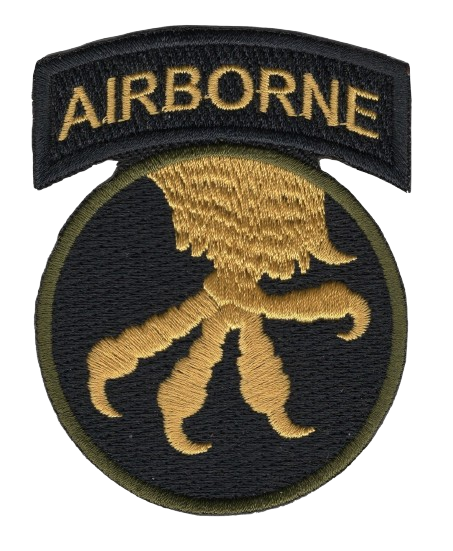
Division Insignia

Division History
The 17th Airborne Division, "The Golden Talons", was an airborne infantry division of the United States Army during World War II.
Activated in April 1943, the division took part in the Knollwood Maneuver and other exercises that helped ensure that the U.S. Army would retain airborne divisions. It arrived in Britain in August 1944, having missed the Allies' first two large-scale airborne operations: Operation Husky and Operation Neptune.
On 16 December 1944 the Wehrmacht launched an offensive in the Ardennes region of Belgium, breaking through Allied lines and rapidly advancing towards Antwerp. On the afternoon of 17 December, Eisenhower decided to commit his theater reserve to the Ardennes in an attempt to halt the German advance; this consisted of the 17th, 82nd and 101st Airborne Divisions under the control of XVIII Airborne Corps. The three divisions were to be attached to Courtney Hodges's U.S. First Army and were ordered to concentrate around the town of St Vith. However, while the other two airborne divisions were able to immediately make their way to the Ardennes as they were already stationed in France, bad weather prevented the 17th from flying in from where the division was stationed in Britain for several days. On 23 December the weather cleared and the division was finally flown to France by emergency night flights. It moved to an assembly area near Rheims. On Christmas Day, the division was attached to George Patton's U.S. Third Army and ordered to assume a thirty-mile long defensive position that ran along the Meuse River near Charleville.
In March 1945, the division participated in its only airborne operation, dropping alongside the British 6th Airborne Division as a part of Operation Varsity. The division advanced through Northern Germany until the end of World War II, when it briefly undertook occupation duties in Germany before shipping back to the United States. It was inactivated in September 1945.
Activated in April 1943, the division took part in the Knollwood Maneuver and other exercises that helped ensure that the U.S. Army would retain airborne divisions. It arrived in Britain in August 1944, having missed the Allies' first two large-scale airborne operations: Operation Husky and Operation Neptune.
On 16 December 1944 the Wehrmacht launched an offensive in the Ardennes region of Belgium, breaking through Allied lines and rapidly advancing towards Antwerp. On the afternoon of 17 December, Eisenhower decided to commit his theater reserve to the Ardennes in an attempt to halt the German advance; this consisted of the 17th, 82nd and 101st Airborne Divisions under the control of XVIII Airborne Corps. The three divisions were to be attached to Courtney Hodges's U.S. First Army and were ordered to concentrate around the town of St Vith. However, while the other two airborne divisions were able to immediately make their way to the Ardennes as they were already stationed in France, bad weather prevented the 17th from flying in from where the division was stationed in Britain for several days. On 23 December the weather cleared and the division was finally flown to France by emergency night flights. It moved to an assembly area near Rheims. On Christmas Day, the division was attached to George Patton's U.S. Third Army and ordered to assume a thirty-mile long defensive position that ran along the Meuse River near Charleville.
In March 1945, the division participated in its only airborne operation, dropping alongside the British 6th Airborne Division as a part of Operation Varsity. The division advanced through Northern Germany until the end of World War II, when it briefly undertook occupation duties in Germany before shipping back to the United States. It was inactivated in September 1945.
Featured Missions
| Campaign | Mission |
|---|---|
| Battle of the Bulge | Through Flamierge |
Ingame Shoulder Patch