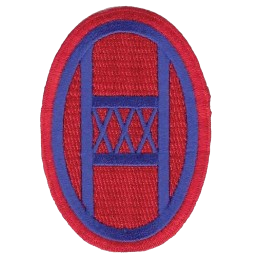
Division Insignia

History
The 30th Infantry Division was a United States Army unit of the National Guard that served in World War I and World War II. It was nicknamed the "Old Hickory" division, in honor of President Andrew Jackson. The Germans nicknamed this division "Roosevelt's SS". The 30th Infantry Division, involved in 282 days of intense combat over a period from June 1944 through April 1945, was regarded by a team of historians led by S.L.A. Marshall as the American infantry division that had "performed the most efficient and consistent battle services" in the European Theater of Operations (ETO).
In the spring of 1942, the division was reorganized from a four-regiment "square" organization into a three-regiment "triangular" organization. During the summer of 1942, the division was then used as a source of personnel for new units. Volunteers for United States Army Air Forces training and officer candidate school quotas also contributed to the division's decline from 12,400 officers and men in June to only 3,000 in August. In the fall of 1942, the 119th Infantry Regiment and 197th Field Artillery Battalion were activated and assigned to the division to replace the 118th Infantry Regiment and 115th Field Artillery Battalion, which had been sent as a task force to England. The 30th Infantry Division, "having lost within a year the equivalent of a full division in both officers and men" was then moved to Camp Blanding, Florida, to restart training in December, with "two-thirds of its enlisted personnel fresh from the reception center." It stayed at Blanding from October 1942 to May 1943, then moved to Camp Forrest, Tennessee in May 1943, and finally Camp Atterbury, Indiana, from 10 November 1943 to 26 January 1944.
After training in the United States for just over two years, the 30th Infantry Division, under the command of Major General Leland Hobbs, arrived in England, 22 February 1944, and trained for the Allied invasion of Normandy until June.
It landed at Omaha Beach, Normandy, on 11 June 1944, five days after the initial D-Day landings of 6 June 1944, secured the Vire-et-Taute Canal, crossed the Vire River on 7 July. Beginning on 25 July, the 30th Division spearheaded the Saint-Lô break-through of Operation Cobra, which was intended to break out of the Normandy beachhead, thus ending the stalemate that had occurred.
The division relieved the veteran 1st Infantry Division near Mortain on 6 August. The German drive to Avranches began shortly after. The 30th Division clashed with the 1st SS Panzer Division, and fierce fighting in place with all available personnel broke out. The division frustrated enemy plans and broke the spearhead of the enemy assault in a violent struggle from 7–12 August. After the liberation of Paris, the division drove east through Belgium, crossing the Meuse River at Visé and Liège on 10 September. Elements of the division entered the Netherlands on 12 September, and Maastricht fell the next day. Moving into Germany and taking up positions along the Wurm River, the 30th Division launched its attack on the heavily defended city of Aachen on 2 October 1944, and succeeded in contacting the 1st Division on 16 October, resulting in the encirclement and takeover of Aachen.
After a rest period, the 30th Division eliminated an enemy salient northeast of Aachen on 16 November, pushed to the Inde River at Inden/Altdorf on 28 November, and then moved to rest areas.
The 30th moved back for training and rehabilitation on 3 March, and on 24 March made its assault crossing of the Rhine. It pursued the enemy across Germany, mopping up enemy pockets of resistance, took Hamelin on 7 April, Braunschweig on 12 April, and helped to reduce Magdeburg on 17 April. As the 30th was capturing Braunschweig, elements of the Division also liberated Weferlingen, a sub-camp of Buchenwald. Approximately 2,500 prisoners were freed through the efforts of the 30th. The Russians were contacted at Grunewald on the Elbe River. The end of World War II in Europe came soon afterwards and, after a short occupation period, the 30th Division began its return to the United States, arriving on 19 August 1945. The surrender of Japan followed soon, which brought the war to an end, and the division was subsequently inactivated on 25 November 1945 at Fort Jackson, South Carolina. By its disbandment, It had spent a cumulative 282 days in combat and had participated in the campaigns and battles of Normandy, Northern France, Rhineland, Ardennes-Alsace and Central Europe.
In the spring of 1942, the division was reorganized from a four-regiment "square" organization into a three-regiment "triangular" organization. During the summer of 1942, the division was then used as a source of personnel for new units. Volunteers for United States Army Air Forces training and officer candidate school quotas also contributed to the division's decline from 12,400 officers and men in June to only 3,000 in August. In the fall of 1942, the 119th Infantry Regiment and 197th Field Artillery Battalion were activated and assigned to the division to replace the 118th Infantry Regiment and 115th Field Artillery Battalion, which had been sent as a task force to England. The 30th Infantry Division, "having lost within a year the equivalent of a full division in both officers and men" was then moved to Camp Blanding, Florida, to restart training in December, with "two-thirds of its enlisted personnel fresh from the reception center." It stayed at Blanding from October 1942 to May 1943, then moved to Camp Forrest, Tennessee in May 1943, and finally Camp Atterbury, Indiana, from 10 November 1943 to 26 January 1944.
After training in the United States for just over two years, the 30th Infantry Division, under the command of Major General Leland Hobbs, arrived in England, 22 February 1944, and trained for the Allied invasion of Normandy until June.
It landed at Omaha Beach, Normandy, on 11 June 1944, five days after the initial D-Day landings of 6 June 1944, secured the Vire-et-Taute Canal, crossed the Vire River on 7 July. Beginning on 25 July, the 30th Division spearheaded the Saint-Lô break-through of Operation Cobra, which was intended to break out of the Normandy beachhead, thus ending the stalemate that had occurred.
The division relieved the veteran 1st Infantry Division near Mortain on 6 August. The German drive to Avranches began shortly after. The 30th Division clashed with the 1st SS Panzer Division, and fierce fighting in place with all available personnel broke out. The division frustrated enemy plans and broke the spearhead of the enemy assault in a violent struggle from 7–12 August. After the liberation of Paris, the division drove east through Belgium, crossing the Meuse River at Visé and Liège on 10 September. Elements of the division entered the Netherlands on 12 September, and Maastricht fell the next day. Moving into Germany and taking up positions along the Wurm River, the 30th Division launched its attack on the heavily defended city of Aachen on 2 October 1944, and succeeded in contacting the 1st Division on 16 October, resulting in the encirclement and takeover of Aachen.
After a rest period, the 30th Division eliminated an enemy salient northeast of Aachen on 16 November, pushed to the Inde River at Inden/Altdorf on 28 November, and then moved to rest areas.
The 30th moved back for training and rehabilitation on 3 March, and on 24 March made its assault crossing of the Rhine. It pursued the enemy across Germany, mopping up enemy pockets of resistance, took Hamelin on 7 April, Braunschweig on 12 April, and helped to reduce Magdeburg on 17 April. As the 30th was capturing Braunschweig, elements of the Division also liberated Weferlingen, a sub-camp of Buchenwald. Approximately 2,500 prisoners were freed through the efforts of the 30th. The Russians were contacted at Grunewald on the Elbe River. The end of World War II in Europe came soon afterwards and, after a short occupation period, the 30th Division began its return to the United States, arriving on 19 August 1945. The surrender of Japan followed soon, which brought the war to an end, and the division was subsequently inactivated on 25 November 1945 at Fort Jackson, South Carolina. By its disbandment, It had spent a cumulative 282 days in combat and had participated in the campaigns and battles of Normandy, Northern France, Rhineland, Ardennes-Alsace and Central Europe.
Featured Missions
| Campaign | Mission |
|---|---|
| Operation Overlord | Battle of Saint-Lô |
Ingame Shoulder Patch