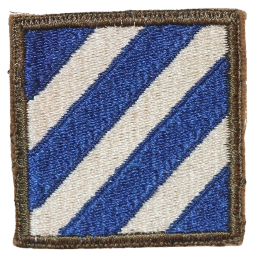
Division Motto
Nous Resterons Là - We Shall Remain Here
Division Insignia

Division History
The 3rd Infantry Division (3ID) (nicknamed Rock of the Marne) is a combined arms division of the United States Army based at Fort Stewart, Georgia.
The 3rd Division is the only division of the U.S. Army during World War II that fought the Axis on all European fronts, and was among the first American combat units to engage in offensive ground combat operations. Audie Murphy, the most highly decorated American soldier of the war, served with the 3rd Division. The 3rd Infantry Division saw combat in North Africa, Sicily, Italy, France, Germany and Austria for 531 consecutive days.
The 3rd Division, under the command of Major General Jonathan W. Anderson, after spending many months training in the United States after the Japanese attack on Pearl Harbor, first saw action during the war as a part of the Western Task Force in Operation Torch, the Allied invasion of North Africa, landing at Fedala on 8 November 1942, and captured half of French Morocco. The division remained there for the next few months and therefore took no part in the Tunisian Campaign, which came to an end in May 1943.
On 10 July 1943, the division (with a Moroccan Goumier Tabor attached) made another amphibious assault landing on the Italian island of Sicily (codenamed Operation Husky), at Licata, a town on the beach, with Torre di Gaffi and Mollarella to the west, and, to the east, Falconara.
Later, the 3rd Infantry Division, serving under the command of Lieutenant General George S. Patton's U.S. Seventh Army, fought its way into Palermo before elements of the 2nd Armored Division could get there, in the process marching 90 miles in three days, and raced on to capture Messina on 17 August 1943, thus ending the brief Sicilian campaign, where the division had a short rest to absorb replacements. During the campaign, the 3rd Division gained a reputation as one of the best divisions in the Seventh Army.
Eight days after the Allied invasion of mainland Italy, on 18 September 1943, the 3rd Division came ashore at Salerno, where they came under the command of VI Corps, under Major General Ernest J. Dawley who was replaced two days later by Major General John P. Lucas (who had commanded the division from September 1941 to March 1942). The corps was part of Lieutenant General Mark W. Clark's U.S. Fifth Army. The 3rd Division was destined to see some of the fiercest and toughest fighting of the war thus far, serving on the Italian Front. Seeing intensive action along the way, the division drove to and across the Volturno River by October 1943, and then to Monte Cassino, where the Battle of Monte Cassino would later be fought, before, with the rest of the 15th Army Group, being held up at the Winter Line (also known as the Gustav Line). In mid-November the division, after spearheading the Fifth Army's advance and suffering heavy casualties during the past few weeks, was relieved by the 36th Infantry Division and pulled out of the line to rest and absorb replacements, coming under the command of Major General Geoffrey Keyes' II Corps. The division remained out of action until late December.
After a brief rest, the division was part of the amphibious landing at Anzio, codenamed Operation Shingle, on 22 January 1944, still as part of VI Corps, and serving alongside the British 1st Infantry Division and other units. It would remain there for just over four months in a toe-hold against numerous furious German counterattacks, and enduring trench warfare similar to that suffered on the Western Front during World War I. On 29 February 1944, the 3rd Division fought off an attack by three German divisions, who fell back with heavy losses two days later. In a single day of combat at Anzio, the 3rd Infantry Division suffered more than 900 casualties, the most of any American division on one day in World War II.
In late May, VI Corps broke out of the Anzio beachhead in Operation Diadem with the 3rd Division in the main thrust. Instead of defeating the Germans, Lieutenant General Clark, the Fifth Army commander, disobeying orders from General Sir Harold Alexander, Commander-in-Chief (C-in-C) of the Allied Armies in Italy (formerly the 15th Army Group), sent the division on to the Italian capital of Rome. This allowed the majority of the German 10th Army, which would otherwise have been trapped, to escape, thus prolonging the campaign in Italy. The division was then removed from the front line and went into training for the Operation Dragoon, the Allied invasion of Southern France.
On 15 August 1944, D-Day for Dragoon, the division, still under VI Corps command but back under the U.S. Seventh Army, landed at St. Tropez, advanced up the Rhone Valley, through the Vosges Mountains, and reached the Rhine at Strasbourg, 26–27 November 1944. After maintaining defensive positions it took part in clearing the Colmar Pocket on 23 January, and on 15 March struck against Siegfried Line positions south of Zweibrücken. The division advanced through the defenses and crossed the Rhine, on 26 March 1945; then drove on to take Nuremberg in a fierce battle, capturing the city in block-by-block fighting, 17–20 April. The 3rd pushed on to take Augsburg where it liberated thousands of forced laborers from the Augsburg concentration camp, a forced labor subcamp of Dachau, and Munich, 27–30 April, and was in the vicinity of Salzburg when the war in Europe ended. Elements of the 7th Infantry Regiment serving under the 3rd Infantry Division captured Hitler's retreat near Berchtesgaden.
The 3rd Division is the only division of the U.S. Army during World War II that fought the Axis on all European fronts, and was among the first American combat units to engage in offensive ground combat operations. Audie Murphy, the most highly decorated American soldier of the war, served with the 3rd Division. The 3rd Infantry Division saw combat in North Africa, Sicily, Italy, France, Germany and Austria for 531 consecutive days.
The 3rd Division, under the command of Major General Jonathan W. Anderson, after spending many months training in the United States after the Japanese attack on Pearl Harbor, first saw action during the war as a part of the Western Task Force in Operation Torch, the Allied invasion of North Africa, landing at Fedala on 8 November 1942, and captured half of French Morocco. The division remained there for the next few months and therefore took no part in the Tunisian Campaign, which came to an end in May 1943.
On 10 July 1943, the division (with a Moroccan Goumier Tabor attached) made another amphibious assault landing on the Italian island of Sicily (codenamed Operation Husky), at Licata, a town on the beach, with Torre di Gaffi and Mollarella to the west, and, to the east, Falconara.
Later, the 3rd Infantry Division, serving under the command of Lieutenant General George S. Patton's U.S. Seventh Army, fought its way into Palermo before elements of the 2nd Armored Division could get there, in the process marching 90 miles in three days, and raced on to capture Messina on 17 August 1943, thus ending the brief Sicilian campaign, where the division had a short rest to absorb replacements. During the campaign, the 3rd Division gained a reputation as one of the best divisions in the Seventh Army.
Eight days after the Allied invasion of mainland Italy, on 18 September 1943, the 3rd Division came ashore at Salerno, where they came under the command of VI Corps, under Major General Ernest J. Dawley who was replaced two days later by Major General John P. Lucas (who had commanded the division from September 1941 to March 1942). The corps was part of Lieutenant General Mark W. Clark's U.S. Fifth Army. The 3rd Division was destined to see some of the fiercest and toughest fighting of the war thus far, serving on the Italian Front. Seeing intensive action along the way, the division drove to and across the Volturno River by October 1943, and then to Monte Cassino, where the Battle of Monte Cassino would later be fought, before, with the rest of the 15th Army Group, being held up at the Winter Line (also known as the Gustav Line). In mid-November the division, after spearheading the Fifth Army's advance and suffering heavy casualties during the past few weeks, was relieved by the 36th Infantry Division and pulled out of the line to rest and absorb replacements, coming under the command of Major General Geoffrey Keyes' II Corps. The division remained out of action until late December.
After a brief rest, the division was part of the amphibious landing at Anzio, codenamed Operation Shingle, on 22 January 1944, still as part of VI Corps, and serving alongside the British 1st Infantry Division and other units. It would remain there for just over four months in a toe-hold against numerous furious German counterattacks, and enduring trench warfare similar to that suffered on the Western Front during World War I. On 29 February 1944, the 3rd Division fought off an attack by three German divisions, who fell back with heavy losses two days later. In a single day of combat at Anzio, the 3rd Infantry Division suffered more than 900 casualties, the most of any American division on one day in World War II.
In late May, VI Corps broke out of the Anzio beachhead in Operation Diadem with the 3rd Division in the main thrust. Instead of defeating the Germans, Lieutenant General Clark, the Fifth Army commander, disobeying orders from General Sir Harold Alexander, Commander-in-Chief (C-in-C) of the Allied Armies in Italy (formerly the 15th Army Group), sent the division on to the Italian capital of Rome. This allowed the majority of the German 10th Army, which would otherwise have been trapped, to escape, thus prolonging the campaign in Italy. The division was then removed from the front line and went into training for the Operation Dragoon, the Allied invasion of Southern France.
On 15 August 1944, D-Day for Dragoon, the division, still under VI Corps command but back under the U.S. Seventh Army, landed at St. Tropez, advanced up the Rhone Valley, through the Vosges Mountains, and reached the Rhine at Strasbourg, 26–27 November 1944. After maintaining defensive positions it took part in clearing the Colmar Pocket on 23 January, and on 15 March struck against Siegfried Line positions south of Zweibrücken. The division advanced through the defenses and crossed the Rhine, on 26 March 1945; then drove on to take Nuremberg in a fierce battle, capturing the city in block-by-block fighting, 17–20 April. The 3rd pushed on to take Augsburg where it liberated thousands of forced laborers from the Augsburg concentration camp, a forced labor subcamp of Dachau, and Munich, 27–30 April, and was in the vicinity of Salzburg when the war in Europe ended. Elements of the 7th Infantry Regiment serving under the 3rd Infantry Division captured Hitler's retreat near Berchtesgaden.
Featured Missions
| Campaign | Mission | Campaign | Mission |
|---|---|---|---|
| Battle of Anzio | Breakout: Clearing Cisterna | Battle of Anzio | Shores East of Nettuno |
| Battle of Anzio | Breakout: Campoleone Crossroads | Battle of Anzio | Padiglione Forest Patrol |
| Battle of Anzio | Up Towards Cisterna | Battle of Anzio | Breakout: Securing Aprilia |
Ingame Shoulder Patch