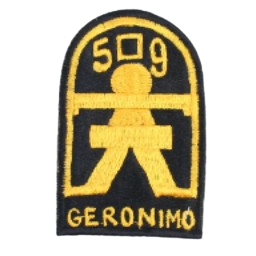
Regiment Insignia

Regiment History
The 509th Infantry Regiment (previously the 509th Parachute Infantry Regiment) is an airborne infantry regiment of the United States Army. The unit was initially activated as a single battalion, the 504th Parachute Infantry Battalion, in October 1941 at Fort Benning, Georgia. Nicknamed "Geronimo".
The advent of World War II ushered in a need for highly mobile units capable of quick insertion within the theater of battle by the Allies. Originally constituted on March 14, 1941, as the 504th Parachute Infantry Battalion (PIB) and activated on October 5, the 509th PIB qualified its first paratroopers at Fort Benning, Georgia. The unit moved to Fort Bragg, North Carolina, where the 503rd and 504th Parachute Infantry Battalions were consolidated together to form the 503rd Parachute Infantry Regiment on February 24, 1942, two months after the United States entered World War II.
The 2-509th carried out the first American combat jump during the invasion of North Africa. The transport planes flew all the way from English airfields to the African coast. This first operation was unsuccessful, with 7 of its 39 C-47s widely scattered. Only 10 aircraft actually dropped their troops, while the others unloaded after 28 troop carriers, nearly out of fuel, landed on the Sebkha d'Oran, a dry lake near their target. The 509th marched overland to occupy its objective, and on 15 November 355 paratroopers successfully dropped on the Youks-les-Bains Airfield.
During the Battle of the Bulge in late 1944, the 509th fought in Belgium to blunt the German attack. An account of this battle is described in the book "Bloody Clash at Sadzot." The 509th Infantry Regiment's service during World War II concluded at the end of January 1945 near St. Vith, Belgium. Of the original 700 paratroopers who entered the battle, approximately ninety-three percent were injured. Effective 1 March 1945, the 509th PIB was disbanded, and the soldiers who remained were reassigned as replacements in the U.S. 82nd Airborne Division or the U.S. 17th Airborne Division.
The 509th made a total of five combat jumps during the war.
The advent of World War II ushered in a need for highly mobile units capable of quick insertion within the theater of battle by the Allies. Originally constituted on March 14, 1941, as the 504th Parachute Infantry Battalion (PIB) and activated on October 5, the 509th PIB qualified its first paratroopers at Fort Benning, Georgia. The unit moved to Fort Bragg, North Carolina, where the 503rd and 504th Parachute Infantry Battalions were consolidated together to form the 503rd Parachute Infantry Regiment on February 24, 1942, two months after the United States entered World War II.
The 2-509th carried out the first American combat jump during the invasion of North Africa. The transport planes flew all the way from English airfields to the African coast. This first operation was unsuccessful, with 7 of its 39 C-47s widely scattered. Only 10 aircraft actually dropped their troops, while the others unloaded after 28 troop carriers, nearly out of fuel, landed on the Sebkha d'Oran, a dry lake near their target. The 509th marched overland to occupy its objective, and on 15 November 355 paratroopers successfully dropped on the Youks-les-Bains Airfield.
During the Battle of the Bulge in late 1944, the 509th fought in Belgium to blunt the German attack. An account of this battle is described in the book "Bloody Clash at Sadzot." The 509th Infantry Regiment's service during World War II concluded at the end of January 1945 near St. Vith, Belgium. Of the original 700 paratroopers who entered the battle, approximately ninety-three percent were injured. Effective 1 March 1945, the 509th PIB was disbanded, and the soldiers who remained were reassigned as replacements in the U.S. 82nd Airborne Division or the U.S. 17th Airborne Division.
The 509th made a total of five combat jumps during the war.
Featured Missions
| Campaign | Mission |
|---|---|
| Tunisia : Southern Operations | Gafsa Airfield Drop |
Ingame Shoulder Patch