Division Motto
Go To It
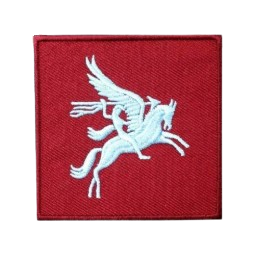
Division Insignia

Division History
The 6th Airborne Division was an airborne infantry division of the British Army during the Second World War. Despite its name, the 6th was actually the second of two airborne divisions raised by the British Army during the war, the other being the 1st Airborne Division. The 6th Airborne Division was formed in the Second World War, in mid-1943, and was commanded by Major-General Richard N. Gale. The division consisted of the 3rd and 5th Parachute Brigades along with the 6th Airlanding Brigade and supporting units.
The division's initial operation, which also resulted in it becoming the first Allied unit to land its troops in France as part of Operation Overlord, was Operation Tonga on 6 June 1944, D-Day, part of the Normandy landings, where it was responsible for securing the left flank of the Allied invasion. Having successfully carried out this task the division remained in Normandy for three months before being withdrawn in September. The division was entrained day after day later that month, over nearly a week, preparing to join Operation Market Garden but was eventually stood down. While still recruiting and reforming in England, it was mobilised again and sent to Belgium in December 1944, to help counter the surprise German offensive in the Ardennes, the Battle of the Bulge. Their final airborne mission followed in March 1945, Operation Varsity, the second Allied airborne assault over the River Rhine.
The division's initial operation, which also resulted in it becoming the first Allied unit to land its troops in France as part of Operation Overlord, was Operation Tonga on 6 June 1944, D-Day, part of the Normandy landings, where it was responsible for securing the left flank of the Allied invasion. Having successfully carried out this task the division remained in Normandy for three months before being withdrawn in September. The division was entrained day after day later that month, over nearly a week, preparing to join Operation Market Garden but was eventually stood down. While still recruiting and reforming in England, it was mobilised again and sent to Belgium in December 1944, to help counter the surprise German offensive in the Ardennes, the Battle of the Bulge. Their final airborne mission followed in March 1945, Operation Varsity, the second Allied airborne assault over the River Rhine.
Featured Missions
| Campaign | Mission |
|---|---|
| Operation Overlord | Taking Pegasus Bridge |
| Operation Overlord | Holding Pegasus Bridge |
The division is features as the 6th Airlanding Brigade on Taking Pegasus Bridge and Holding Pegasus Bridge missions
Ingame Shoulder Patch