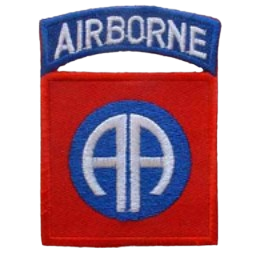
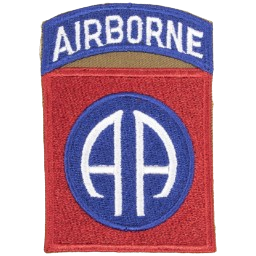
Division Motto
Death from Above
Division Insignia

Division History
The 82nd Airborne Division ("All American") is a United States Army airborne infantry division, that specializes in parachute assault, based in Fort Bragg, North Carolina.
The 82nd Division was constituted during World War I on 5 August 1917 as an infantry division in the National Army. It was organized and formally activated on 25 August 1917 at Camp Gordon, Georgia. At the time, the division consisted entirely of newly conscripted soldiers. Original enlisted men assigned to the division came from Alabama, Georgia, and Tennessee. In October 1917, nearly all of them were transferred to fill shortages in National Guard and National Army units, principally the 30th, 31st, and 81st Divisions, which were training at other camps in the Southern United States.
The 82nd Division was redesignated on 13 February 1942 as Division Headquarters, 82nd Division, and ordered into active service on 25 March 1942, at Camp Claiborne, Louisiana, under the command of Major General Omar N. Bradley. The officer and enlisted cadre mostly came from the 9th Infantry Division. The enlisted men came from reception centers in the Midwest, South, and Southwest. During this period, the division brought together three officers who would ultimately steer the US Army during the following two decades: Matthew Ridgway, James M. Gavin, and Maxwell D. Taylor. Under Major General Bradley, the 82nd Division's Chief of staff was George Van Pope.
On 15 August 1942, the 82nd Infantry Division, now commanded by Major General Ridgway, became the first airborne division in the history of the US Army, and was redesignated as the 82nd Airborne Division. The 82nd was selected after deliberations by the US Army General Staff because of a number of factors. It was not a Regular Army or National Guard unit, its personnel had all completed basic training, and it was stationed in an area that had good weather and flying facilities. Historian John B. Wilson wrote that "many traditionalists in those components wanted nothing to do with such an experimental force". James M. Gavin wrote that many states would refuse the conversion of their National Guard units, likely because of the additional expenses needed to maintain facilities for airborne units.
In April 1943, paratroopers from the 82nd, under the command of Major General Ridgway, sailed into the Mediterranean Theater of Operations and landed in North Africa as part of the Allied plan to invade Sicily. The division's first two combat operations were parachute assaults into Sicily on 9 July and Salerno on 13 September 1943.
In January 1944, the 504th, commanded by Colonel Reuben Tucker, which was temporarily detached to fight at Anzio, adopted the nickname "Devils in Baggy Pants", taken from an entry in a German officer's diary.
With two air drops under its belt, the 82nd Airborne was ready for the second "D-Day" operation in the division's history; Operation Neptune, or the amphibious assault portion of Allied invasion of Normandy. The division conducted Mission Boston, a component of the Operation Overlord plan.
In preparation for the operation, the division was significantly reorganized. To ease the integration of replacement troops, rest, and refitting following the fighting in Italy, the 504th PIR did not rejoin the division for the invasion. Two new parachute infantry regiments (PIRs), the 507th and the 508th, provided it, along with the veteran 505th, a three-parachute infantry regiment punch. The 325th was also reinforced by the addition of the 3rd Battalion of the 401st GIR, bringing it up to a strength of three battalions.
On 5 and 6 June these paratroopers, parachute artillery elements, and the 319th and 320th, boarded hundreds of transport planes and gliders to begin history's largest airborne assault at the time. Only Operation Market Garden later that year would be larger. During the 6 June assault, a 508th platoon leader, First lieutenant Robert P. Mathias, was the first US Army officer killed by German fire during the invasion. On 7 June, after this first wave of attack, the 325th GIR arrived by glider to provide a division reserve.
Following Normandy, the 82nd Airborne Division returned to England to rest and refit for future airborne operations. The 82nd became part of the newly organized XVIII Airborne Corps, which consisted of the 17th, 82nd, and 101st Airborne Divisions. Ridgway was given command of the corps but was not officially promoted to lieutenant general until 1945. His recommendation for succession as division commander was Brigadier General James M. Gavin, previously the 82nd's assistant division commander. Upon being promoted to major general in October 1944 at the age of 37, Gavin became the youngest general since the Civil War to command a US Army division.
On 2 August 1944, the division became part of the First Allied Airborne Army. In September, planning for Operation Market Garden, the Allied invasion of the Netherlands, began in earnest. The operation called for three, at minimum, airborne divisions to seize and hold key bridges and roads deep behind German lines. The 504th PIR, now back at full strength, was reassigned to the 82nd, while the 507th was assigned to the 17th Airborne Division, at the time training in England.
On 17 September, the "All American" Division conducted its fourth and final combat jump of World War II. Fighting off German counterattacks, the division captured its objectives between Grave, and Nijmegen. The division failed to initially capture Nijmegen Bridge when the opportunity presented itself early in the battle. When the British XXX Corps arrived in Nijmegen, six hours ahead of schedule, they found themselves having to fight to take a bridge that should have already been in Allied hands.
The Market Garden salient was held in a defensive operation for several weeks until the 82nd was relieved by Canadian troops, and sent into reserve in France. During the operation, 19-year-old Private John R. Towle of the 504th PIR was posthumously awarded the 82nd Airborne Division's second Medal of Honor of World War II.
On 16 December 1944, the Germans launched a surprise offensive through the Ardennes Forest, which became known as the Battle of the Bulge. In SHAEF reserve, the 82nd was committed on the northern face of the bulge near Elsenborn Ridge.
On 20 December 1944, the 82nd Airborne Division was assigned to take Cheneux which had been captured by Kampfgruppe Peiper. On 21–22 December 1944, the 82nd Airborne faced counterattacks from two Waffen SS divisions which included the 1st SS Panzer Division Leibstandarte SS Adolf Hitler (lit. translation "The SS Bodyguard Division of Adolf Hitler") and the 9th SS Panzer Division Hohenstaufen. The Waffen SS efforts to relieve the Kampfgruppe Peiper failed due to the stubborn defense of the 82nd Airborne, the 30th ID, 2nd ID, and other units.
After several days of fighting, the destruction of the 62nd Volksgrenadiers, and what had been left of the 9th SS Panzer Division was complete. For the 82nd Airborne Division the first part of the Battle of the Bulge had ended.
After helping to secure the Ruhr, the 82nd Airborne Division took over Ludwigslust past the Elbe River, accepting the surrender of over 150,000 men of Lieutenant General Kurt von Tippelskirch's 21st Army on 2 May 1945. General Omar Bradley, commanding the US 12th Army Group, stated in a 1975 interview with Gavin that Field Marshal Sir Bernard Montgomery, commanding the Anglo-Canadian 21st Army Group, had told him that German opposition was too great to cross the Elbe. When Gavin's 82nd crossed the river, in company with the British 6th Airborne Division, the 82nd Airborne Division moved 36 miles in one day and captured over 100,000 troops, causing great laughter in Bradley's 12th Army Group headquarters.
Following Germany's surrender, the 82nd Airborne Division entered Berlin for occupation duty, replacing the 2nd Armored Division in August 1945. The war ended before their scheduled participation in the Allied invasion of Japan, Operation Downfall.
The 82nd Division was constituted during World War I on 5 August 1917 as an infantry division in the National Army. It was organized and formally activated on 25 August 1917 at Camp Gordon, Georgia. At the time, the division consisted entirely of newly conscripted soldiers. Original enlisted men assigned to the division came from Alabama, Georgia, and Tennessee. In October 1917, nearly all of them were transferred to fill shortages in National Guard and National Army units, principally the 30th, 31st, and 81st Divisions, which were training at other camps in the Southern United States.
The 82nd Division was redesignated on 13 February 1942 as Division Headquarters, 82nd Division, and ordered into active service on 25 March 1942, at Camp Claiborne, Louisiana, under the command of Major General Omar N. Bradley. The officer and enlisted cadre mostly came from the 9th Infantry Division. The enlisted men came from reception centers in the Midwest, South, and Southwest. During this period, the division brought together three officers who would ultimately steer the US Army during the following two decades: Matthew Ridgway, James M. Gavin, and Maxwell D. Taylor. Under Major General Bradley, the 82nd Division's Chief of staff was George Van Pope.
On 15 August 1942, the 82nd Infantry Division, now commanded by Major General Ridgway, became the first airborne division in the history of the US Army, and was redesignated as the 82nd Airborne Division. The 82nd was selected after deliberations by the US Army General Staff because of a number of factors. It was not a Regular Army or National Guard unit, its personnel had all completed basic training, and it was stationed in an area that had good weather and flying facilities. Historian John B. Wilson wrote that "many traditionalists in those components wanted nothing to do with such an experimental force". James M. Gavin wrote that many states would refuse the conversion of their National Guard units, likely because of the additional expenses needed to maintain facilities for airborne units.
In April 1943, paratroopers from the 82nd, under the command of Major General Ridgway, sailed into the Mediterranean Theater of Operations and landed in North Africa as part of the Allied plan to invade Sicily. The division's first two combat operations were parachute assaults into Sicily on 9 July and Salerno on 13 September 1943.
In January 1944, the 504th, commanded by Colonel Reuben Tucker, which was temporarily detached to fight at Anzio, adopted the nickname "Devils in Baggy Pants", taken from an entry in a German officer's diary.
With two air drops under its belt, the 82nd Airborne was ready for the second "D-Day" operation in the division's history; Operation Neptune, or the amphibious assault portion of Allied invasion of Normandy. The division conducted Mission Boston, a component of the Operation Overlord plan.
In preparation for the operation, the division was significantly reorganized. To ease the integration of replacement troops, rest, and refitting following the fighting in Italy, the 504th PIR did not rejoin the division for the invasion. Two new parachute infantry regiments (PIRs), the 507th and the 508th, provided it, along with the veteran 505th, a three-parachute infantry regiment punch. The 325th was also reinforced by the addition of the 3rd Battalion of the 401st GIR, bringing it up to a strength of three battalions.
On 5 and 6 June these paratroopers, parachute artillery elements, and the 319th and 320th, boarded hundreds of transport planes and gliders to begin history's largest airborne assault at the time. Only Operation Market Garden later that year would be larger. During the 6 June assault, a 508th platoon leader, First lieutenant Robert P. Mathias, was the first US Army officer killed by German fire during the invasion. On 7 June, after this first wave of attack, the 325th GIR arrived by glider to provide a division reserve.
Following Normandy, the 82nd Airborne Division returned to England to rest and refit for future airborne operations. The 82nd became part of the newly organized XVIII Airborne Corps, which consisted of the 17th, 82nd, and 101st Airborne Divisions. Ridgway was given command of the corps but was not officially promoted to lieutenant general until 1945. His recommendation for succession as division commander was Brigadier General James M. Gavin, previously the 82nd's assistant division commander. Upon being promoted to major general in October 1944 at the age of 37, Gavin became the youngest general since the Civil War to command a US Army division.
On 2 August 1944, the division became part of the First Allied Airborne Army. In September, planning for Operation Market Garden, the Allied invasion of the Netherlands, began in earnest. The operation called for three, at minimum, airborne divisions to seize and hold key bridges and roads deep behind German lines. The 504th PIR, now back at full strength, was reassigned to the 82nd, while the 507th was assigned to the 17th Airborne Division, at the time training in England.
On 17 September, the "All American" Division conducted its fourth and final combat jump of World War II. Fighting off German counterattacks, the division captured its objectives between Grave, and Nijmegen. The division failed to initially capture Nijmegen Bridge when the opportunity presented itself early in the battle. When the British XXX Corps arrived in Nijmegen, six hours ahead of schedule, they found themselves having to fight to take a bridge that should have already been in Allied hands.
The Market Garden salient was held in a defensive operation for several weeks until the 82nd was relieved by Canadian troops, and sent into reserve in France. During the operation, 19-year-old Private John R. Towle of the 504th PIR was posthumously awarded the 82nd Airborne Division's second Medal of Honor of World War II.
On 16 December 1944, the Germans launched a surprise offensive through the Ardennes Forest, which became known as the Battle of the Bulge. In SHAEF reserve, the 82nd was committed on the northern face of the bulge near Elsenborn Ridge.
On 20 December 1944, the 82nd Airborne Division was assigned to take Cheneux which had been captured by Kampfgruppe Peiper. On 21–22 December 1944, the 82nd Airborne faced counterattacks from two Waffen SS divisions which included the 1st SS Panzer Division Leibstandarte SS Adolf Hitler (lit. translation "The SS Bodyguard Division of Adolf Hitler") and the 9th SS Panzer Division Hohenstaufen. The Waffen SS efforts to relieve the Kampfgruppe Peiper failed due to the stubborn defense of the 82nd Airborne, the 30th ID, 2nd ID, and other units.
After several days of fighting, the destruction of the 62nd Volksgrenadiers, and what had been left of the 9th SS Panzer Division was complete. For the 82nd Airborne Division the first part of the Battle of the Bulge had ended.
After helping to secure the Ruhr, the 82nd Airborne Division took over Ludwigslust past the Elbe River, accepting the surrender of over 150,000 men of Lieutenant General Kurt von Tippelskirch's 21st Army on 2 May 1945. General Omar Bradley, commanding the US 12th Army Group, stated in a 1975 interview with Gavin that Field Marshal Sir Bernard Montgomery, commanding the Anglo-Canadian 21st Army Group, had told him that German opposition was too great to cross the Elbe. When Gavin's 82nd crossed the river, in company with the British 6th Airborne Division, the 82nd Airborne Division moved 36 miles in one day and captured over 100,000 troops, causing great laughter in Bradley's 12th Army Group headquarters.
Following Germany's surrender, the 82nd Airborne Division entered Berlin for occupation duty, replacing the 2nd Armored Division in August 1945. The war ended before their scheduled participation in the Allied invasion of Japan, Operation Downfall.
Featured Missions
| Campaign | Mission |
|---|---|
| Operation Overlord | Over Saint-Mere-Église |
| Battle of Anzio | Fischfang: Panzer bei Cisterna |
| Battle of Anzio | Fischfang: Zentraler Vorstoß |
504th Parachute Infantry Regiment attached to the 82nd Airborne Division are featured on the Anzio campaign
Ingame Shoulder Patch