
Vehicle History
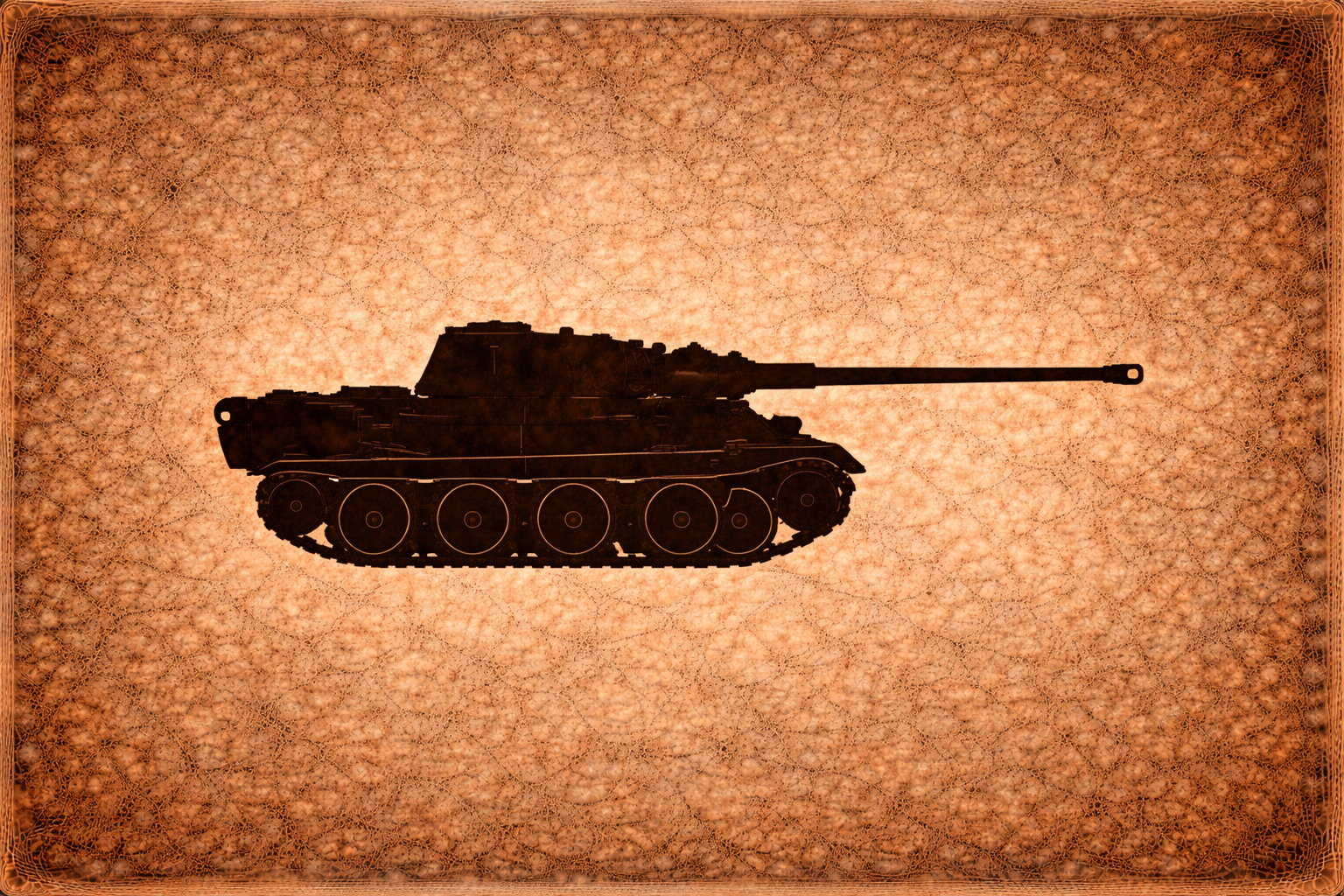
Unlike the expedient and resource-driven tank destroyers that preceded it, the Jagdpanther (Sd.Kfz. 173) was conceived as a deliberate attempt to perfect the German heavy Panzerjäger concept. Initiated in late 1942, its development sought to unite the proven mobility and chassis of the Panther with the unmatched lethality of the 8.8 cm Pak 43, creating a vehicle capable of destroying enemy armor at extreme ranges while retaining operational flexibility. Rather than a stopgap born of crisis, the Jagdpanther represented an effort to distill battlefield experience into a balanced and purpose-built design—one that prioritized firepower, protection, and mobility in equal measure. In doing so, it stood apart from earlier compromises such as the Ferdinand and Nashorn, embodying Germany’s most refined vision of a heavy tank destroyer.
The Jagdpanther’s design philosophy emphasized an efficient balance between firepower, protection, and mobility: a fixed casemate superstructure atop the Panther chassis, prioritizing lethality over versatility. Its sloped 80 mm frontal armor, equivalent to 138 mm effective thickness at 55 degrees, shrugged off most threats, while sides at 50 mm and rear at 40 mm balanced protection with a manageable 45.5-tonne weight. The star was the 8.8 cm Pak 43/3 L/71 gun—later the 43/4—capable of penetrating any Allied tank at ranges up to 2,500 meters. A 7.92 mm MG 34 provided secondary defense. The five-man crew—commander, gunner, loader, driver, and radio operator—operated in a roomy interior, though limited traverse (12 degrees) demanded precise positioning. Variants evolved from the early G1 with welded mantlet and Zimmerit coating to the streamlined G2 with bolted mantlet and simplified features, reflecting wartime adaptations. Production, however, was a tale of ambition thwarted by adversity. Manufacturing kicked off in January 1944 at MIAG in Braunschweig, with ambitions of 150 units monthly, but Allied bombings, supply shortages, and labor crises—exacerbated by fleeing workers—capped peaks at 72 in January 1945. Additional plants like MNH in Hanover (from November 1944) and MBA in Potsdam (from December) contributed, yielding a total of about 413 vehicles by war's end in May 1945.
Combat history unfolded in the war's desperate denouement, where the Jagdpanther's prowess shone brightest in calculated strikes. Deployed to heavy anti-tank battalions from mid-1944, it first clashed in Normandy with the 654th Schwere Panzerjäger-Abteilung, where a handful destroyed 11 Churchills in one engagement but struggled in bocage terrain. In the Ardennes Offensive, concentrations bolstered German pushes, though losses mounted from mines and flanking. On the Eastern Front, it served as a stalwart defender, with doctrine emphasizing long-range sniping and infantry escorts to cover blind spots. Units like the 559th in Geel, Belgium, tallied kills against British forces, but overall impact was muted by sparse numbers and rushed crews—often young recruits with minimal training.
Shortcomings, alas, tempered this mechanical marvel's menace. While mechanically sounder than many late-war peers, early final drives failed after mere 35 km. The casemate's limited traverse and poor close-quarters visibility demanded escorts, leaving it vulnerable to infantry or flanking maneuvers. Spare parts scarcity and abbreviated training amplified breakdowns, with reports of sprocket tension issues after extended travel. In unsuitable terrain like Normandy's hedges, its long-range gun was underutilized, and the vehicle's weight strained recovery efforts when immobilized.
In the grand chronicle of armored legends, the Jagdpanther endures as a symbol of German engineering's defiant elegance—swift, armored, and armed to obliterate foes from afar. Its limited production and late arrival curtailed strategic sway, yet in tactical duels, it reigned supreme, influencing postwar designs. Today, restored survivors at museums like Munster and Bovington whisper tales of what might have been, a sleek hunter forever frozen in history's amber.
The Jagdpanther’s design philosophy emphasized an efficient balance between firepower, protection, and mobility: a fixed casemate superstructure atop the Panther chassis, prioritizing lethality over versatility. Its sloped 80 mm frontal armor, equivalent to 138 mm effective thickness at 55 degrees, shrugged off most threats, while sides at 50 mm and rear at 40 mm balanced protection with a manageable 45.5-tonne weight. The star was the 8.8 cm Pak 43/3 L/71 gun—later the 43/4—capable of penetrating any Allied tank at ranges up to 2,500 meters. A 7.92 mm MG 34 provided secondary defense. The five-man crew—commander, gunner, loader, driver, and radio operator—operated in a roomy interior, though limited traverse (12 degrees) demanded precise positioning. Variants evolved from the early G1 with welded mantlet and Zimmerit coating to the streamlined G2 with bolted mantlet and simplified features, reflecting wartime adaptations. Production, however, was a tale of ambition thwarted by adversity. Manufacturing kicked off in January 1944 at MIAG in Braunschweig, with ambitions of 150 units monthly, but Allied bombings, supply shortages, and labor crises—exacerbated by fleeing workers—capped peaks at 72 in January 1945. Additional plants like MNH in Hanover (from November 1944) and MBA in Potsdam (from December) contributed, yielding a total of about 413 vehicles by war's end in May 1945.
Combat history unfolded in the war's desperate denouement, where the Jagdpanther's prowess shone brightest in calculated strikes. Deployed to heavy anti-tank battalions from mid-1944, it first clashed in Normandy with the 654th Schwere Panzerjäger-Abteilung, where a handful destroyed 11 Churchills in one engagement but struggled in bocage terrain. In the Ardennes Offensive, concentrations bolstered German pushes, though losses mounted from mines and flanking. On the Eastern Front, it served as a stalwart defender, with doctrine emphasizing long-range sniping and infantry escorts to cover blind spots. Units like the 559th in Geel, Belgium, tallied kills against British forces, but overall impact was muted by sparse numbers and rushed crews—often young recruits with minimal training.
Shortcomings, alas, tempered this mechanical marvel's menace. While mechanically sounder than many late-war peers, early final drives failed after mere 35 km. The casemate's limited traverse and poor close-quarters visibility demanded escorts, leaving it vulnerable to infantry or flanking maneuvers. Spare parts scarcity and abbreviated training amplified breakdowns, with reports of sprocket tension issues after extended travel. In unsuitable terrain like Normandy's hedges, its long-range gun was underutilized, and the vehicle's weight strained recovery efforts when immobilized.
In the grand chronicle of armored legends, the Jagdpanther endures as a symbol of German engineering's defiant elegance—swift, armored, and armed to obliterate foes from afar. Its limited production and late arrival curtailed strategic sway, yet in tactical duels, it reigned supreme, influencing postwar designs. Today, restored survivors at museums like Munster and Bovington whisper tales of what might have been, a sleek hunter forever frozen in history's amber.
Vehicle Technical Specification
| Property | Property | ||
|---|---|---|---|
| Role | Tank Destroyer | Top Speed (km/h) | 40 |
| Crew | 5 ( 4 In game ) | Reverse Speed (km/h) | 3 |
| Primary Armament | 88 mm PaK43 cannon | Hull Traverse Speed (°/sec) | 14 |
| Secondary Armament | 7.92 mm MG34 machine gun | Gun Traverse (°/sec) | 7 |
Armour
| Location | Front (mm) | Side (mm) | Rear (mm) |
|---|---|---|---|
| Hull | 80 | 40 | 40 |
Ammunition Types
| Ammo Type | Penetration at 100m (mm) |
|---|---|
| 88mm HE | 27 |
| 88mm AP | 240 |
| 88mm Smoke | 4 |