
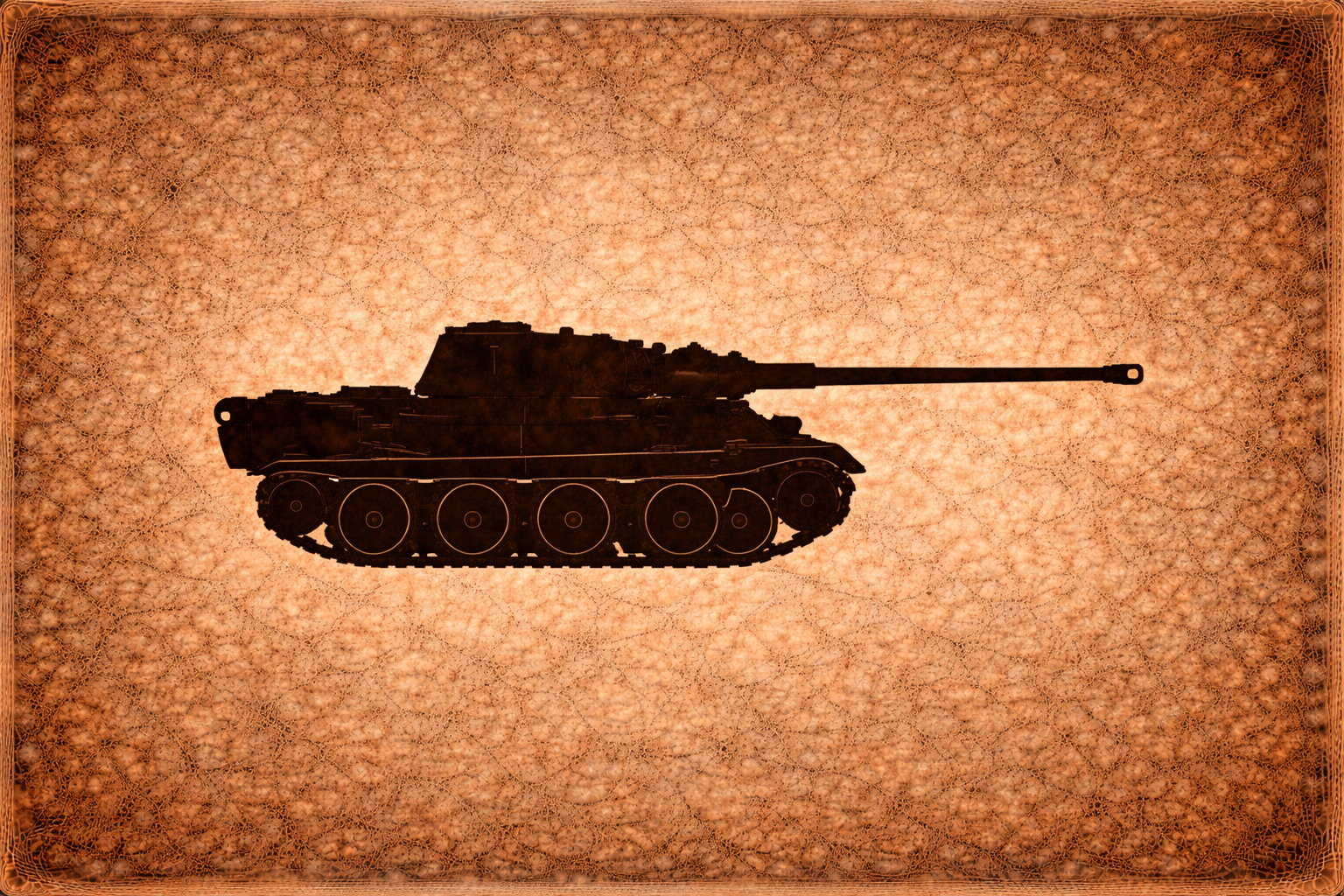
Vehicle History
In the grinding attrition of World War II's later years, as Allied armor pressed from both east and west, Germany scrambled for efficient tank destroyers. The Jagdpanzer 38, later dubbed the Hetzer by postwar historians though the nickname saw limited wartime use, emerged as a pragmatic tank destroyer to fill gaps left by disrupted production lines. Developed in response to November 1943 bombings that crippled Alkett's Sturmgeschütz III facilities, it repurposed the obsolete Panzer 38(t) chassis—once a mainstay but outclassed by 1944—to create a cost-effective alternative to open-topped vehicles like the Marder series. Hitler's admiration for the Romanian Mareșal prototype, inspected in early 1944, further spurred the project, emphasizing rapid assembly using existing tooling at Bohemian-Moravian Machine Works (BMM) in Prague and Škoda Works.
The design philosophy centered on a compact, concealable vehicle optimized for defensive ambushes rather than frontline assaults. At just 2.1 meters tall, its low silhouette aided hiding in foliage or urban rubble, while sloped armor maximized protection on a light 15.75-tonne frame: the upper glacis plate offered 60 mm at 60 degrees, equating to about 120 mm effective thickness against most threats. The casemate-style superstructure housed a potent 7.5 cm Pak 39 L/48 gun, offset to the right with limited traverse (5 degrees left, 11 degrees right), capable of penetrating up to 106 mm of armor at 500 meters with Pzgr. 39 APCBC rounds. A roof-mounted 7.92 mm MG 34 or 42, remotely operated to provided anti-infantry defense. Variants included the flame-throwing Flammpanzer 38 (20 built), recovery Bergepanzer 38 (181 produced), and experimental Starr model with a rigid gun mount (10 completed), reflecting ongoing adaptations to wartime needs.
Production ramped up swiftly from March 1944, with BMM delivering the bulk—starting at three units that month and peaking at 298 in November—while Škoda contributed from July onward. By May 1945, approximately 2,827 vehicles were completed, including 2,612 standard models, amid challenges like supply shortages and Allied bombings
Combat deployment began in July 1944, equipping independent Panzerjäger battalions attached to infantry and Panzer divisions. On the Eastern Front, units like the 731st and 743rd excelled in hit-and-run tactics; one company in Army Group North reportedly destroyed 20 Soviet tanks without loss, while others supported defenses near Warsaw during the August 1944 uprising, where Polish forces captured three. In the Ardennes Offensive of December 1944–January 1945, nearly 300 Hetzers bolstered German counterattacks, though operational numbers dwindled to 131 by late December due to attrition. Hungarian forces received 75, and captured examples saw brief use by Romanian, Bulgarian, and Yugoslav partisans. Overall, the Hetzer's reliability and punch made it a valued asset in static defenses, though it was ill-suited for fluid offensives.
For all its ingenuity, the Jagdpanzer 38 harbored significant limitations that constrained its versatility. Thin side and rear armor (20 mm) left it vulnerable to flanking fire or even anti-tank rifles, while the gun's restricted traverse demanded risky vehicle pivots to aim. The cramped interior hindered crew efficiency, with the loader awkwardly maneuvering across the breech, and visibility was poor through periscopes alone. Early models suffered front-heavy balance and prone drive wheels under the increased weight, though modifications like lighter mantlets and flame-reducing mufflers addressed some issues. Fuel consumption was high for its size, and the leaf springs occasionally failed in rough terrain, leading to recoveries that strained logistics.
In the broader narrative of armored evolution, the Jagdpanzer 38 stands as a clever stopgap that punched above its weight in desperate times, blending affordability with lethality to sustain German defenses when resources waned. Its mechanical dependability and influence on postwar designs—like the Swiss G-13, which served until the 1970s—underscore a legacy of resourceful engineering. Yet, as with many late-war German vehicles, its tactical successes were overshadowed by strategic constraints, a reminder of innovation born from necessity rather than dominance.
The design philosophy centered on a compact, concealable vehicle optimized for defensive ambushes rather than frontline assaults. At just 2.1 meters tall, its low silhouette aided hiding in foliage or urban rubble, while sloped armor maximized protection on a light 15.75-tonne frame: the upper glacis plate offered 60 mm at 60 degrees, equating to about 120 mm effective thickness against most threats. The casemate-style superstructure housed a potent 7.5 cm Pak 39 L/48 gun, offset to the right with limited traverse (5 degrees left, 11 degrees right), capable of penetrating up to 106 mm of armor at 500 meters with Pzgr. 39 APCBC rounds. A roof-mounted 7.92 mm MG 34 or 42, remotely operated to provided anti-infantry defense. Variants included the flame-throwing Flammpanzer 38 (20 built), recovery Bergepanzer 38 (181 produced), and experimental Starr model with a rigid gun mount (10 completed), reflecting ongoing adaptations to wartime needs.
Production ramped up swiftly from March 1944, with BMM delivering the bulk—starting at three units that month and peaking at 298 in November—while Škoda contributed from July onward. By May 1945, approximately 2,827 vehicles were completed, including 2,612 standard models, amid challenges like supply shortages and Allied bombings
Combat deployment began in July 1944, equipping independent Panzerjäger battalions attached to infantry and Panzer divisions. On the Eastern Front, units like the 731st and 743rd excelled in hit-and-run tactics; one company in Army Group North reportedly destroyed 20 Soviet tanks without loss, while others supported defenses near Warsaw during the August 1944 uprising, where Polish forces captured three. In the Ardennes Offensive of December 1944–January 1945, nearly 300 Hetzers bolstered German counterattacks, though operational numbers dwindled to 131 by late December due to attrition. Hungarian forces received 75, and captured examples saw brief use by Romanian, Bulgarian, and Yugoslav partisans. Overall, the Hetzer's reliability and punch made it a valued asset in static defenses, though it was ill-suited for fluid offensives.
For all its ingenuity, the Jagdpanzer 38 harbored significant limitations that constrained its versatility. Thin side and rear armor (20 mm) left it vulnerable to flanking fire or even anti-tank rifles, while the gun's restricted traverse demanded risky vehicle pivots to aim. The cramped interior hindered crew efficiency, with the loader awkwardly maneuvering across the breech, and visibility was poor through periscopes alone. Early models suffered front-heavy balance and prone drive wheels under the increased weight, though modifications like lighter mantlets and flame-reducing mufflers addressed some issues. Fuel consumption was high for its size, and the leaf springs occasionally failed in rough terrain, leading to recoveries that strained logistics.
In the broader narrative of armored evolution, the Jagdpanzer 38 stands as a clever stopgap that punched above its weight in desperate times, blending affordability with lethality to sustain German defenses when resources waned. Its mechanical dependability and influence on postwar designs—like the Swiss G-13, which served until the 1970s—underscore a legacy of resourceful engineering. Yet, as with many late-war German vehicles, its tactical successes were overshadowed by strategic constraints, a reminder of innovation born from necessity rather than dominance.
Vehicle Technical Specification
| Property | Property | ||
|---|---|---|---|
| **Rolev | Tank Destroyer | Top Speed (km/h) | 35 |
| Crew | 4 ( 3 In game ) | Reverse Speed (km/h) | 6 |
| Primary Armament | 75 mm PaK39 L48 cannon | Hull Traverse Speed (°/sec) | 14 |
| Secondary Armament | 7.92 mm MG 34 machine gun (remote-operated) | Gun Traverse (°/sec) | 7 |
Armour
| Location | Front (mm) | Side (mm) | Rear (mm) |
|---|---|---|---|
| Hull | 60 | 20 | 20 |
Ammunition Types
| Ammo Type | Penetration at 100m (mm) |
|---|---|
| 75 mm HE | 14 |
| 75mm AP | 140 |
| 75mm Smoke | 3 |