
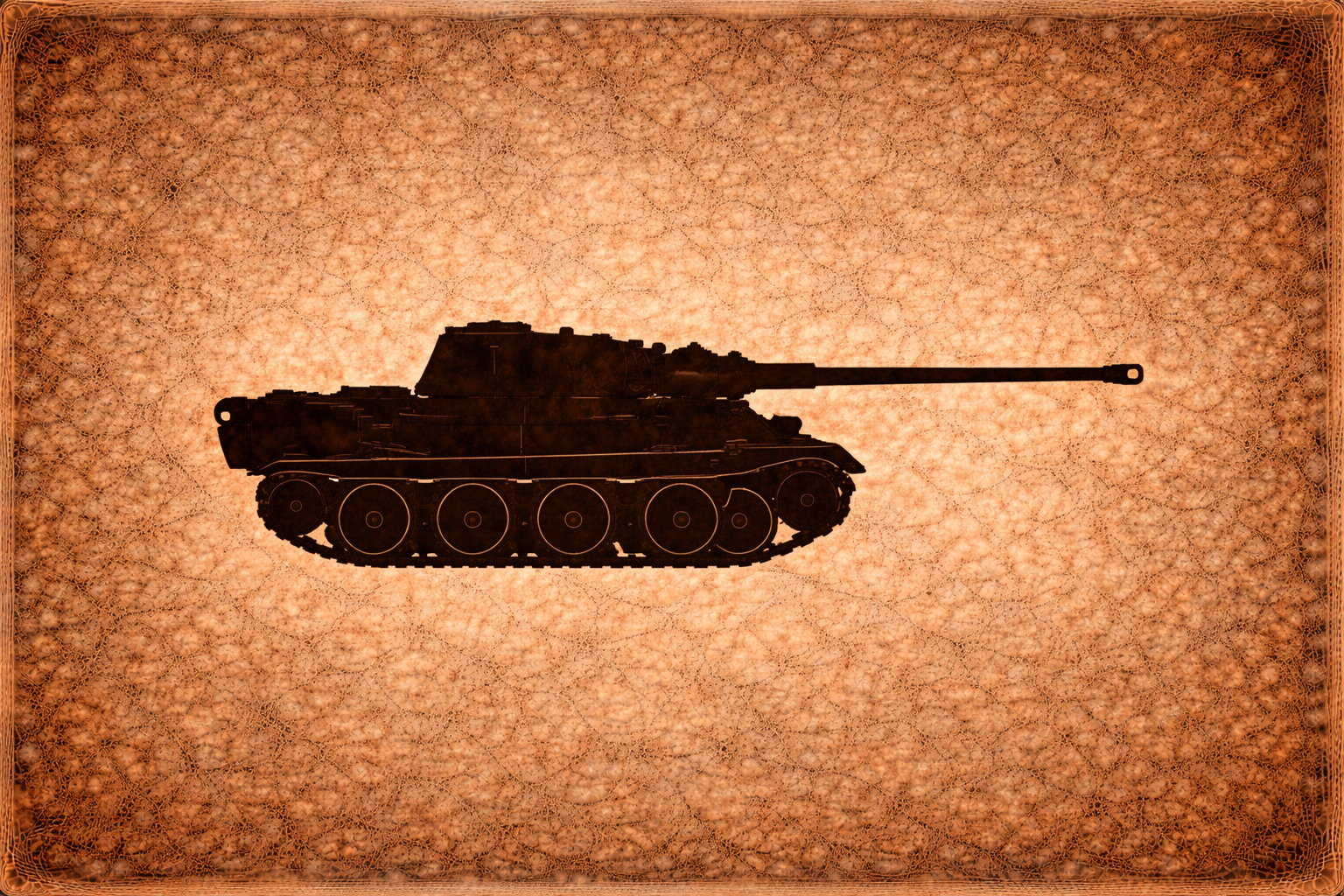
Vehicle History
In the final chapters of World War II, s German forces faced increasing pressure from Allied armored advances, the Jagdpanzer IV (Sd.Kfz.162) with its 7.5 cm Pak 39 L/48 gun emerged as a practical, if contentious, solution. Heinz Guderian, the influential Panzer expert, vehemently opposed the project, arguing that resources should prioritize the proven Sturmgeschütz III instead. Yet, by late 1943, with losses mounting and enemy tanks like the T-34 and Sherman dominating engagements, the Wehrmacht pushed for a better anti-tank platform. Drawing from earlier improvisations like the lightly armored Marder series, the Jagdpanzer IV was designed to provide close fire support and counter superior foes, ultimately approved despite internal debates, as a means to repurpose existing chassis amid material shortages.
The core idea behind its design was a casemate-style superstructure mounted on a modified Panzer IV Ausf. H chassis, emphasizing a low silhouette for ambush tactics over the versatility of a turreted tank. At just 1.85 meters tall, it prioritized concealment in defensive positions, with sloped frontal armor reaching 80 mm (effective up to 100 mm at angles) to deflect incoming fire. The 7.5 cm Pak 39 L/48 gun, chosen for its availability when longer barrels proved scarce, could penetrate 109 mm of armor at 1,000 meters with Pzgr. 39 rounds. Secondary armament included a 7.92 mm MG 42, though early models featured two awkwardly positioned machine guns later reduced to one. Production commenced in January 1944 at Vogtlandische Maschinenfabrik AG (Vomag) in Plauen, following prototypes assembled in late 1943. With Vomag dedicating its lines exclusively to the Jagdpanzer IV from May onward, output peaked at 125 units in July but faltered due to Allied bombings, dropping to just two in November. Total figures for the L/48 variant hover around 769-784 vehicles, though some estimates suggest up to 800.
Debuting in Normandy in June 1944, Jagdpanzer IV equipped elite units like the Panzer Lehr Division (31 vehicles) and 12th SS Panzer Division (21), where it shine in ambushes—destroying Cromwells near Tilly-sur-Seulles and claiming 16-22 Shermans at Hill 112 in August. SS-Oberscharführer Rudolf Roy of the 12th SS achieved 36 tank kills before his death in the Ardennes Offensive, earning the Knight's Cross posthumously. In the Battle of the Bulge (December 1944-January 1945), 92 vehicles supported operations like Northwind, though substantial numbers were lost to combat and mechanical issues. On the Eastern Front, the bulk saw action in Poland and Hungary, with Panzerjäger Abteilung 43 sustained losses near Budapest while others notched successes, such as destroying 12 tanks in a single engagement north of Kisgyarmat. n Italy, 83 were deployed with formations such as the Hermann Göring Division, dwindling to eight operational by year's end.
Shortcomings, however, loomed large, often undermining its potential. The nose-heavy design from added frontal armor stressed the engine and suspension, limiting mobility on rough terrain and leading crews to reportedly nickname it the "duck" (Ente). The muzzle brake kicked up dust clouds, revealing positions until crews removed them by May 1944. Driver visibility was hampered by a right-side blind spot, and the lack of a commander's cupola restricted situational awareness. Thin side armor (40-50 mm) made it vulnerable to flanking, while the gun's offset placement complicated aiming. Early machine gun ports proved impractical, and overall, the vehicle's improvised nature meant it fared poorly as a tank substitute, with high maintenance demands and inadequate numbers exacerbating losses—55 in Poland alone in October 1944.
In retrospect, the Jagdpanzer IV L/48 embodies the ingenuity and desperation of Germany's waning war machine: a solid tank destroyer that excelled in its roles, influencing postwar designs like the West German Kanonenjagdpanzer, yet hampered by compromises that limited its broader impact. Although it accounted for numerous Allied tank destructions and garnered battlefield acclaim, its late arrival and production shortfalls ensured it was more a footnote than a game-changer—a clever adaptation that couldn't stem the tide.
The core idea behind its design was a casemate-style superstructure mounted on a modified Panzer IV Ausf. H chassis, emphasizing a low silhouette for ambush tactics over the versatility of a turreted tank. At just 1.85 meters tall, it prioritized concealment in defensive positions, with sloped frontal armor reaching 80 mm (effective up to 100 mm at angles) to deflect incoming fire. The 7.5 cm Pak 39 L/48 gun, chosen for its availability when longer barrels proved scarce, could penetrate 109 mm of armor at 1,000 meters with Pzgr. 39 rounds. Secondary armament included a 7.92 mm MG 42, though early models featured two awkwardly positioned machine guns later reduced to one. Production commenced in January 1944 at Vogtlandische Maschinenfabrik AG (Vomag) in Plauen, following prototypes assembled in late 1943. With Vomag dedicating its lines exclusively to the Jagdpanzer IV from May onward, output peaked at 125 units in July but faltered due to Allied bombings, dropping to just two in November. Total figures for the L/48 variant hover around 769-784 vehicles, though some estimates suggest up to 800.
Debuting in Normandy in June 1944, Jagdpanzer IV equipped elite units like the Panzer Lehr Division (31 vehicles) and 12th SS Panzer Division (21), where it shine in ambushes—destroying Cromwells near Tilly-sur-Seulles and claiming 16-22 Shermans at Hill 112 in August. SS-Oberscharführer Rudolf Roy of the 12th SS achieved 36 tank kills before his death in the Ardennes Offensive, earning the Knight's Cross posthumously. In the Battle of the Bulge (December 1944-January 1945), 92 vehicles supported operations like Northwind, though substantial numbers were lost to combat and mechanical issues. On the Eastern Front, the bulk saw action in Poland and Hungary, with Panzerjäger Abteilung 43 sustained losses near Budapest while others notched successes, such as destroying 12 tanks in a single engagement north of Kisgyarmat. n Italy, 83 were deployed with formations such as the Hermann Göring Division, dwindling to eight operational by year's end.
Shortcomings, however, loomed large, often undermining its potential. The nose-heavy design from added frontal armor stressed the engine and suspension, limiting mobility on rough terrain and leading crews to reportedly nickname it the "duck" (Ente). The muzzle brake kicked up dust clouds, revealing positions until crews removed them by May 1944. Driver visibility was hampered by a right-side blind spot, and the lack of a commander's cupola restricted situational awareness. Thin side armor (40-50 mm) made it vulnerable to flanking, while the gun's offset placement complicated aiming. Early machine gun ports proved impractical, and overall, the vehicle's improvised nature meant it fared poorly as a tank substitute, with high maintenance demands and inadequate numbers exacerbating losses—55 in Poland alone in October 1944.
In retrospect, the Jagdpanzer IV L/48 embodies the ingenuity and desperation of Germany's waning war machine: a solid tank destroyer that excelled in its roles, influencing postwar designs like the West German Kanonenjagdpanzer, yet hampered by compromises that limited its broader impact. Although it accounted for numerous Allied tank destructions and garnered battlefield acclaim, its late arrival and production shortfalls ensured it was more a footnote than a game-changer—a clever adaptation that couldn't stem the tide.
Vehicle Technical Specification
| Role | Tank Destroyer | Top Speed (km/h) | 35 |
| Crew | 4 ( 4 In game ) | Reverse Speed (km/h) | 7 |
| Primary Armament | 75 mm PaK39 L48 cannon | Hull Traverse Speed (°/sec) | 19 |
| Secondary Armament | 7.92 mm MG42 machine gun | Gun Traverse (°/sec) | 8 |
Armour
| Location | Front (mm) | Side (mm) | Rear (mm) |
|---|---|---|---|
| Hull | 60 | 40 | 22 |
Ammunition Types
| Ammo Type | Penetration at 100m (mm) |
|---|---|
| 75mm HE | 14 |
| 75mm AP | 140 |
| 75mm Smoke | 3 |