
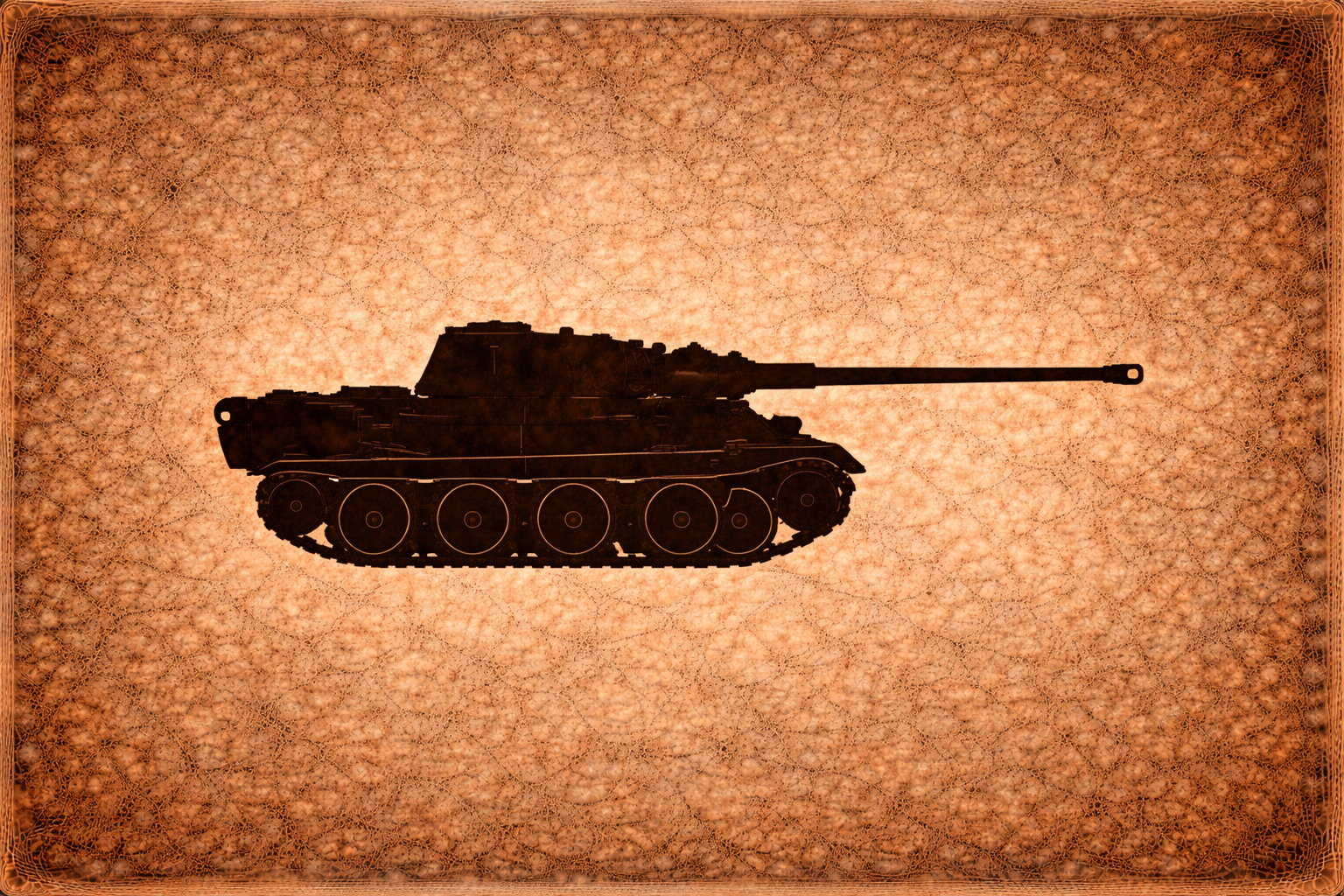
Vehicle History
The Jagdpanzer IV/70(V) (Sd.Kfz.162/1) represented the culmination of the Jagdpanzer IV series, introducing the long-barreled 7.5 cm Pak 42 L/70 to address the growing shortcomings of the earlier L/48-armed variant. Conceived as a direct response to increasingly well-armored Allied tanks, the IV/70(V) traded mechanical simplicity for markedly improved firepower, extending the effective engagement range of the Jagdpanzer IV while preserving its low-profile casemate design.
The primary enhancements of the IV/70(V) centered on its extended armament and supporting modifications, addressing the L/48's limitations in range and penetration. The L/70 gun, derived from the Panther tank's KwK 42, could punch through up to 124 mm of armor at 500 meters with standard Pzgr. 39 rounds, far surpassing the L/48's capabilities. To accommodate this longer barrel, designers at Vomag introduced a redesigned mantlet for weight reduction, a hydro-pneumatic equilibrator for balance, an iron counterweight, and an external travel lock to secure the gun during movement, elevating it to a 13-degree angle to prevent digging into terrain. The superstructure roof was lowered by 30 mm to maintain a low profile despite the added internal space, while exhaust systems shifted to upright Flammentoeter mufflers from November 1944 for improved ventilation. Additional refinements included a vertical towing bracket from December 1944, optional SF 14 Z scissor periscopes and 0.9 m rangefinders in late models, and segmented gun sight covers for easier manufacturing. Optional features like Schürzen side skirts (initially 5 mm plates, later wire mesh) provided modest protection against anti-tank rifles.
Production of the IV/70(V) commenced in August 1944 at Vomag's Plauen facility, utilizing modified Panzer IV Ausf. H and J chassis. Initial quotas were ambitious—Hitler demanded 800 units monthly, though realistic targets hovered around 160—yielding 57 vehicles that month, escalating to peaks of 185 in January 1945 before Allied bombings curtailed output to 50 in March. By war's end in April 1945, estimates place total production at 930 to 940 units, falling short of the planned 1,120 due to material shortages and factory disruptions. A command variant, the Befehlswagen, added specialized radios but saw limited numbers.
Rushed to fronts with minimal training, the IV/70(V) was issued to Panzerjäger companies within Panzer and SS divisions, often in batches of 10 to 14 vehicles. On the Western Front, around 210 participated in the Ardennes Offensive of December 1944–January 1945, with units like the 12th SS Panzer Division engaging in fierce clashes at Krinkelt-Rocherath, destroying American tanks amid minefields and artillery but suffering heavy losses to bazookas and immobilization. Operation Northwind in Alsace saw similar mixed results, with operational numbers plummeting to 33 out of 77 by mid-March 1945. The Eastern Front absorbed the majority, bolstering defenses in Poland, Hungary, and Pomerania; the 563rd Heavy Anti-Tank Battalion reportedly destroyed 58 Soviet tanks in just 10 days in January 1945 with few casualties, while IV SS-Panzer Corps fielded about 55 in the failed Budapest relief and Lake Balaton offensives in early 1945. Scattered examples reached Italy, but only three remained by April, ill-suited to the mountainous terrain.
Shortcomings plagued the IV/70(V) more acutely than the L/48, largely stemming from the longer gun's added weight and balance issues. The nose-heavy configuration overburdened the Maybach HL 120 TRM engine (300 PS), capping road speeds at 35 km/h and cross-country at 15-18 km/h, while reducing range to 210 km on roads and 130 km off them. Suspension woes were rampant: rubber-rimmed road wheels wore rapidly, prompting the switch to steel versions, and return rollers were cut to three per side amid shortages. Steering proved finicky on uneven ground, and the overall strain led to frequent breakdowns. Armor, increased at 80 mm frontal sloped to 45-55 degrees, offered solid protection but couldn't compensate for logistical chaos: bombings disrupted transport, scattering vehicles and hindering cohesive use. Late-war additions like Zimmerit paste (discontinued after September 1944) and optional Nahverteidigungswaffe grenade launchers were inconsistently applied, and poor crew training further diminished potential.
In the tapestry of armored warfare, the Jagdpanzer IV/70(V) emerges as a formidable yet flawed artifact of desperation, its extended gun granting tactical edges that echoed the Panther's prowess on a humbler chassis. Yet, constrained by mechanical burdens, insufficient numbers and the Reich's collapsing infrastructure, it served more as a valiant rearguard than a tide-turner—a testament to engineering resolve in the face of inevitable defeat.
The primary enhancements of the IV/70(V) centered on its extended armament and supporting modifications, addressing the L/48's limitations in range and penetration. The L/70 gun, derived from the Panther tank's KwK 42, could punch through up to 124 mm of armor at 500 meters with standard Pzgr. 39 rounds, far surpassing the L/48's capabilities. To accommodate this longer barrel, designers at Vomag introduced a redesigned mantlet for weight reduction, a hydro-pneumatic equilibrator for balance, an iron counterweight, and an external travel lock to secure the gun during movement, elevating it to a 13-degree angle to prevent digging into terrain. The superstructure roof was lowered by 30 mm to maintain a low profile despite the added internal space, while exhaust systems shifted to upright Flammentoeter mufflers from November 1944 for improved ventilation. Additional refinements included a vertical towing bracket from December 1944, optional SF 14 Z scissor periscopes and 0.9 m rangefinders in late models, and segmented gun sight covers for easier manufacturing. Optional features like Schürzen side skirts (initially 5 mm plates, later wire mesh) provided modest protection against anti-tank rifles.
Production of the IV/70(V) commenced in August 1944 at Vomag's Plauen facility, utilizing modified Panzer IV Ausf. H and J chassis. Initial quotas were ambitious—Hitler demanded 800 units monthly, though realistic targets hovered around 160—yielding 57 vehicles that month, escalating to peaks of 185 in January 1945 before Allied bombings curtailed output to 50 in March. By war's end in April 1945, estimates place total production at 930 to 940 units, falling short of the planned 1,120 due to material shortages and factory disruptions. A command variant, the Befehlswagen, added specialized radios but saw limited numbers.
Rushed to fronts with minimal training, the IV/70(V) was issued to Panzerjäger companies within Panzer and SS divisions, often in batches of 10 to 14 vehicles. On the Western Front, around 210 participated in the Ardennes Offensive of December 1944–January 1945, with units like the 12th SS Panzer Division engaging in fierce clashes at Krinkelt-Rocherath, destroying American tanks amid minefields and artillery but suffering heavy losses to bazookas and immobilization. Operation Northwind in Alsace saw similar mixed results, with operational numbers plummeting to 33 out of 77 by mid-March 1945. The Eastern Front absorbed the majority, bolstering defenses in Poland, Hungary, and Pomerania; the 563rd Heavy Anti-Tank Battalion reportedly destroyed 58 Soviet tanks in just 10 days in January 1945 with few casualties, while IV SS-Panzer Corps fielded about 55 in the failed Budapest relief and Lake Balaton offensives in early 1945. Scattered examples reached Italy, but only three remained by April, ill-suited to the mountainous terrain.
Shortcomings plagued the IV/70(V) more acutely than the L/48, largely stemming from the longer gun's added weight and balance issues. The nose-heavy configuration overburdened the Maybach HL 120 TRM engine (300 PS), capping road speeds at 35 km/h and cross-country at 15-18 km/h, while reducing range to 210 km on roads and 130 km off them. Suspension woes were rampant: rubber-rimmed road wheels wore rapidly, prompting the switch to steel versions, and return rollers were cut to three per side amid shortages. Steering proved finicky on uneven ground, and the overall strain led to frequent breakdowns. Armor, increased at 80 mm frontal sloped to 45-55 degrees, offered solid protection but couldn't compensate for logistical chaos: bombings disrupted transport, scattering vehicles and hindering cohesive use. Late-war additions like Zimmerit paste (discontinued after September 1944) and optional Nahverteidigungswaffe grenade launchers were inconsistently applied, and poor crew training further diminished potential.
In the tapestry of armored warfare, the Jagdpanzer IV/70(V) emerges as a formidable yet flawed artifact of desperation, its extended gun granting tactical edges that echoed the Panther's prowess on a humbler chassis. Yet, constrained by mechanical burdens, insufficient numbers and the Reich's collapsing infrastructure, it served more as a valiant rearguard than a tide-turner—a testament to engineering resolve in the face of inevitable defeat.
Vehicle Technical Specification
| Role | Tank Destroyer | Top Speed (km/h) | 30 |
| Crew | 4 ( 3 In game ) | Reverse Speed (km/h) | 7 |
| Primary Armament | 75 mm PaK42 cannon | Hull Traverse Speed (°/sec) | 12 |
| Secondary Armament | 7.92 mm MG42 machine gun | Gun Traverse (°/sec) | 7 |
Armour
| Location | Front (mm) | Side (mm) | Rear (mm) |
|---|---|---|---|
| Hull | 80 | 40 | 30 |
Ammunition Types
| Ammo Type | Penetration at 100m (mm) |
|---|---|
| 75mm HE | 15 |
| 75mm AP | 192 |