
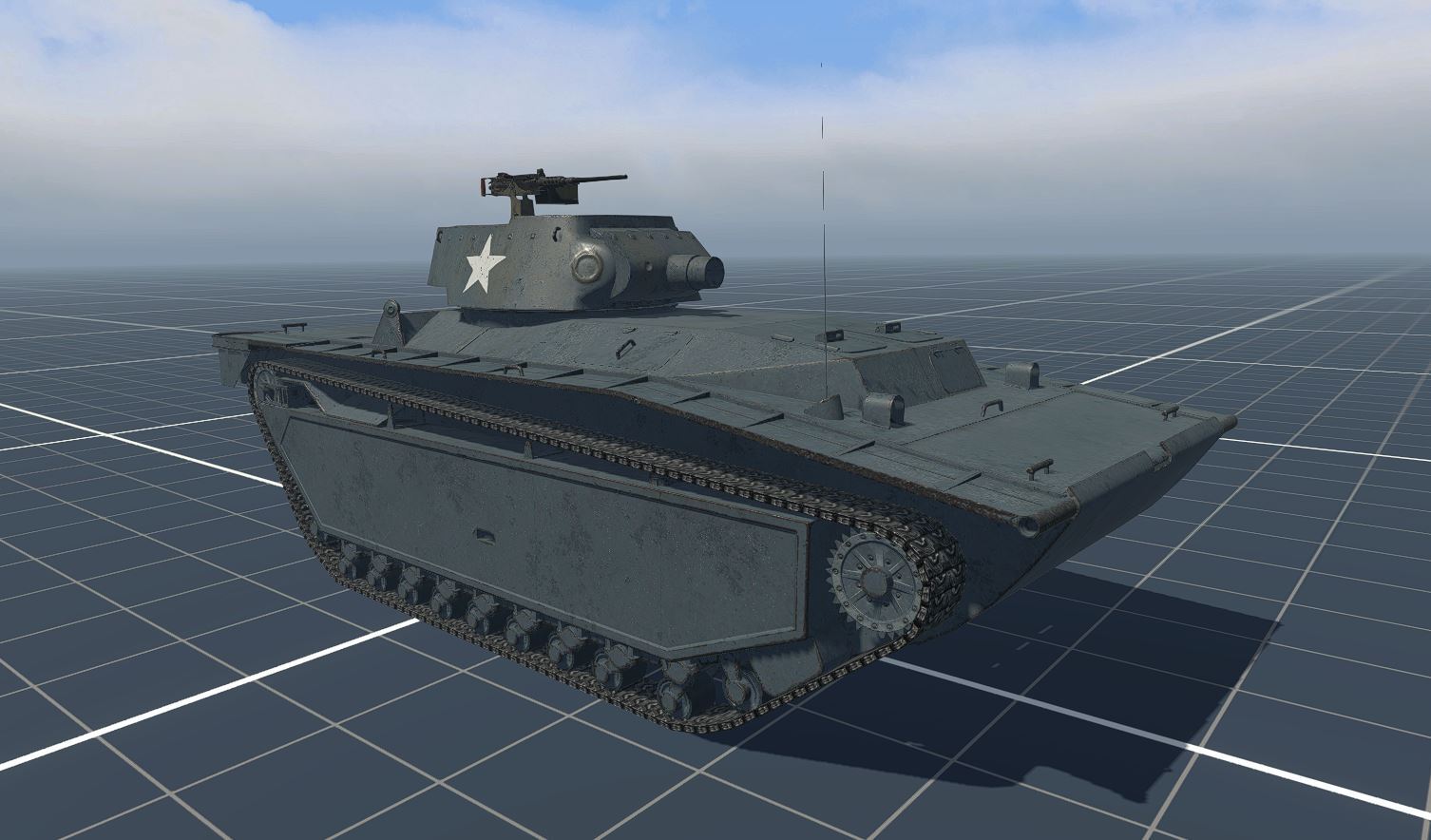

Vehicle History
The Landing Vehicle, Tracked (Armored) LVT(A)-4 was a fire-support amphibious armored vehicle developed by mounting the 75 mm howitzer turret of the M8 Scott onto the LVT chassis. It became one of the most widely produced amphibious armored vehicles of World War II and saw service in multiple campaigns across the conflict. The LVT(A)-4 was a derivative of earlier LVT models, equipped with the 75 mm M2 howitzer and turret from the M8 Scott to address the critical lack of firepower in previous variants. In particular, it is often regarded as a design that influenced later concepts of fire-support landing vehicles. Its development reflected the growing realization that amphibious assault units required organic, mobile artillery capable of engaging fortified positions immediately upon landing.
Earlier armored LVTs, most notably the LVT(A)-1, had been fitted with a 37 mm turret from the M3 Stuart light tank and were introduced during the Pacific War to provide limited protection and defensive firepower. However, this armament proved insufficient against well-constructed Japanese bunkers and fortified beach positions. The LVT(A)-4, with its heavier howitzer, offered far greater destructive capability. Although its turret was open-topped and therefore vulnerable to shrapnel and airburst weapons, this was considered an acceptable compromise, since its primary role was to provide fire support during the initial landing phase rather than to operate as a front-line battle tank. Once heavier armor such as the M4 Sherman reached the beach, responsibility for sustained armored combat would pass to those vehicles. Both the U.S. Army and the U.S. Marine Corps were satisfied with the effectiveness of the 75 mm gun, and production reached approximately 1,890 units. Of these, about 1,307 were delivered to the U.S. Marine Corps, around 50 to British Indian and Commonwealth forces, and the remainder to other Allied nations.
The LVT(A)-4 entered combat in 1944 as American forces advanced across the Central Pacific. It made its combat debut during the Battle of Saipan, where its amphibious mobility allowed it to accompany the first assault waves, while its 75 mm howitzer delivered immediate direct fire against beach defenses, pillboxes, and strongpoints just inland—targets that often pinned down infantry during the most vulnerable moments of the landing. In later battles such as Peleliu and Iwo Jima, LVT(A)-4s operated alongside troop-carrying LVT-4s, suppressing enemy positions and supporting the advance off the beaches. Though less prominent in the European theater—where naval gunfire and engineering units played a greater role in amphibious operations—armored LVT variants, including the A-4, were employed during river-crossing operations such as the Rhine crossings in 1945.
In conclusion, the LVT(A)-4 occupies a distinct place in the history of amphibious warfare. It was not merely a transport for assault troops, but a mobile fire-support platform that brought direct artillery to bear at the most critical phase of an amphibious landing. By combining tracked mobility, seaworthiness, and substantial firepower, the LVT(A)-4 helped redefine expectations for support vehicles in combined operations and demonstrated the growing sophistication of amphibious assault doctrine in the later years of World War II.
Earlier armored LVTs, most notably the LVT(A)-1, had been fitted with a 37 mm turret from the M3 Stuart light tank and were introduced during the Pacific War to provide limited protection and defensive firepower. However, this armament proved insufficient against well-constructed Japanese bunkers and fortified beach positions. The LVT(A)-4, with its heavier howitzer, offered far greater destructive capability. Although its turret was open-topped and therefore vulnerable to shrapnel and airburst weapons, this was considered an acceptable compromise, since its primary role was to provide fire support during the initial landing phase rather than to operate as a front-line battle tank. Once heavier armor such as the M4 Sherman reached the beach, responsibility for sustained armored combat would pass to those vehicles. Both the U.S. Army and the U.S. Marine Corps were satisfied with the effectiveness of the 75 mm gun, and production reached approximately 1,890 units. Of these, about 1,307 were delivered to the U.S. Marine Corps, around 50 to British Indian and Commonwealth forces, and the remainder to other Allied nations.
The LVT(A)-4 entered combat in 1944 as American forces advanced across the Central Pacific. It made its combat debut during the Battle of Saipan, where its amphibious mobility allowed it to accompany the first assault waves, while its 75 mm howitzer delivered immediate direct fire against beach defenses, pillboxes, and strongpoints just inland—targets that often pinned down infantry during the most vulnerable moments of the landing. In later battles such as Peleliu and Iwo Jima, LVT(A)-4s operated alongside troop-carrying LVT-4s, suppressing enemy positions and supporting the advance off the beaches. Though less prominent in the European theater—where naval gunfire and engineering units played a greater role in amphibious operations—armored LVT variants, including the A-4, were employed during river-crossing operations such as the Rhine crossings in 1945.
In conclusion, the LVT(A)-4 occupies a distinct place in the history of amphibious warfare. It was not merely a transport for assault troops, but a mobile fire-support platform that brought direct artillery to bear at the most critical phase of an amphibious landing. By combining tracked mobility, seaworthiness, and substantial firepower, the LVT(A)-4 helped redefine expectations for support vehicles in combined operations and demonstrated the growing sophistication of amphibious assault doctrine in the later years of World War II.
Vehicle Technical Specification
| Role | Amphibious Light Tank | Top Speed on water (km/h) | 12 |
| Crew | 5 ( 3 In game ) | Reverse Speed on land (km/h) | 16 |
| Primary Armament | 75 mm M2 cannon | Reverse Speed on water (km/h) | 6 |
| Secondary Armament | 12.7 mm M2 machine gun | Hull Traverse Speed (°/sec)** | 12 |
| Top Speed on land (km/h) | 32 | Turret Traverse (°/sec) | 5 ( hand-cranked ) |
Armour
| Location | Front (mm) | Side (mm) | Rear (mm) |
|---|---|---|---|
| Hull | 12 | 6 | 6 |
| Turret | 38 | 25 | 25 |
Ammunition Types
| Ammo Type | Penetration at 100m (mm) |
|---|---|
| 75mm HE | 4 |
| 75mm HEAT | 82 |