
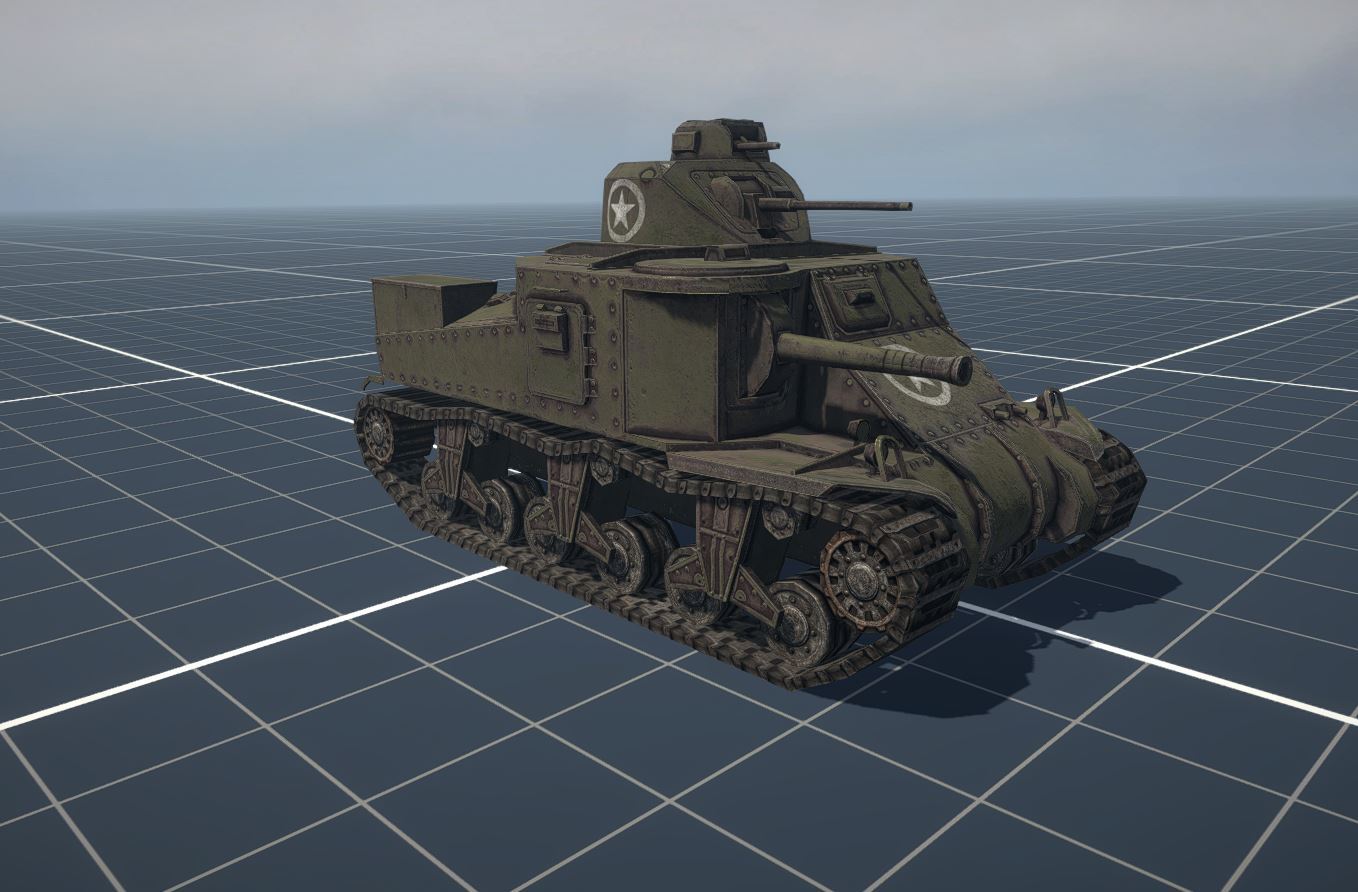

Vehicle History
The Medium Tank M3, commonly referred to as the M3 Lee in U.S. Army service and the M3 Grant in British Commonwealth configurations, emerged as a critical interim armored vehicle during World War II, developed to address the United States' acute shortage of modern tanks in the face of escalating global conflict. Initiated in July 1940 following the rapid German victories in the Battle of France, where Panzer III and IV tanks demonstrated superior firepower and mobility, the M3 was conceived as a stopgap measure to rapidly equip Allied forces. The U.S. Army, hampered by interwar budget constraints and limited design expertise, had only a few hundred obsolete tanks by 1939, prompting an urgent response to Britain's Lend-Lease request for 3,650 medium tanks after the Dunkirk evacuation. The core idea behind the M3 was to adapt existing M2 Medium Tank components for expedited production, incorporating a 75 mm M2 gun in a hull-mounted sponson for anti-tank and high-explosive capabilities, supplemented by a turreted 37 mm M5/M6 gun, while full turret integration for the larger weapon awaited the M4 Sherman's development. This dual-gun arrangement aimed to provide versatile firepower without delaying manufacturing, resulting in 6,258 units produced from August 1941 to December 1942 by facilities such as the Detroit Tank Arsenal and Baldwin Locomotive Works.
In combat, the M3 debuted effectively in North Africa during the Battle of Gazala in May 1942, where British Grants surprised Axis forces with the 75 mm gun's superior range, outmatching Italian M13/40 tanks and early German models like the Panzer IV with short-barreled guns. It proved reliable in providing infantry support and long-range fire, serving as a mainstay for Commonwealth forces until M4 Shermans arrived later that year, and contributed to victories at El Alamein. Soviet forces received 1,386 units via Lend-Lease, employing them on secondary fronts such as the 1944 Petsamo–Kirkenes Offensive, though they were less favored due to vulnerabilities. In the Pacific and Southeast Asia, U.S. and British Indian Army M3s saw action in operations like the 1943 Makin Atoll assault and the 1944 Battle of Imphal, where they dominated lighter Japanese Type 95 Ha-Go tanks and supported jungle warfare until 1945. Australian variants were primarily reserved for homeland defense but demonstrated the tank's adaptability in diverse terrains.
Despite its initial successes, the M3 suffered from significant shortcomings that limited its longevity, including a tall silhouette that hindered hull-down positioning and increased visibility, riveted construction prone to internal spalling from impacts, and the sponson-mounted main gun's restricted traverse, which compromised tactical flexibility. Additional issues encompassed suboptimal off-road performance due to its vertical volute spring suspension, a flammable gasoline engine (though diesel variants like the M3A3 and M3A5 mitigated this), and a crew of up to seven that complicated operations. By mid-1943, as Axis tanks evolved with more powerful armament, the M3 was outclassed and withdrawn from frontline service in most theaters in favor of the more advanced M4 Sherman.
In conclusion, the M3 Lee/Grant represented a pragmatic but flawed bridge in American tank evolution, fulfilling urgent wartime needs by supplying Allies with essential armored support during the conflict's early phases. Its chassis legacy endured through postwar variants, such as the M7 Priest self-propelled gun and recovery vehicles, with some units serving foreign militaries until the 1950s and even inspiring civilian conversions in Australia, underscoring its role in accelerating U.S. industrial mobilization and influencing subsequent armored designs.
In combat, the M3 debuted effectively in North Africa during the Battle of Gazala in May 1942, where British Grants surprised Axis forces with the 75 mm gun's superior range, outmatching Italian M13/40 tanks and early German models like the Panzer IV with short-barreled guns. It proved reliable in providing infantry support and long-range fire, serving as a mainstay for Commonwealth forces until M4 Shermans arrived later that year, and contributed to victories at El Alamein. Soviet forces received 1,386 units via Lend-Lease, employing them on secondary fronts such as the 1944 Petsamo–Kirkenes Offensive, though they were less favored due to vulnerabilities. In the Pacific and Southeast Asia, U.S. and British Indian Army M3s saw action in operations like the 1943 Makin Atoll assault and the 1944 Battle of Imphal, where they dominated lighter Japanese Type 95 Ha-Go tanks and supported jungle warfare until 1945. Australian variants were primarily reserved for homeland defense but demonstrated the tank's adaptability in diverse terrains.
Despite its initial successes, the M3 suffered from significant shortcomings that limited its longevity, including a tall silhouette that hindered hull-down positioning and increased visibility, riveted construction prone to internal spalling from impacts, and the sponson-mounted main gun's restricted traverse, which compromised tactical flexibility. Additional issues encompassed suboptimal off-road performance due to its vertical volute spring suspension, a flammable gasoline engine (though diesel variants like the M3A3 and M3A5 mitigated this), and a crew of up to seven that complicated operations. By mid-1943, as Axis tanks evolved with more powerful armament, the M3 was outclassed and withdrawn from frontline service in most theaters in favor of the more advanced M4 Sherman.
In conclusion, the M3 Lee/Grant represented a pragmatic but flawed bridge in American tank evolution, fulfilling urgent wartime needs by supplying Allies with essential armored support during the conflict's early phases. Its chassis legacy endured through postwar variants, such as the M7 Priest self-propelled gun and recovery vehicles, with some units serving foreign militaries until the 1950s and even inspiring civilian conversions in Australia, underscoring its role in accelerating U.S. industrial mobilization and influencing subsequent armored designs.
Vehicle Technical Specification
| Role | Medium Tank | Top Speed (km/h) | 39 |
| Crew | 7 ( 5 In game ) | Reverse Speed (km/h) | 5 |
| Primary Armament | 75 mm M2 cannon | Hull Traverse Speed (°/sec) | 12 |
| Secondary Armament | 37 mm M5 cannon | Turret Traverse (°/sec) | 10 |
| Secondary Armament | 7.62 mm M1919 machine gun | Hull Gun Traverse (°/sec) | 8 |
Armour
| Location | Front (mm) | Side (mm) | Rear (mm) |
|---|---|---|---|
| Hull | 50 | 38 | 38 |
| Turret | 38 | 38 | 38 |
Ammunition Types
| Ammo Type | Penetration at 100m (mm) |
|---|---|
| 75mm AP | 88 |
| 75mm HE | 9 |
| 37mm AP | 79 |
| 37mm HE | 6 |