
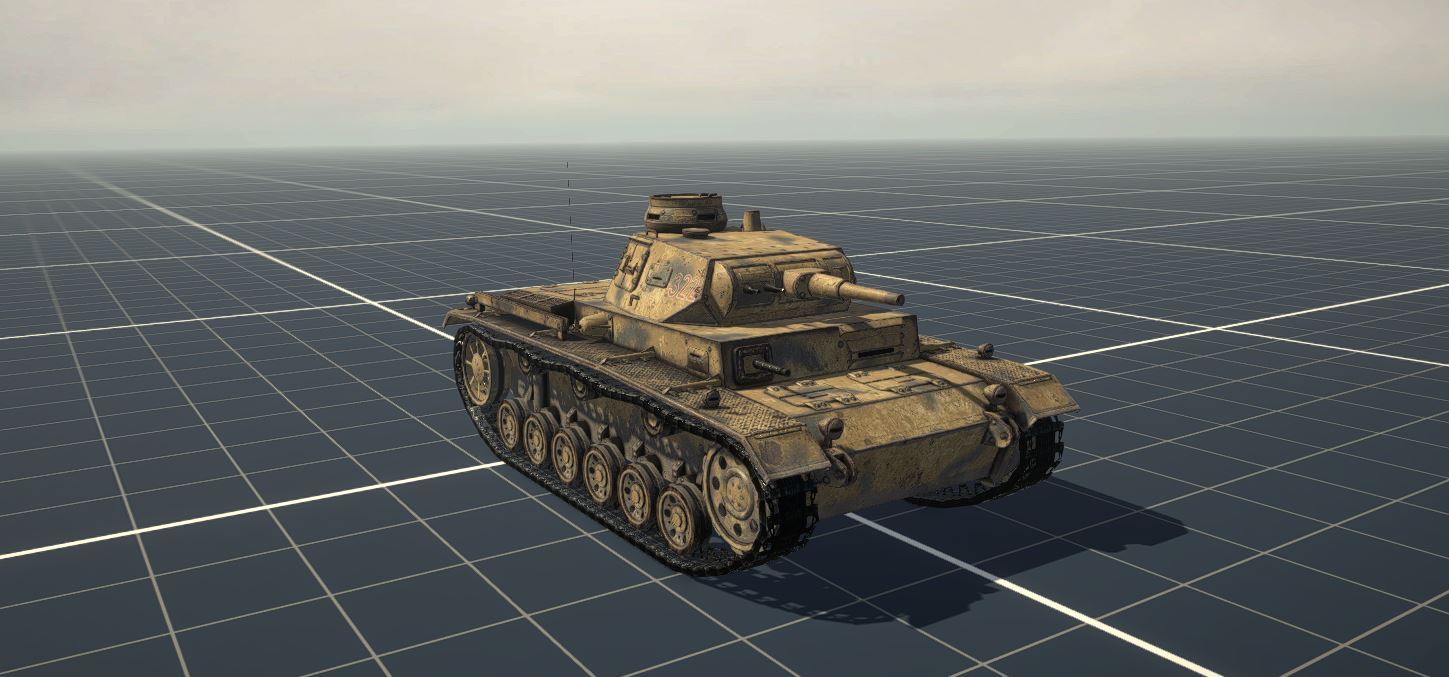
Vehicle History
The Panzerkampfwagen III Ausf. E represents a crucial step in the early development of German medium tanks, marking the transition from experimental pre-war designs to a standardized and combat-capable vehicle. Emerging in the late 1930s as part of Germany’s rearmament program, this variant addressed the significant shortcomings of its predecessors, the Ausf. A–D variants, which had relied on complex suspension systems that proved unreliable under operational conditions.
The impetus for the Ausf. E’s development arose from evaluations conducted by Waffenprüfwesen 6 in 1936, which concluded that existing Panzer III models lacked sufficient protection against contemporary anti-tank weapons such as the French 25 mm gun. In response, engineers at Daimler-Benz replaced the earlier leaf-spring suspension with a torsion-bar system featuring six road wheels per side. This configuration significantly improved ride quality and durability over rough terrain and became the standard suspension layout for all subsequent Panzer III variants. Armor protection was uniformly increased to 30 mm across most surfaces and paired with the 300 PS Maybach HL 120 TRM engine. The tank achieved a top speed of 40 km/h on roads, with operational ranges of 165 km on paved surfaces or approximately 95 km cross-country. Its three-man turret layout—commander, gunner, and loader—allowed for better task specialization and improved crew coordination. This design supported the Panzer III’s intended role as the Wehrmacht’s primary anti-tank vehicle, complementing the infantry-support role of the Panzer IV within German armored doctrine.
A total of 96 Ausf. E vehicles were produced, with chassis numbers ranging from 60401 to 60496. Daimler-Benz manufactured the first 41 units, while M.A.N. completed the remaining 55. Production began in late 1938, with the first vehicle initially scheduled for completion in May. However, component shortages and early reliability issues with the new transmission delayed output, resulting in low monthly production during early 1939. Manufacturing concluded by the end of that year, with subcontractors contributing major components—Alkett produced 90 turrets, while Krupp supplied six. Hulls were assembled at multiple facilities, including Eisen- und Hüttenwerk AG in Bochum, before final assembly and fitting. Of the total production run, 45 vehicles were converted into Panzerbefehlswagen Ausf. E command tanks, equipped with dummy main guns and additional radio equipment, while several others were adapted for artillery observation roles.
The Ausf. E entered service in limited numbers during the invasion of Poland in September 1939. Only a small number were operational at the time, forming part of the 98 Panzer IIIs allocated overall, primarily within the 1st Panzer Division. Mechanical issues—particularly with the transmission—reduced availability during this initial deployment. By the 1940 Western Campaign, a total of 349 Panzer IIIs of all variants, including the Ausf. E, were fielded across seven divisions. During engagements such as the Battle of Hannut, Panzer III units successfully engaged French Hotchkiss tanks and maneuvered to flank Somua S-35s at close range, benefiting from superior radios, crew training, and five-man crews. Encounters with heavily armored vehicles such as the Char B1 bis near Sedan highlighted the limitations of early Panzer III variants, with individual French tanks capable of inflicting heavy losses during single engagements.
The Ausf. E likely saw combat during the Balkan Campaign in 1941 and experienced limited service in North Africa with the 5th Panzer Regiment. Its most demanding test came during Operation Barbarossa, where Ausf. E vehicles—many upgraded with the 5 cm KwK 38 L/42 gun and additional bolted armor—were among the roughly 350 short-barreled Panzer IIIs deployed. While effective against older Soviet tanks such as the T-26 and BT series, they struggled against the newer T-34 and KV-1. Heavy attrition on the Eastern Front meant that few Ausf. E vehicles survived in frontline service beyond late 1941.
As the war progressed, the Ausf. E’s limitations became increasingly apparent. Its 30 mm armor was vulnerable to newer anti-tank guns, and the side armor could be penetrated even by anti-tank rifles at close range. The original 3.7 cm KwK 36 L/46.5 gun, while adequate against lightly armored targets, proved inadequate against improved enemy armor beyond short distances. The semi-automatic transmission, although innovative, suffered from reliability problems, forcing drivers to operate the vehicle cautiously and avoid sustained high speeds that accelerated wear on rubber-rimmed road wheels.
In retrospect, the Panzer III Ausf. E played an important role in shaping German armored vehicle design and doctrine. It established the mechanical and structural foundations for later Panzer III variants and contributed to the development of derivative vehicles such as the Sturmgeschütz III, which became the most widely produced German armored fighting vehicle of the war. Although quickly surpassed by evolving battlefield requirements, the Ausf. E remains a significant milestone in the early history of German armored forces.
The impetus for the Ausf. E’s development arose from evaluations conducted by Waffenprüfwesen 6 in 1936, which concluded that existing Panzer III models lacked sufficient protection against contemporary anti-tank weapons such as the French 25 mm gun. In response, engineers at Daimler-Benz replaced the earlier leaf-spring suspension with a torsion-bar system featuring six road wheels per side. This configuration significantly improved ride quality and durability over rough terrain and became the standard suspension layout for all subsequent Panzer III variants. Armor protection was uniformly increased to 30 mm across most surfaces and paired with the 300 PS Maybach HL 120 TRM engine. The tank achieved a top speed of 40 km/h on roads, with operational ranges of 165 km on paved surfaces or approximately 95 km cross-country. Its three-man turret layout—commander, gunner, and loader—allowed for better task specialization and improved crew coordination. This design supported the Panzer III’s intended role as the Wehrmacht’s primary anti-tank vehicle, complementing the infantry-support role of the Panzer IV within German armored doctrine.
A total of 96 Ausf. E vehicles were produced, with chassis numbers ranging from 60401 to 60496. Daimler-Benz manufactured the first 41 units, while M.A.N. completed the remaining 55. Production began in late 1938, with the first vehicle initially scheduled for completion in May. However, component shortages and early reliability issues with the new transmission delayed output, resulting in low monthly production during early 1939. Manufacturing concluded by the end of that year, with subcontractors contributing major components—Alkett produced 90 turrets, while Krupp supplied six. Hulls were assembled at multiple facilities, including Eisen- und Hüttenwerk AG in Bochum, before final assembly and fitting. Of the total production run, 45 vehicles were converted into Panzerbefehlswagen Ausf. E command tanks, equipped with dummy main guns and additional radio equipment, while several others were adapted for artillery observation roles.
The Ausf. E entered service in limited numbers during the invasion of Poland in September 1939. Only a small number were operational at the time, forming part of the 98 Panzer IIIs allocated overall, primarily within the 1st Panzer Division. Mechanical issues—particularly with the transmission—reduced availability during this initial deployment. By the 1940 Western Campaign, a total of 349 Panzer IIIs of all variants, including the Ausf. E, were fielded across seven divisions. During engagements such as the Battle of Hannut, Panzer III units successfully engaged French Hotchkiss tanks and maneuvered to flank Somua S-35s at close range, benefiting from superior radios, crew training, and five-man crews. Encounters with heavily armored vehicles such as the Char B1 bis near Sedan highlighted the limitations of early Panzer III variants, with individual French tanks capable of inflicting heavy losses during single engagements.
The Ausf. E likely saw combat during the Balkan Campaign in 1941 and experienced limited service in North Africa with the 5th Panzer Regiment. Its most demanding test came during Operation Barbarossa, where Ausf. E vehicles—many upgraded with the 5 cm KwK 38 L/42 gun and additional bolted armor—were among the roughly 350 short-barreled Panzer IIIs deployed. While effective against older Soviet tanks such as the T-26 and BT series, they struggled against the newer T-34 and KV-1. Heavy attrition on the Eastern Front meant that few Ausf. E vehicles survived in frontline service beyond late 1941.
As the war progressed, the Ausf. E’s limitations became increasingly apparent. Its 30 mm armor was vulnerable to newer anti-tank guns, and the side armor could be penetrated even by anti-tank rifles at close range. The original 3.7 cm KwK 36 L/46.5 gun, while adequate against lightly armored targets, proved inadequate against improved enemy armor beyond short distances. The semi-automatic transmission, although innovative, suffered from reliability problems, forcing drivers to operate the vehicle cautiously and avoid sustained high speeds that accelerated wear on rubber-rimmed road wheels.
In retrospect, the Panzer III Ausf. E played an important role in shaping German armored vehicle design and doctrine. It established the mechanical and structural foundations for later Panzer III variants and contributed to the development of derivative vehicles such as the Sturmgeschütz III, which became the most widely produced German armored fighting vehicle of the war. Although quickly surpassed by evolving battlefield requirements, the Ausf. E remains a significant milestone in the early history of German armored forces.
Vehicle Technical Specification
| Role | Medium Tank | Top Speed (km/h) | 40 |
| Crew | 5 ( 4 in game ) | Reverse Speed (km/h) | 12 |
| Primary Armament | 37 mm KwK36 cannon | Hull Traverse Speed (°/sec) | 18 |
| Secondary Armament | 2 x 7.92 mm MG 34 machine guns | Turret Traverse (°/sec) | 10 ( hand-cranked ) |
Armour
| Location | Front (mm) | Side (mm) | Rear (mm) |
|---|---|---|---|
| Hull | 30 | 30 | 20 |
| Turret | 35 | 30 | 30 |
Ammunition Types
| Ammo Type | Penetration at 100m (mm) |
|---|---|
| 37mm APHE | 40 |
| 37mm AP | 62 |