
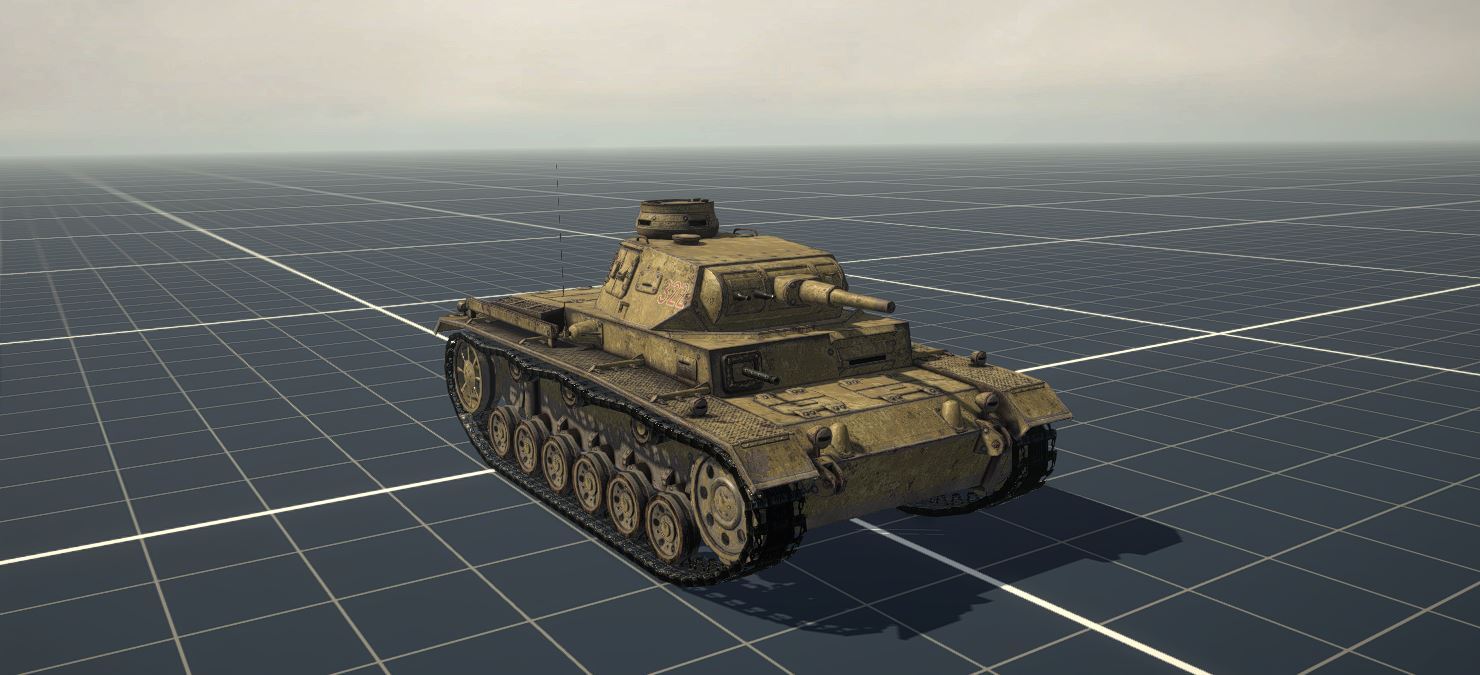
Vehicle History
By the late 1930s, earlier Panzer III variants had already established a workable formula, so engineers concentrated less on experimentation and more on improving production efficiency and operational reliability. It was not a radical redesign, but in mechanized warfare even small evolutionary changes could influence readiness. The Ausf. F is best understood as a vehicle shaped by battlefield experience rather than theoretical planning.
What set the Ausf. F apart from its predecessor, the Ausf. E, were service-driven improvements based on operational use. The familiar six-road-wheel torsion-bar chassis remained, but the rubber rims were widened from 75 mm to 95 mm to reduce wear. The front return roller was moved forward to minimize track interference. Armored covers were added to protect steering brake ventilation ports on the glacis, reflecting lessons about frontal vulnerability observed in earlier service.
The Maybach HL 120 TR engine continued to provide 265 hp, while revisions to the electric starter and cooling system increased dependability. The superstructure gained a side vision port for the radio operator and deflectors to shield the turret ring from debris. The turret received a revised mantlet that accommodated future armament upgrades and improved ventilation. By April 1941, many vehicles were fitted with a rear storage bin. Armor remained 30 mm on the front and sides, though many later received 30 mm appliqué plates to counter improved anti-tank threats. Smoke grenade racks at the rear added tactical flexibility. Taken together, these modifications aimed to make a proven vehicle more durable under campaign conditions.
A total of 435 vehicles were built between 1939 and 1941, making it far more numerous than the Ausf. E. Six manufacturers shared production, with Henschel producing the largest share, while subcontractors supplied turrets, armor, and engines. Despite this cooperation, output often remained moderate due to transmission and armor supply bottlenecks.
On the battlefield, the Ausf. F served in multiple theaters rather than defining a single campaign. It took part in the 1940 Western Campaign within the broader Panzer III force, where success depended heavily on crew coordination and radio communication. The variant later appeared in the Balkans, North Africa, and on the Eastern Front. In North Africa, desert conditions prompted the use of improved air filtration systems and additional external stowage for long-range operations. Fighting on the Eastern Front highlighted the growing need for stronger armor and more effective armament. Against lighter vehicles such as early-war light tanks, the Ausf. F performed competently, but heavier enemy armor increasingly required close-range tactics or upgraded guns. By late 1941, attrition and redeployment had significantly reduced operational numbers.
The Ausf. F’s limitations became more apparent as the war progressed. The Maybach Variorex transmission remained maintenance-intensive under sustained use. The original 3.7 cm gun was already becoming obsolete by 1940, leading many Ausf. F tanks to receive the 5 cm KwK L/42. This upgrade improved firepower but reduced ammunition capacity and slightly increased weight. The 30 mm armor, once acceptable, offered decreasing protection as anti-tank weapons improved. Harsh environments—from desert dust to Russian mud—placed further strain on maintenance. As a result, the Ausf. F functioned more as a workhorse adapting to changing conditions than as a major technological leap.
Although later variants overshadowed it, the Ausf. F demonstrates how incremental development and battlefield adaptation—rather than dramatic innovation—often shaped early-war armored effectiveness.
What set the Ausf. F apart from its predecessor, the Ausf. E, were service-driven improvements based on operational use. The familiar six-road-wheel torsion-bar chassis remained, but the rubber rims were widened from 75 mm to 95 mm to reduce wear. The front return roller was moved forward to minimize track interference. Armored covers were added to protect steering brake ventilation ports on the glacis, reflecting lessons about frontal vulnerability observed in earlier service.
The Maybach HL 120 TR engine continued to provide 265 hp, while revisions to the electric starter and cooling system increased dependability. The superstructure gained a side vision port for the radio operator and deflectors to shield the turret ring from debris. The turret received a revised mantlet that accommodated future armament upgrades and improved ventilation. By April 1941, many vehicles were fitted with a rear storage bin. Armor remained 30 mm on the front and sides, though many later received 30 mm appliqué plates to counter improved anti-tank threats. Smoke grenade racks at the rear added tactical flexibility. Taken together, these modifications aimed to make a proven vehicle more durable under campaign conditions.
A total of 435 vehicles were built between 1939 and 1941, making it far more numerous than the Ausf. E. Six manufacturers shared production, with Henschel producing the largest share, while subcontractors supplied turrets, armor, and engines. Despite this cooperation, output often remained moderate due to transmission and armor supply bottlenecks.
On the battlefield, the Ausf. F served in multiple theaters rather than defining a single campaign. It took part in the 1940 Western Campaign within the broader Panzer III force, where success depended heavily on crew coordination and radio communication. The variant later appeared in the Balkans, North Africa, and on the Eastern Front. In North Africa, desert conditions prompted the use of improved air filtration systems and additional external stowage for long-range operations. Fighting on the Eastern Front highlighted the growing need for stronger armor and more effective armament. Against lighter vehicles such as early-war light tanks, the Ausf. F performed competently, but heavier enemy armor increasingly required close-range tactics or upgraded guns. By late 1941, attrition and redeployment had significantly reduced operational numbers.
The Ausf. F’s limitations became more apparent as the war progressed. The Maybach Variorex transmission remained maintenance-intensive under sustained use. The original 3.7 cm gun was already becoming obsolete by 1940, leading many Ausf. F tanks to receive the 5 cm KwK L/42. This upgrade improved firepower but reduced ammunition capacity and slightly increased weight. The 30 mm armor, once acceptable, offered decreasing protection as anti-tank weapons improved. Harsh environments—from desert dust to Russian mud—placed further strain on maintenance. As a result, the Ausf. F functioned more as a workhorse adapting to changing conditions than as a major technological leap.
Although later variants overshadowed it, the Ausf. F demonstrates how incremental development and battlefield adaptation—rather than dramatic innovation—often shaped early-war armored effectiveness.
Vehicle Technical Specification
| Role | Medium Tank | Top Speed (km/h) | 45 |
| Crew | 5 ( 4 In game ) | Reverse Speed (km/h) | 10 |
| Primary Armament | 37 mm KwK36 cannon | Hull Traverse Speed (°/sec) | 20 |
| Secondary Armament | 2 x 7.92 mm MG 34 machine guns | Turret Traverse (°/sec) | 10 ( hand-cranked ) |
Armour
| Location | Front (mm) | Side (mm) | Rear (mm) |
|---|---|---|---|
| Hull | 30 | 30 | 20 |
| Turret | 30 | 30 | 30 |
Ammunition Types
| Ammo Type | Penetration at 100m (mm) |
|---|---|
| 37mm APHE | 40 |
| 37mm AP | 62 |