
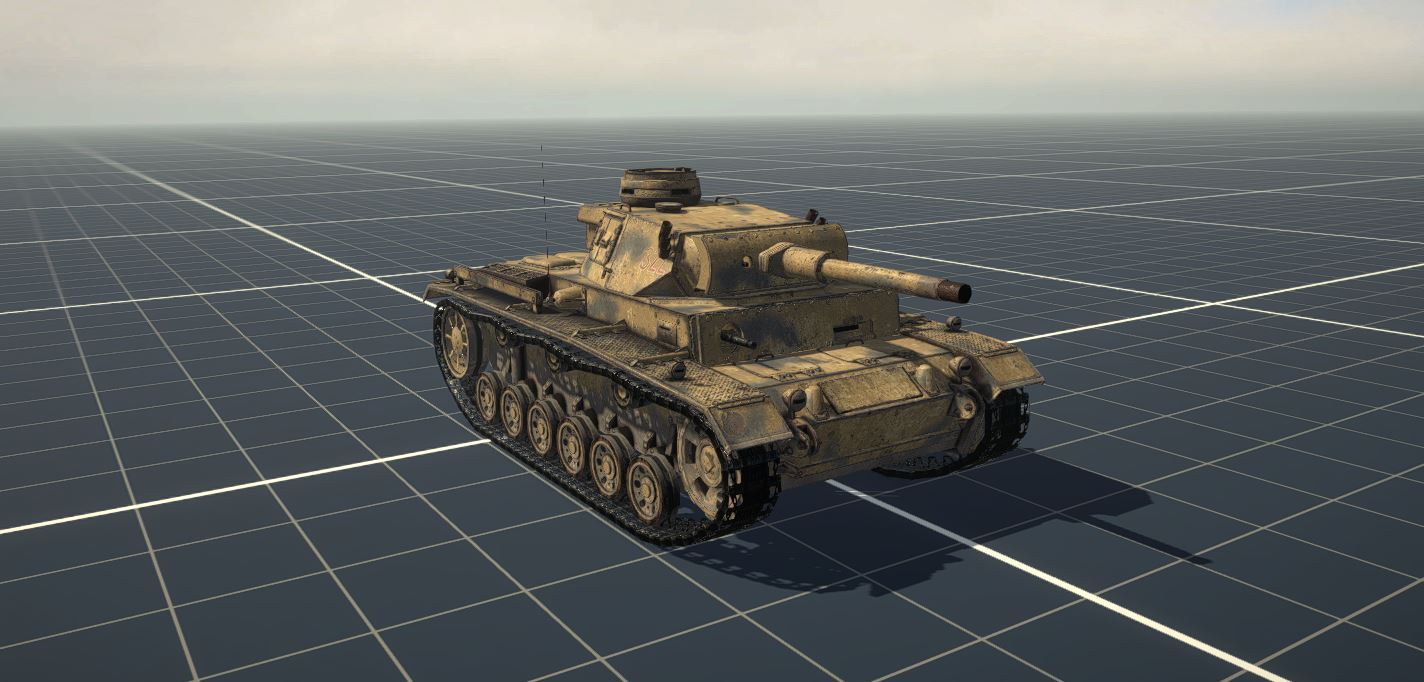
Vehicle History
The Flammpanzer III (Sd.Kfz. 141/3) was developed in 1942 to meet this requirement as a dedicated flamethrower tank. It was intended primarily for urban combat and assaults against prepared defenses, roles in which conventional tank armament was often less effective. Earlier flame tanks like the lightly armored Panzer II "Flamingo" had proven too vulnerable, often succumbing to anti-tank fire, while improvised designs on captured French Char B1s highlighted the need for a reliable, well-protected platform.
The Flammpanzer III was based on the Panzer III Ausf. M hull, modified to replace its main armament with a flamethrower system. The standard 5 cm KwK 39 gun was removed and replaced with a 14 mm flamethrower nozzle, which was enclosed within a dummy barrel approximately 1.5 meters long. This concealment was intended to make the vehicle appear externally similar to a conventional Panzer III, reducing the likelihood of immediate identification by enemy forces. Fuel, a tar-thickened oil with a creosote-like scent, was stored in two hull-mounted tanks totaling 1,020 liters, pumped at high pressure by a Koebe system driven by a 28 hp Auto Union engine. This allowed 70-80 bursts, reaching 50-60 meters when ignited by electrical glow plugs. The turret retained full 360° traverse, but the crew slimmed to three—commander (who doubled as flame operator via foot pedal), driver, and bow gunner/radio operator—freeing space for the volatile payload. Armor was bolstered with an extra 30 mm plate on the hull front (totaling 75-80 mm effective), plus Vorpanzer spacing, and five fire extinguishers guarded against the ever-present risk of fire.
Production of the Flammpanzer III was limited. From January to April 1943, 100 fresh Panzer III Ausf. M hulls—delivered unarmed from MIAG in Braunschweig—were shipped to Wegmann in Kassel for conversion. The schedule aimed for 20 in January, 45 in February, and 35 in March, but delays pushed completions to 65 in February, 34 in March, and the final one in April. Designated initially as Flammpanzerwagen (Sd.Kfz. 141), it later became Pz.Kpfw. III (Fl) (Sd.Kfz. 141/3).
Although originally intended for use during the Battle of Stalingrad, production delays prevented deployment until mid-1943. The Flammpanzer III debuted at Kursk in July 1943, where its short range and visibility issues hampered performance against Soviet defenses. Distributed across divisions like Grossdeutschland (28 vehicles), 1st Panzer (14), and others, it saw scattered action on the Eastern Front, reducing fortifications in limited engagements but losing units to artillery in open terrain. In the Italian Campaign, Flammpanzer III units attached to Panzer-Regiment 26 achieved more favorable results, particularly during night operations and in restricted terrain. Engagements near Mozzagrogna in November 1943 and around Ortona in December demonstrated the vehicle’s effectiveness in suppressing infantry positions, though such successes were limited in scope. Yet, by autumn 1943, many were deemed underwhelming and reconverted to standard Panzer IIIs with 5 cm guns. Surviving platoons lingered in reserve roles, with units like Panzer-Flamm-Kompanie 351 fighting until Budapest in 1945.
The Flammpanzer III’s limitations ultimately restricted its usefulness. The flamethrower's brief range exposed the tank to close-range threats, while ignition created billowing smoke that blinded crews and signaled positions to enemies— which reduced its effectiveness in combat. Inherited from the aging Panzer III, vulnerabilities to advanced anti-tank weapons rendered it obsolete against armor, confining it to infantry support in covered terrain. Fuel flammability posed constant hazards, despite safeguards, and the reduced crew strained operations in high-stress urban fights. As a result, the Flammpanzer III remained a specialized and relatively short-lived design.
Today, the Flammpanzer III is remembered as a specialized adaptation of an aging platform, reflecting German efforts to address tactical challenges through modification rather than large-scale new production. One surviving example is preserved in running condition at the Wehrtechnische Studiensammlung in Koblenz, providing an example of flame-based armored vehicle design.
The Flammpanzer III was based on the Panzer III Ausf. M hull, modified to replace its main armament with a flamethrower system. The standard 5 cm KwK 39 gun was removed and replaced with a 14 mm flamethrower nozzle, which was enclosed within a dummy barrel approximately 1.5 meters long. This concealment was intended to make the vehicle appear externally similar to a conventional Panzer III, reducing the likelihood of immediate identification by enemy forces. Fuel, a tar-thickened oil with a creosote-like scent, was stored in two hull-mounted tanks totaling 1,020 liters, pumped at high pressure by a Koebe system driven by a 28 hp Auto Union engine. This allowed 70-80 bursts, reaching 50-60 meters when ignited by electrical glow plugs. The turret retained full 360° traverse, but the crew slimmed to three—commander (who doubled as flame operator via foot pedal), driver, and bow gunner/radio operator—freeing space for the volatile payload. Armor was bolstered with an extra 30 mm plate on the hull front (totaling 75-80 mm effective), plus Vorpanzer spacing, and five fire extinguishers guarded against the ever-present risk of fire.
Production of the Flammpanzer III was limited. From January to April 1943, 100 fresh Panzer III Ausf. M hulls—delivered unarmed from MIAG in Braunschweig—were shipped to Wegmann in Kassel for conversion. The schedule aimed for 20 in January, 45 in February, and 35 in March, but delays pushed completions to 65 in February, 34 in March, and the final one in April. Designated initially as Flammpanzerwagen (Sd.Kfz. 141), it later became Pz.Kpfw. III (Fl) (Sd.Kfz. 141/3).
Although originally intended for use during the Battle of Stalingrad, production delays prevented deployment until mid-1943. The Flammpanzer III debuted at Kursk in July 1943, where its short range and visibility issues hampered performance against Soviet defenses. Distributed across divisions like Grossdeutschland (28 vehicles), 1st Panzer (14), and others, it saw scattered action on the Eastern Front, reducing fortifications in limited engagements but losing units to artillery in open terrain. In the Italian Campaign, Flammpanzer III units attached to Panzer-Regiment 26 achieved more favorable results, particularly during night operations and in restricted terrain. Engagements near Mozzagrogna in November 1943 and around Ortona in December demonstrated the vehicle’s effectiveness in suppressing infantry positions, though such successes were limited in scope. Yet, by autumn 1943, many were deemed underwhelming and reconverted to standard Panzer IIIs with 5 cm guns. Surviving platoons lingered in reserve roles, with units like Panzer-Flamm-Kompanie 351 fighting until Budapest in 1945.
The Flammpanzer III’s limitations ultimately restricted its usefulness. The flamethrower's brief range exposed the tank to close-range threats, while ignition created billowing smoke that blinded crews and signaled positions to enemies— which reduced its effectiveness in combat. Inherited from the aging Panzer III, vulnerabilities to advanced anti-tank weapons rendered it obsolete against armor, confining it to infantry support in covered terrain. Fuel flammability posed constant hazards, despite safeguards, and the reduced crew strained operations in high-stress urban fights. As a result, the Flammpanzer III remained a specialized and relatively short-lived design.
Today, the Flammpanzer III is remembered as a specialized adaptation of an aging platform, reflecting German efforts to address tactical challenges through modification rather than large-scale new production. One surviving example is preserved in running condition at the Wehrtechnische Studiensammlung in Koblenz, providing an example of flame-based armored vehicle design.
Vehicle Technical Specification
| Role | Flamethrower Tank | Top Speed (km/h) | 45 |
| Crew | 3 ( 4 in game ) | Reverse Speed (km/h) | 10 |
| Primary Armament | 14mm Flammenwerfer | Hull Traverse Speed (°/sec) | 20 |
| Secondary Armament | 2 x 7.92 mm MG34 machine gun | Turret Traverse (°/sec) | 12 |
Armour
| Location | Front (mm) | Side (mm) | Rear (mm) |
|---|---|---|---|
| Hull | 53 | 30 | 30 |
| Turret | 50 | 30 | 30 |
Ammunition Types
| Ammo Type | Penetration at 100m (mm) |
|---|---|
| Flamethrower fuel | 119 |