
Vehicle History
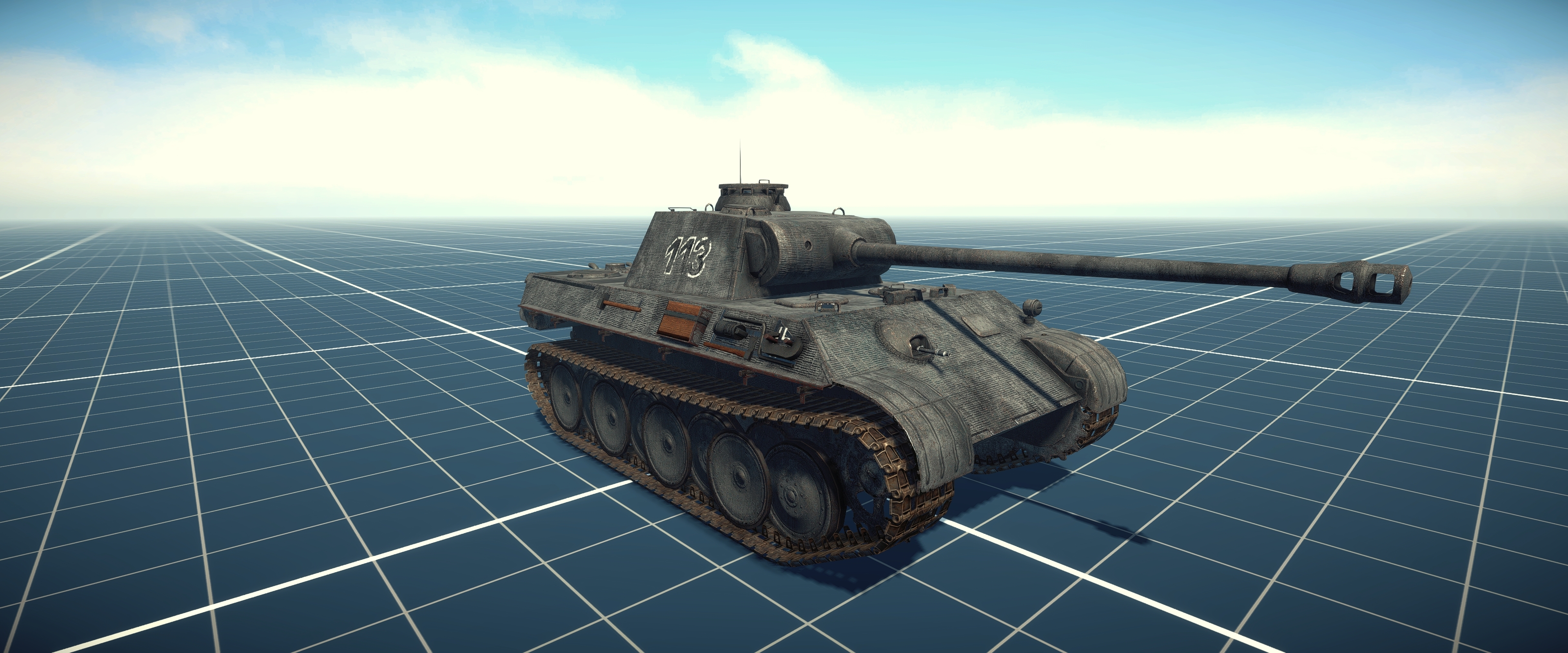
The Panzerkampfwagen V Ausführung A (Panther A) is the second production variant of the iconic Panzerkampfwagen V Panther medium tank family. Compared to the Ausf. D, the Ausf. A introduced several incremental but meaningful changes aimed at improving usability and reliability.
The commander's cupola was redesigned as a cast armor unit, replacing the forged version on the D, and incorporated periscopes for better all-around vision along with a steel ring mount for an anti-aircraft MG 34. The hull machine gun mount shifted from the Ausf. D's rudimentary "letterbox" flap to a more precise ball mount with a K.Z.F.2 telescopic sight, improving accuracy and crew protection. Ammunition storage was modestly increased, with deeper sponsons allowing for 79 rounds total (typically 48 in the sponsons versus 36 on the D), reducing the frequency of resupply in prolonged engagements. Turret traversal was refined for smoother operation, achieving a full 360 degrees in as little as 15 seconds at maximum engine RPM.
Production of the Ausf. A ramped up as German industry adapted to the Panther's demands. Monthly averages climbed from 148 tanks in 1943 to 315 in 1944, though Allied bombing campaigns disrupted facilities, reducing potential output by 25-30% in the first year of Panther production. The Ausf. A's run totaled around 2,200 vehicles, making it the backbone of Panther-equipped units during the critical period of 1943-1944.
Combat history of the Ausf. A unfolded primarily after the Battle of Kursk in July 1943, where the Ausf. D had borne the brunt of early Panther losses. As Ausf. A vehicles reached frontline units from late summer 1943, they bolstered German defenses on the Eastern Front during the Soviet counteroffensives. By March 1944, a mix of Ausf. A and surviving D models—served as mobile reserves in retreating Panzer divisions, with peak Eastern Front strength reaching 522 operational tanks out of 728 by September 1944. On the Western Front, the Ausf. A debuted in significant numbers during the Normandy campaign from June 1944, with 156 Panthers available initially, rising to 432 by July. They proved devastating in open fields, as at Caen, where their long-range gunnery outmatched standard M4 Shermans, but the bocage terrain exposed side vulnerabilities to flanking attacks and infantry weapons like bazookas. The Battle of Arracourt in September 1944 saw U.S. forces decimate Panther units through superior tactics and fog-obscured ambushes, highlighting the Ausf. A's limitations in poor visibility. During the Ardennes Offensive (Battle of the Bulge) in December 1944-January 1945, around 400 Panthers participated, but mechanical breakdowns and fuel shortages reduced operational numbers to just 97 of 282 by mid-January.
In conclusion, the Panther Ausf. A stood as a pragmatic refinement of an ambitious design, effectively mitigating many of the Ausf. D's mechanical frailties while preserving the Panther's core strengths in firepower, frontal protection and mobility, though persistent vulnerabilities like weak side armor and complex maintenance limited its effectiveness.
The commander's cupola was redesigned as a cast armor unit, replacing the forged version on the D, and incorporated periscopes for better all-around vision along with a steel ring mount for an anti-aircraft MG 34. The hull machine gun mount shifted from the Ausf. D's rudimentary "letterbox" flap to a more precise ball mount with a K.Z.F.2 telescopic sight, improving accuracy and crew protection. Ammunition storage was modestly increased, with deeper sponsons allowing for 79 rounds total (typically 48 in the sponsons versus 36 on the D), reducing the frequency of resupply in prolonged engagements. Turret traversal was refined for smoother operation, achieving a full 360 degrees in as little as 15 seconds at maximum engine RPM.
Production of the Ausf. A ramped up as German industry adapted to the Panther's demands. Monthly averages climbed from 148 tanks in 1943 to 315 in 1944, though Allied bombing campaigns disrupted facilities, reducing potential output by 25-30% in the first year of Panther production. The Ausf. A's run totaled around 2,200 vehicles, making it the backbone of Panther-equipped units during the critical period of 1943-1944.
Combat history of the Ausf. A unfolded primarily after the Battle of Kursk in July 1943, where the Ausf. D had borne the brunt of early Panther losses. As Ausf. A vehicles reached frontline units from late summer 1943, they bolstered German defenses on the Eastern Front during the Soviet counteroffensives. By March 1944, a mix of Ausf. A and surviving D models—served as mobile reserves in retreating Panzer divisions, with peak Eastern Front strength reaching 522 operational tanks out of 728 by September 1944. On the Western Front, the Ausf. A debuted in significant numbers during the Normandy campaign from June 1944, with 156 Panthers available initially, rising to 432 by July. They proved devastating in open fields, as at Caen, where their long-range gunnery outmatched standard M4 Shermans, but the bocage terrain exposed side vulnerabilities to flanking attacks and infantry weapons like bazookas. The Battle of Arracourt in September 1944 saw U.S. forces decimate Panther units through superior tactics and fog-obscured ambushes, highlighting the Ausf. A's limitations in poor visibility. During the Ardennes Offensive (Battle of the Bulge) in December 1944-January 1945, around 400 Panthers participated, but mechanical breakdowns and fuel shortages reduced operational numbers to just 97 of 282 by mid-January.
In conclusion, the Panther Ausf. A stood as a pragmatic refinement of an ambitious design, effectively mitigating many of the Ausf. D's mechanical frailties while preserving the Panther's core strengths in firepower, frontal protection and mobility, though persistent vulnerabilities like weak side armor and complex maintenance limited its effectiveness.
About Zimmerit
In the evolving contest of armoured warfare during the Second World War, military engineers sought not only more powerful guns and thicker armour, but also ways to counter new infantry threats. Among the more unusual solutions to emerge from this technological struggle was Zimmerit—a textured, paste-like coating applied to German tanks and self-propelled guns in the later years of the conflict. Though visually distinctive, its purpose was highly practical: to prevent magnetic anti-tank weapons from adhering to armoured hulls.
By 1942, German infantry had begun using the Hafthohlladung, a magnetically attached shaped-charge that could be placed directly onto an enemy vehicle and detonated at optimal distance for penetration. While such weapons were dangerous to enemy tanks, they also sparked concern within the German high command. If Allied or Soviet forces adopted similar magnetic charges in large numbers, German armour could face a serious new threat. Zimmerit was conceived as a preventative response.
Mixed into a thick paste, Zimmerit was applied directly to the exterior surfaces of armoured vehicles. While still wet, it was patterned using trowels or comb-like tools to create ridges or waffle-like textures. These grooves increased the effective distance between a magnetic mine and the steel hull without adding excessive weight, while also helping the coating adhere more securely as it hardened.
Application was usually performed at the factory before vehicles entered service, rather than in field workshops. The distinctive surface patterns varied by manufacturer and vehicle type, leaving modern historians and modelers with a visual catalogue of production practices across German industry.
Zimmerit began appearing in late 1943 on many German armoured vehicles, including the Panzer III and IV, Panther, Tiger I, early Tiger II, and assault guns such as the StuG III. It was rarely applied to vehicles already in service, making it largely a feature of mid- to late-war production.
From a technical standpoint, Zimmerit functioned as intended. Its role was not to strengthen armour, but to defeat magnetism itself by increasing the distance between a magnetic device and the steel hull beneath. Magnetic devices could not reliably adhere to the treated surfaces, reducing the risk of effective placement. Yet effectiveness on paper did not translate into strategic value, because the battlefield conditions that justified its use rarely existed.
Moreover, the coating imposed real costs. Applying Zimmerit added time to vehicle production—an increasingly serious problem as Germany struggled to replace mounting losses and sustain armoured strength.
Zimmerit remains a striking example of German wartime innovation shaped more by paranoia than by direct necessity. It reflects the uncertainty faced by German planners, who prepared for threats that seemed imminent but never became widespread.
By 1942, German infantry had begun using the Hafthohlladung, a magnetically attached shaped-charge that could be placed directly onto an enemy vehicle and detonated at optimal distance for penetration. While such weapons were dangerous to enemy tanks, they also sparked concern within the German high command. If Allied or Soviet forces adopted similar magnetic charges in large numbers, German armour could face a serious new threat. Zimmerit was conceived as a preventative response.
Mixed into a thick paste, Zimmerit was applied directly to the exterior surfaces of armoured vehicles. While still wet, it was patterned using trowels or comb-like tools to create ridges or waffle-like textures. These grooves increased the effective distance between a magnetic mine and the steel hull without adding excessive weight, while also helping the coating adhere more securely as it hardened.
Application was usually performed at the factory before vehicles entered service, rather than in field workshops. The distinctive surface patterns varied by manufacturer and vehicle type, leaving modern historians and modelers with a visual catalogue of production practices across German industry.
Zimmerit began appearing in late 1943 on many German armoured vehicles, including the Panzer III and IV, Panther, Tiger I, early Tiger II, and assault guns such as the StuG III. It was rarely applied to vehicles already in service, making it largely a feature of mid- to late-war production.
From a technical standpoint, Zimmerit functioned as intended. Its role was not to strengthen armour, but to defeat magnetism itself by increasing the distance between a magnetic device and the steel hull beneath. Magnetic devices could not reliably adhere to the treated surfaces, reducing the risk of effective placement. Yet effectiveness on paper did not translate into strategic value, because the battlefield conditions that justified its use rarely existed.
Moreover, the coating imposed real costs. Applying Zimmerit added time to vehicle production—an increasingly serious problem as Germany struggled to replace mounting losses and sustain armoured strength.
Zimmerit remains a striking example of German wartime innovation shaped more by paranoia than by direct necessity. It reflects the uncertainty faced by German planners, who prepared for threats that seemed imminent but never became widespread.
Vehicle Technical Specification
| Role | Medium Tank | Top Speed (km/h) | 55 |
| Crew | 5 (4 In Game) | Reverse Speed (km/h) | 4 |
| Primary Armament | 75mm KwK 42 L/70 cannon | Hull Traverse Speed (°/sec) | 10 |
| Secondary Armament | 2x 7.92x57mm MG 34 machine guns | Turret Traverse Speed (°/sec) | 6 |
Armour
| Location | Front (mm) | Side (mm) | Rear (mm) |
|---|---|---|---|
| Hull | 80 | 40 | 40 |
| Turret | 110 | 45 | 45 |
Ammunition Types
| Ammo Type | Penetration at 100m (mm) |
|---|---|
| 75mm HE | 15 |
| 75mm AP | 192 |