
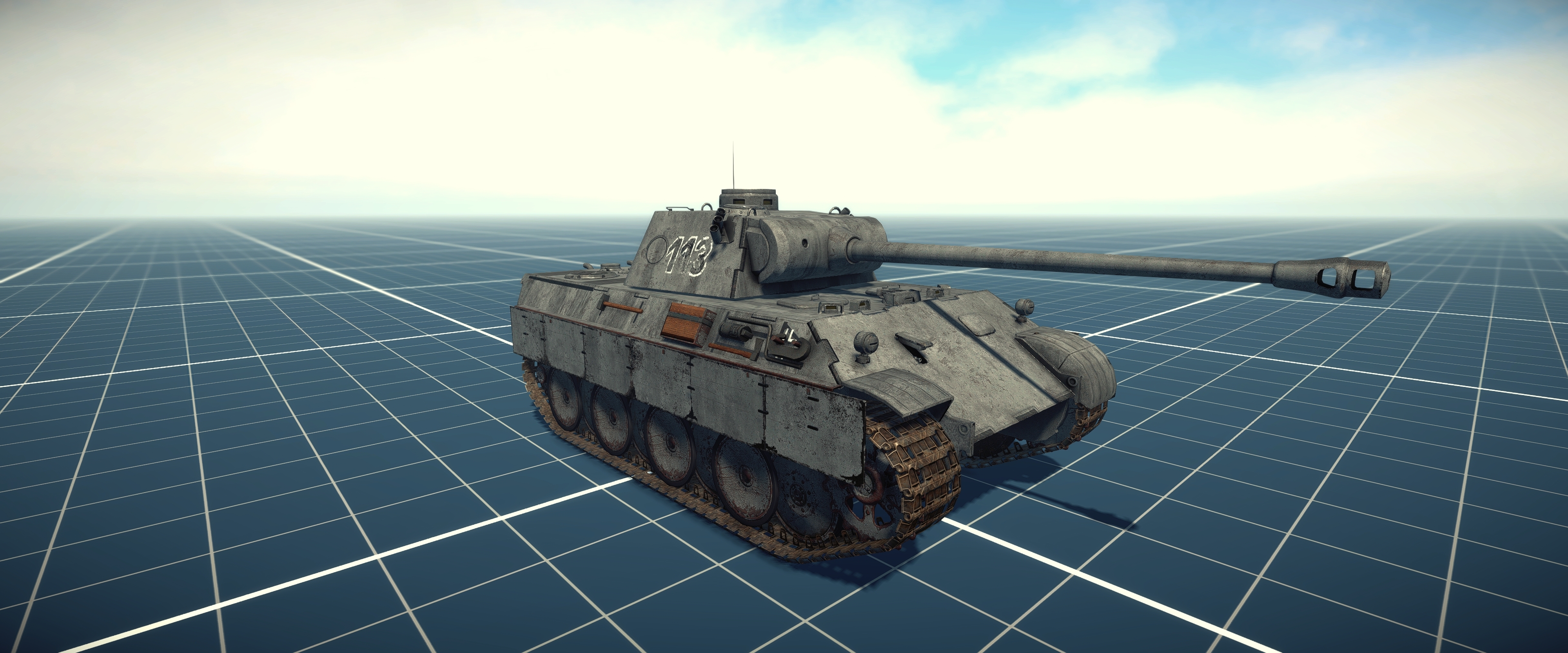
Vehicle History
The Panzerkampfwagen V Ausführung D (Panther Ausf. D), designated Sd.Kfz. 171, was the first production variant of the Panther medium tank series. Developed as a direct response to the battlefield superiority of the Soviet T-34, it was intended to supersede the increasingly inadequate Panzer III and Panzer IV in Wehrmacht frontline service. Under intense pressure from the Heer to field a vehicle combining long-range firepower, effective protection, and reasonable mobility, the design process was compressed into 1942–1943. The Ausf. D entered production in January 1943 as the initial series model to meet this urgent requirement.
The Panther’s design clearly drew inspiration from the T-34, most notably in the sharply sloped frontal armor. The glacis plate—an 80 mm slab set at 55°—provided an effective thickness of approximately 140 mm against perpendicular impact, offering substantial resistance to most contemporary Allied anti-tank guns. Main armament consisted of the 75 mm KwK 42 L/70, a high-velocity cannon that conferred a marked advantage in penetration and range over virtually all Allied tank guns then in service. Production of the Ausf. D ran from January to September 1943, during which approximately 842–850 vehicles were completed (an initial order for 1,000 having been reduced) by the manufacturers MAN, Daimler-Benz, MNH, and Henschel, before output transitioned to improved variants.
The consequences of such accelerated development proved severe. Mechanical unreliability was endemic in the early Panthers: engines were prone to overheating and fires, transmissions failed under load, and the final drives—above all—broke with alarming frequency. These defects, stemming from insufficient development time, limited testing, and the pressures of wartime resource constraints, resulted in heavy non-combat attrition and compelled units to withdraw numerous tanks for extensive repairs soon after they reached the front. Although later modifications to components, improved manufacturing standards, and greater crew experience gradually brought reliability to acceptable levels, the initial problems left a lasting mark on the Panther’s early operational record.
The Ausf. D first saw combat during Operation Citadel (the Battle of Kursk) in July 1943. When functioning properly, its combination of powerful, long-range 75 mm fire and strong frontal protection made it a formidable opponent at typical engagement distances. Nevertheless, persistent mechanical failures, inadequately trained crews, and the inevitable teething troubles of a new design led to high losses and restricted its overall battlefield contribution. Most of these major defects were systematically addressed in the subsequent Ausf. A and Ausf. G models.
In retrospect, the Panther family as a whole came to be regarded as one of the most capable medium tanks of the Second World War, achieving an effective synthesis of firepower, protection, and mobility. The troubled introduction of the Ausf. D, however, serves as a clear example of the compromises and risks inherent in attempting to field advanced armored designs under the severe constraints of late-war German industry.
The Panther’s design clearly drew inspiration from the T-34, most notably in the sharply sloped frontal armor. The glacis plate—an 80 mm slab set at 55°—provided an effective thickness of approximately 140 mm against perpendicular impact, offering substantial resistance to most contemporary Allied anti-tank guns. Main armament consisted of the 75 mm KwK 42 L/70, a high-velocity cannon that conferred a marked advantage in penetration and range over virtually all Allied tank guns then in service. Production of the Ausf. D ran from January to September 1943, during which approximately 842–850 vehicles were completed (an initial order for 1,000 having been reduced) by the manufacturers MAN, Daimler-Benz, MNH, and Henschel, before output transitioned to improved variants.
The consequences of such accelerated development proved severe. Mechanical unreliability was endemic in the early Panthers: engines were prone to overheating and fires, transmissions failed under load, and the final drives—above all—broke with alarming frequency. These defects, stemming from insufficient development time, limited testing, and the pressures of wartime resource constraints, resulted in heavy non-combat attrition and compelled units to withdraw numerous tanks for extensive repairs soon after they reached the front. Although later modifications to components, improved manufacturing standards, and greater crew experience gradually brought reliability to acceptable levels, the initial problems left a lasting mark on the Panther’s early operational record.
The Ausf. D first saw combat during Operation Citadel (the Battle of Kursk) in July 1943. When functioning properly, its combination of powerful, long-range 75 mm fire and strong frontal protection made it a formidable opponent at typical engagement distances. Nevertheless, persistent mechanical failures, inadequately trained crews, and the inevitable teething troubles of a new design led to high losses and restricted its overall battlefield contribution. Most of these major defects were systematically addressed in the subsequent Ausf. A and Ausf. G models.
In retrospect, the Panther family as a whole came to be regarded as one of the most capable medium tanks of the Second World War, achieving an effective synthesis of firepower, protection, and mobility. The troubled introduction of the Ausf. D, however, serves as a clear example of the compromises and risks inherent in attempting to field advanced armored designs under the severe constraints of late-war German industry.
Vehicle Technical Specification
| Role | Medium Tank | Top Speed (km/h) | 24 |
| Crew | 5 (4 In Game) | Reverse Speed (km/h) | 4 |
| Primary Armament | 75mm KwK 42 L/70 cannon | Hull Traverse Speed (°/sec) | 19 |
| Secondary Armament | 2 x 7.92 mm MG 34 machine guns | Turret Traverse Speed (°/sec) | 6 |
Armour
| Location | Front (mm) | Side (mm) | Rear (mm) |
|---|---|---|---|
| Hull | 80 | 40 | 40 |
| Turret | 100 | 45 | 45 |
Ammunition Types
| Ammo Type | Penetration at 100m (mm) |
|---|---|
| 75mm HE | 15 |
| 75mm AP | 191 |