
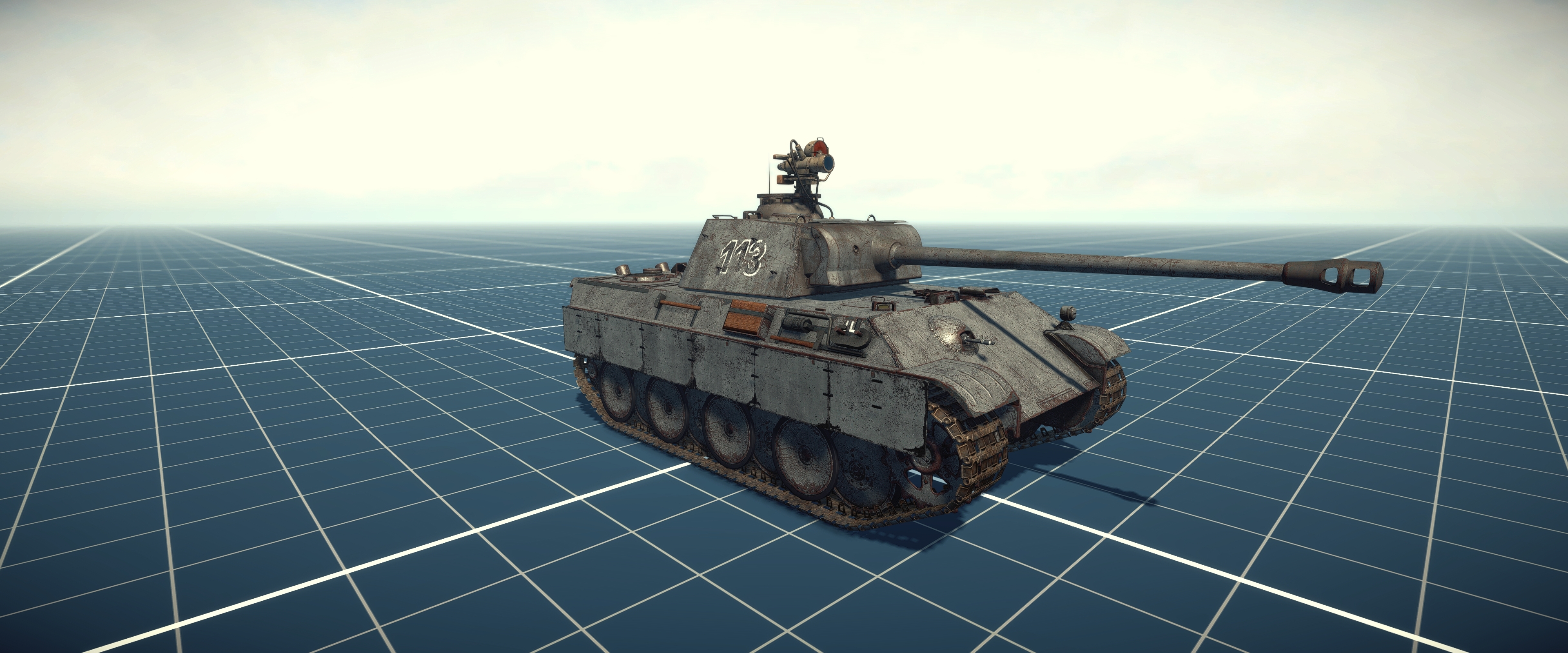
![Panzer V Panther Ausf. G [Blood on the Danube DLC]](https://wiki.easyred2.com/assets/uploads/1774789096_a18b32_pantherg.jpg)
Vehicle History
The Panzerkampfwagen V Panther Ausführung G represents the culmination of Germany's most ambitious medium tank program of the Second World War — the final, most refined, and most produced expression of a design that had begun life in crisis and been beaten into shape by two years of brutal combat experience.
The first Panther, the Ausf. D, left the MAN production line in January 1943 and was rushed into combat at Kursk in such a state of mechanical unreadiness that its average serviceability rate that summer stood at a calamitous 16%. Transmission failures, engine fires, and chronic overheating plagued the early vehicles in numbers that alarmed even their own crews.
The Ausf. A followed with a revised cupola, a ball-mounted hull machine gun, and an uprated 700 horsepower engine — improvements that pushed reliability upward, if never to a comfortable level. By early 1944, accumulated lessons from the Eastern Front, combined with mounting pressure to simplify manufacturing for an industry stretched to its limits, produced the third and final variant: the Ausführung G.
Production began in March 1944, carried out by MAN, Daimler-Benz, and MNH.
Nearly 3,000 were completed by 1945 — making the Ausf. G not only the most numerous Panther variant, but the single most-produced German tank of the war's final year.
The improvements it incorporated were extensive and aimed at two goals simultaneously: survivability and manufacturability.
The most significant change was a redesigned hull.
The superstructure side was now formed from a single plate and the upper hull side armour was thickened. The slope angle of the side armour was reduced by eleven degrees — making it geometrically less effective — so the side armour thickness was increased from 40 mm to 50 mm to compensate.
The driver's position was also overhauled: the vision port was removed from the front hull to strengthen the glacis plate, replaced by a rotating traversable periscope, and the driver's seat was redesigned so it could be raised, allowing the driver to extend his head through the hatch for better situational awareness when moving away from contact.
Late in the production run, the gun mantlet was modified to address a dangerous flaw — the earlier circular profile created a "shot trap" at its base where incoming rounds could be deflected downward onto the thin roof Armor. The bottom half of the new mantlet was made wedge-shaped, eliminating the problem entirely.
Further refinements accumulated throughout the run. Exhaust pipe shields were added to mask the red night glow of the engine, later replaced by purpose-built Flammenvernichter flame-arresting mufflers.
Zimmerit anti-magnetic paste application was halted in September 1944 after evidence linked it to tank fires. A shortage of raw materials forced the adoption of all-steel road wheels on later hulls — noisier than the rubber-rimmed type, but more durable under the conditions of 1944–45.
Until the end of the war, Ausf. G Panthers were deployed on the Eastern, south-eastern, and Western Fronts simultaneously, generally representing approximately half the tank strength of the Panzer divisions to which they were assigned.
On the Eastern Front they fought the grinding defensive battles of East Prussia and Hungary, where the 75 mm KwK 42 L/70 — capable of penetrating virtually every Allied and Soviet tank at combat ranges — remained their most decisive advantage.
On the Western Front, approximately 450 Panthers stood with Army Group B when the Ardennes offensive began in December 1944, forming the armoured core of Germany's last major push in the West. Some Ausf. G hulls were even disguised with sheet metal bodywork and American markings to impersonate M10 tank destroyers during the Battle of the Bulge — an episode that captured both German ingenuity and the desperation of the hour in equal measure.
The Panther Ausf. G arrived at the peak of its development just as the war it was built to win became unwinnable.
Faster than the Sherman, more powerfully armed than virtually anything it faced, and formidably protected at the front — yet fuel-hungry, mechanically demanding, and built under Allied bombing campaigns that increasingly strangled supply and output.
Nearly 3,000 were completed, but never enough, never fast enough. The Ausf. G stands as the Panther at its finest: a formidable, sophisticated, and ultimately tragic machine — brilliant in conception, relentless in development, and exhausted at the finish line.
The first Panther, the Ausf. D, left the MAN production line in January 1943 and was rushed into combat at Kursk in such a state of mechanical unreadiness that its average serviceability rate that summer stood at a calamitous 16%. Transmission failures, engine fires, and chronic overheating plagued the early vehicles in numbers that alarmed even their own crews.
The Ausf. A followed with a revised cupola, a ball-mounted hull machine gun, and an uprated 700 horsepower engine — improvements that pushed reliability upward, if never to a comfortable level. By early 1944, accumulated lessons from the Eastern Front, combined with mounting pressure to simplify manufacturing for an industry stretched to its limits, produced the third and final variant: the Ausführung G.
Production began in March 1944, carried out by MAN, Daimler-Benz, and MNH.
Nearly 3,000 were completed by 1945 — making the Ausf. G not only the most numerous Panther variant, but the single most-produced German tank of the war's final year.
The improvements it incorporated were extensive and aimed at two goals simultaneously: survivability and manufacturability.
The most significant change was a redesigned hull.
The superstructure side was now formed from a single plate and the upper hull side armour was thickened. The slope angle of the side armour was reduced by eleven degrees — making it geometrically less effective — so the side armour thickness was increased from 40 mm to 50 mm to compensate.
The driver's position was also overhauled: the vision port was removed from the front hull to strengthen the glacis plate, replaced by a rotating traversable periscope, and the driver's seat was redesigned so it could be raised, allowing the driver to extend his head through the hatch for better situational awareness when moving away from contact.
Late in the production run, the gun mantlet was modified to address a dangerous flaw — the earlier circular profile created a "shot trap" at its base where incoming rounds could be deflected downward onto the thin roof Armor. The bottom half of the new mantlet was made wedge-shaped, eliminating the problem entirely.
Further refinements accumulated throughout the run. Exhaust pipe shields were added to mask the red night glow of the engine, later replaced by purpose-built Flammenvernichter flame-arresting mufflers.
Zimmerit anti-magnetic paste application was halted in September 1944 after evidence linked it to tank fires. A shortage of raw materials forced the adoption of all-steel road wheels on later hulls — noisier than the rubber-rimmed type, but more durable under the conditions of 1944–45.
Until the end of the war, Ausf. G Panthers were deployed on the Eastern, south-eastern, and Western Fronts simultaneously, generally representing approximately half the tank strength of the Panzer divisions to which they were assigned.
On the Eastern Front they fought the grinding defensive battles of East Prussia and Hungary, where the 75 mm KwK 42 L/70 — capable of penetrating virtually every Allied and Soviet tank at combat ranges — remained their most decisive advantage.
On the Western Front, approximately 450 Panthers stood with Army Group B when the Ardennes offensive began in December 1944, forming the armoured core of Germany's last major push in the West. Some Ausf. G hulls were even disguised with sheet metal bodywork and American markings to impersonate M10 tank destroyers during the Battle of the Bulge — an episode that captured both German ingenuity and the desperation of the hour in equal measure.
The Panther Ausf. G arrived at the peak of its development just as the war it was built to win became unwinnable.
Faster than the Sherman, more powerfully armed than virtually anything it faced, and formidably protected at the front — yet fuel-hungry, mechanically demanding, and built under Allied bombing campaigns that increasingly strangled supply and output.
Nearly 3,000 were completed, but never enough, never fast enough. The Ausf. G stands as the Panther at its finest: a formidable, sophisticated, and ultimately tragic machine — brilliant in conception, relentless in development, and exhausted at the finish line.
Vehicle Technical Specification
| Role | Medium Tank | Top Speed (km/h) | 24 |
| Crew | 5 (4 in Game) | Reverse Speed (km/h) | 4 |
| Primary Armament | 7.5 cm KwK 42 L/70 cannon | Hull Traverse Speed (°/sec) | 19 |
| Secondary Armament | 2 x 7.92 mm MG 34 machine guns | Turret Traverse (°/sec) | 6 |
Armour
| Location | Front (mm) | Side (mm) | Rear (mm) |
|---|---|---|---|
| Hull | 80 | 50 | 40 |
| Turret | 110 | 45 | 45 |
Ammunition Types
| Ammo Type | Penetration at 100m (mm) |
|---|---|
| 75mm HE | 15 |
| 75mm AP | 191 |
Panzer V Panther Ausf. G 'Sperber' Infared
FG 1250 or Fahr- und Zielgerät FG 1250
When looking at World War II, it’s easy to forget that armoured combat usually ground to a complete halt once the sun went down. Tanks were virtually blind in the dark, and trying to operate them was just an invitation to an ambush. To solve this, German engineers began working on a solution as early as 1941, partnering with optics companies like Carl Zeiss, AEG, and Ernst Leitz. Their goal was to find a way to keep their armoured divisions operating around the clock.
The result of this development was the Fahr- und Zielgerät FG 1250 (Driving and Aiming Device), codenamed Sperber (Sparrowhawk). It was one of the very first active infrared night vision systems ever mounted on a tank. By late 1944, the German high command hoped to mount this system on the Panther tank—which was already highly effective during the day—to give crews a major advantage in low-visibility conditions.
The FG 1250 was an "active" infrared system, meaning it didn't just amplify existing ambient light; it actually broadcast its own invisible light. The setup was mounted on a special bracket right above the commander's cupola and consisted of two main parts:
The Emitter: A 20-centimeter, 200-watt infrared spotlight powered by 12-volt batteries.
The Receiver: A 46-centimeter-long image converter tube with a 112mm lens that translated the reflected IR light into a greenish image the commander could see.
Fitting this equipment into a cramped Panther Ausf. G tank required some serious compromises. To make room for the bulky batteries and generator inside the fighting compartment, crews had to sacrifice storage space for three 75mm main gun shells. They also had to bolt a large armoured container onto the right rear of the tank just to house the extra gear.
Ultimately, the FG 1250 fell into the common German wartime trap of being highly advanced but too late and too rare to matter. Production was incredibly slow, largely because German factories were facing constant Allied bombing. Only about 50 to 80 Panther Ausf. G tanks were ever actually equipped or retrofitted with the Sperber system before the war ended in 1945.
In the field, the system was a mix of innovation and severe frustration. The biggest problem was its range. The FG 1250 only let the commander see about 600 meters out. During the day, the Panther’s 75mm gun could easily pick off targets from well over a kilometre away, but at night, this short vision range forced the tank into dangerous, close-quarters fighting.
Crew coordination was another headache. Only the tank commander had the night vision scope. To actually shoot an enemy, the commander had to look through his IR sight and verbally talk the blind gunner onto the target, which was an incredibly stressful way to fight. To try and fix the range issue, the military eventually paired these Panthers with Sd.Kfz. 251 halftracks. These halftracks carried massive 60cm "Uhu" (Owl) infrared searchlights to illuminate the battlefield from a distance.
The actual combat record of the FG 1250 is pretty vague. While crews from units like the 3rd Company of the 1st Panzer Regiment 24 claimed they made successful hits during training and deployment, there are almost no officially documented, undeniable combat kills credited to the system. The gear was fragile, and if the Allies happened to have their own rudimentary infrared detectors, turning on the Sperber spotlight was essentially the equivalent of lighting a flare in a dark room.
While the FG 1250 was over-engineered, deployed in tiny numbers, and lacked the range to match the tank's gun, it proved that night-vision warfare was possible. It didn't change the course of World War II, but it served as the early blueprint for the night-vision systems built into modern main battle tanks today.
The result of this development was the Fahr- und Zielgerät FG 1250 (Driving and Aiming Device), codenamed Sperber (Sparrowhawk). It was one of the very first active infrared night vision systems ever mounted on a tank. By late 1944, the German high command hoped to mount this system on the Panther tank—which was already highly effective during the day—to give crews a major advantage in low-visibility conditions.
The FG 1250 was an "active" infrared system, meaning it didn't just amplify existing ambient light; it actually broadcast its own invisible light. The setup was mounted on a special bracket right above the commander's cupola and consisted of two main parts:
The Emitter: A 20-centimeter, 200-watt infrared spotlight powered by 12-volt batteries.
The Receiver: A 46-centimeter-long image converter tube with a 112mm lens that translated the reflected IR light into a greenish image the commander could see.
Fitting this equipment into a cramped Panther Ausf. G tank required some serious compromises. To make room for the bulky batteries and generator inside the fighting compartment, crews had to sacrifice storage space for three 75mm main gun shells. They also had to bolt a large armoured container onto the right rear of the tank just to house the extra gear.
Ultimately, the FG 1250 fell into the common German wartime trap of being highly advanced but too late and too rare to matter. Production was incredibly slow, largely because German factories were facing constant Allied bombing. Only about 50 to 80 Panther Ausf. G tanks were ever actually equipped or retrofitted with the Sperber system before the war ended in 1945.
In the field, the system was a mix of innovation and severe frustration. The biggest problem was its range. The FG 1250 only let the commander see about 600 meters out. During the day, the Panther’s 75mm gun could easily pick off targets from well over a kilometre away, but at night, this short vision range forced the tank into dangerous, close-quarters fighting.
Crew coordination was another headache. Only the tank commander had the night vision scope. To actually shoot an enemy, the commander had to look through his IR sight and verbally talk the blind gunner onto the target, which was an incredibly stressful way to fight. To try and fix the range issue, the military eventually paired these Panthers with Sd.Kfz. 251 halftracks. These halftracks carried massive 60cm "Uhu" (Owl) infrared searchlights to illuminate the battlefield from a distance.
The actual combat record of the FG 1250 is pretty vague. While crews from units like the 3rd Company of the 1st Panzer Regiment 24 claimed they made successful hits during training and deployment, there are almost no officially documented, undeniable combat kills credited to the system. The gear was fragile, and if the Allies happened to have their own rudimentary infrared detectors, turning on the Sperber spotlight was essentially the equivalent of lighting a flare in a dark room.
While the FG 1250 was over-engineered, deployed in tiny numbers, and lacked the range to match the tank's gun, it proved that night-vision warfare was possible. It didn't change the course of World War II, but it served as the early blueprint for the night-vision systems built into modern main battle tanks today.