
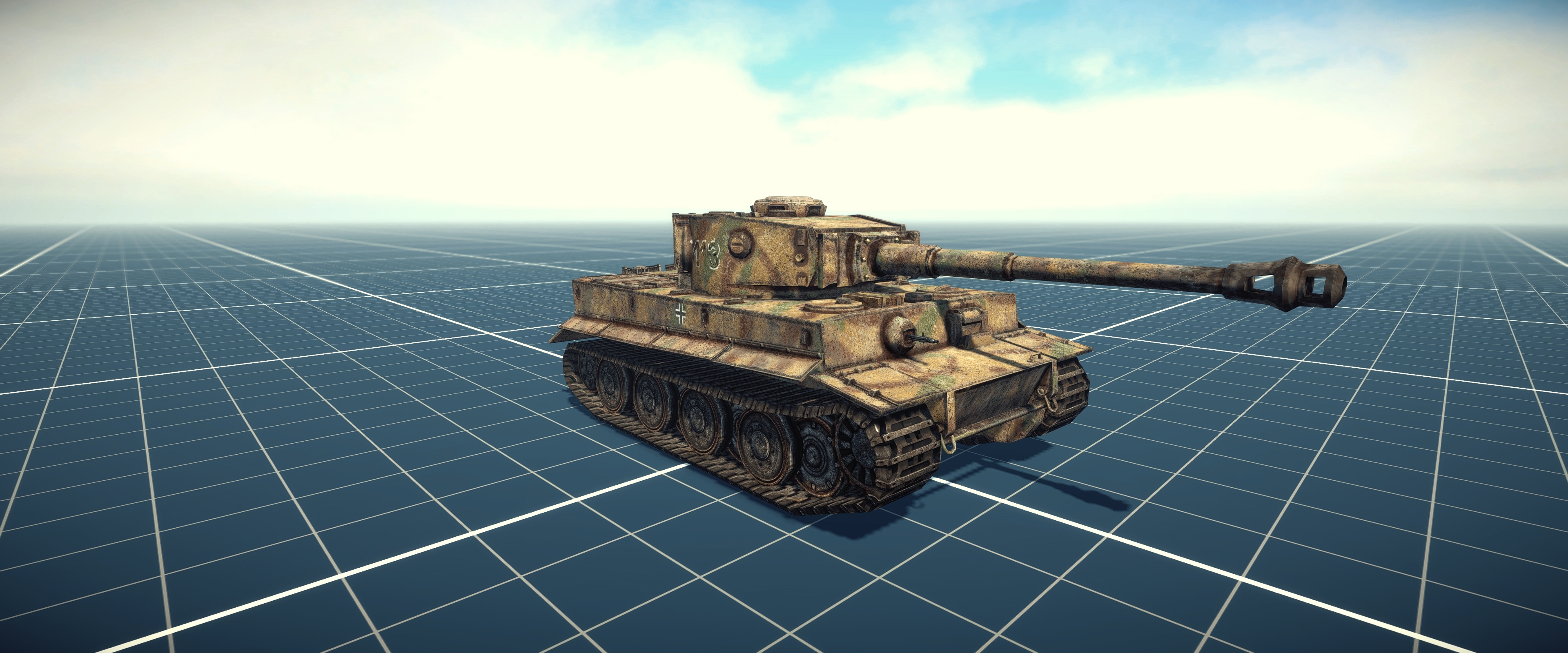
Vehicle History
The Panzerkampfwagen VI Ausführung E, commonly known as the Tiger Ausf. E or Tiger I, represented the primary production variant of Germany's heavy tank during World War II. Redesignated from the initial Ausf. H1 in March 1943, it incorporated a series of refinements to address early operational challenges, entering widespread service from mid-1943 onward and continuing until the war's end in 1945.
As the standardized model, the Ausf. E embodied incremental advancements that aimed to balance formidable firepower with improved reliability amid escalating wartime pressures.
The Ausf. E built upon the foundational design of the Ausf. H1. Key improvements included an engine upgrade starting with chassis number 251 in May 1943, replacing the Maybach HL 210 P45 (650 hp) with the more robust HL 230 P45 (700 hp), which featured a larger displacement and cast-iron block for enhanced durability. The commander's cupola was redesigned with a lower profile, reducing the tank's overall height for better concealment and incorporating thicker bullet-proof vision blocks. Secondary armament ammunition was increased slightly, and smoke dischargers were standardized.
Combat history of the Ausf. E unfolded across multiple fronts, showcasing its strengths in defensive and ambush roles. In Italy, Ausf. E Tigers from the 504th Battalion ambushed Allied forces near Anzio in 1944, destroying multiple Shermans in engagements like the one at Massa Marittima.
On the Western Front, they debuted in significant numbers during the Normandy campaign from June 1944, with actions such as Michael Wittmann's raid at Villers-Bocage decimating a British column. During the Ardennes Offensive in December 1944, around 150 Ausf. E Tigers participated, but fuel shortages and attrition reduced effectiveness. On the Eastern Front, later deployments included defensive stands in 1945, where one Ausf. E reportedly survived extensive damage before withdrawal.
Despite these refinements, the Ausf. E retained notable shortcomings that tempered its battlefield potential. Its overengineered design led to high fuel consumption (around 540 liters for a 195 km road range) and vulnerability to jamming in the interleaved road wheels from mud or ice, often requiring hours for clearance.
The weight restricted mobility over soft terrain or weak bridges, and recovery demanded multiple heavy tractors. Maintenance remained complex, with transmissions and final drives prone to failure under prolonged stress, keeping many units sidelined.
In conclusion, the Tiger Ausf. E was a formidable heavy tank that embodied German engineering ambition in the face of mounting Allied superiority. Its combination of firepower, protection, and psychological impact made it one of the most respected—and feared—vehicles of the war.
Yet its overengineering, mechanical demands, and production constraints exemplified the late-war compromises forced upon German industry. While it influenced postwar heavy tank concepts, its legacy is one of tactical excellence tempered by strategic limitations, a symbol of both technical prowess and the unsustainable costs of prolonged armored warfare.
As the standardized model, the Ausf. E embodied incremental advancements that aimed to balance formidable firepower with improved reliability amid escalating wartime pressures.
The Ausf. E built upon the foundational design of the Ausf. H1. Key improvements included an engine upgrade starting with chassis number 251 in May 1943, replacing the Maybach HL 210 P45 (650 hp) with the more robust HL 230 P45 (700 hp), which featured a larger displacement and cast-iron block for enhanced durability. The commander's cupola was redesigned with a lower profile, reducing the tank's overall height for better concealment and incorporating thicker bullet-proof vision blocks. Secondary armament ammunition was increased slightly, and smoke dischargers were standardized.
Combat history of the Ausf. E unfolded across multiple fronts, showcasing its strengths in defensive and ambush roles. In Italy, Ausf. E Tigers from the 504th Battalion ambushed Allied forces near Anzio in 1944, destroying multiple Shermans in engagements like the one at Massa Marittima.
On the Western Front, they debuted in significant numbers during the Normandy campaign from June 1944, with actions such as Michael Wittmann's raid at Villers-Bocage decimating a British column. During the Ardennes Offensive in December 1944, around 150 Ausf. E Tigers participated, but fuel shortages and attrition reduced effectiveness. On the Eastern Front, later deployments included defensive stands in 1945, where one Ausf. E reportedly survived extensive damage before withdrawal.
Despite these refinements, the Ausf. E retained notable shortcomings that tempered its battlefield potential. Its overengineered design led to high fuel consumption (around 540 liters for a 195 km road range) and vulnerability to jamming in the interleaved road wheels from mud or ice, often requiring hours for clearance.
The weight restricted mobility over soft terrain or weak bridges, and recovery demanded multiple heavy tractors. Maintenance remained complex, with transmissions and final drives prone to failure under prolonged stress, keeping many units sidelined.
In conclusion, the Tiger Ausf. E was a formidable heavy tank that embodied German engineering ambition in the face of mounting Allied superiority. Its combination of firepower, protection, and psychological impact made it one of the most respected—and feared—vehicles of the war.
Yet its overengineering, mechanical demands, and production constraints exemplified the late-war compromises forced upon German industry. While it influenced postwar heavy tank concepts, its legacy is one of tactical excellence tempered by strategic limitations, a symbol of both technical prowess and the unsustainable costs of prolonged armored warfare.
Vehicle Technical Specification
| Role | Heavy Tank | Top Speed (km/h) | 38 |
| Crew | 5 (4 In Game) | Reverse Speed (km/h) | 10 |
| Primary Armament | 8.8 cm KwK 36 L/56 cannon | Hull Traverse Speed (°/sec) | 30 |
| Secondary Armament | 2 x 7.92 mm MG 34 machine guns | Turret Traverse (°/sec) | 6 |
Armour
| Location | Front (mm) | Side (mm) | Rear (mm) |
|---|---|---|---|
| Hull | 100 | 80 | 80 |
| Turret | 100 | 80 | 80 |
Ammunition Types
| Ammo Type | Penetration at 100m (mm) |
|---|---|
| 88mm HE | 26 |
| 88mm AP | 153 |
| 88mm Smoke | 2 |