Vehicle History
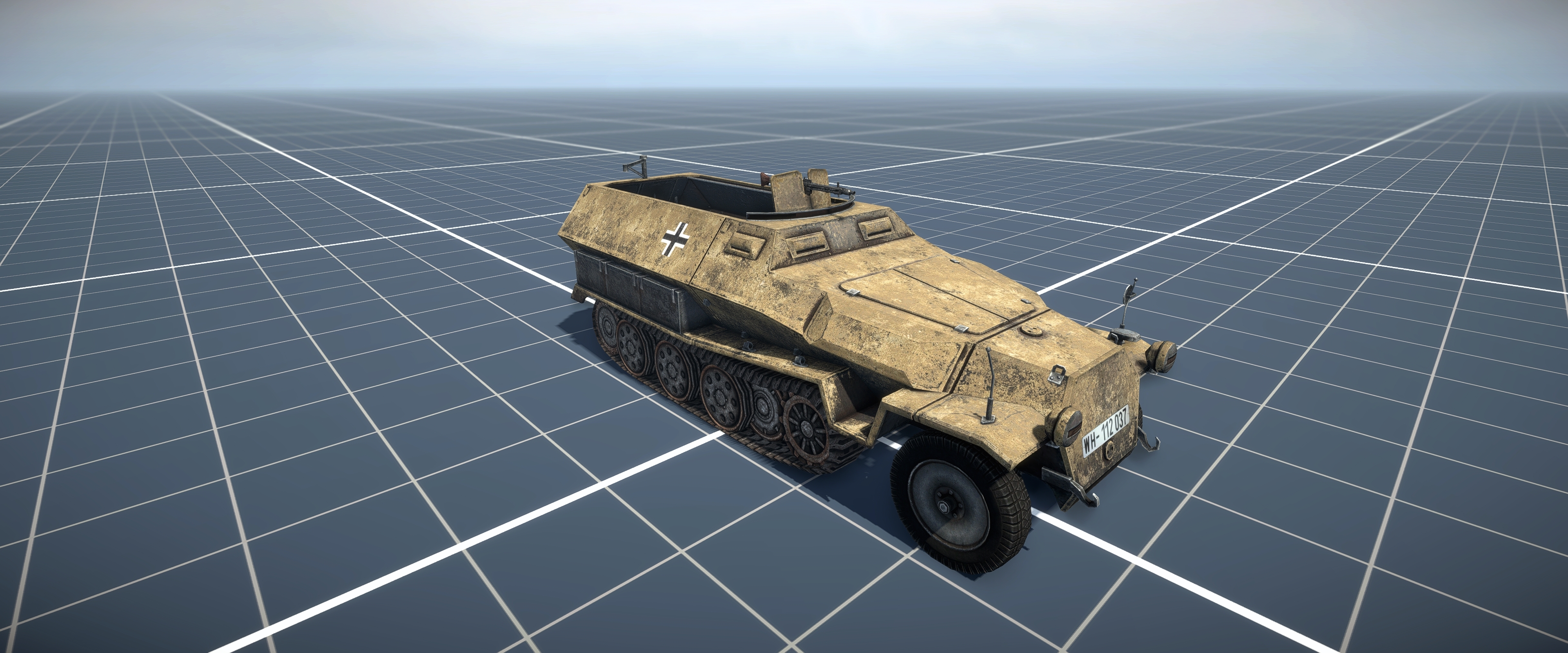
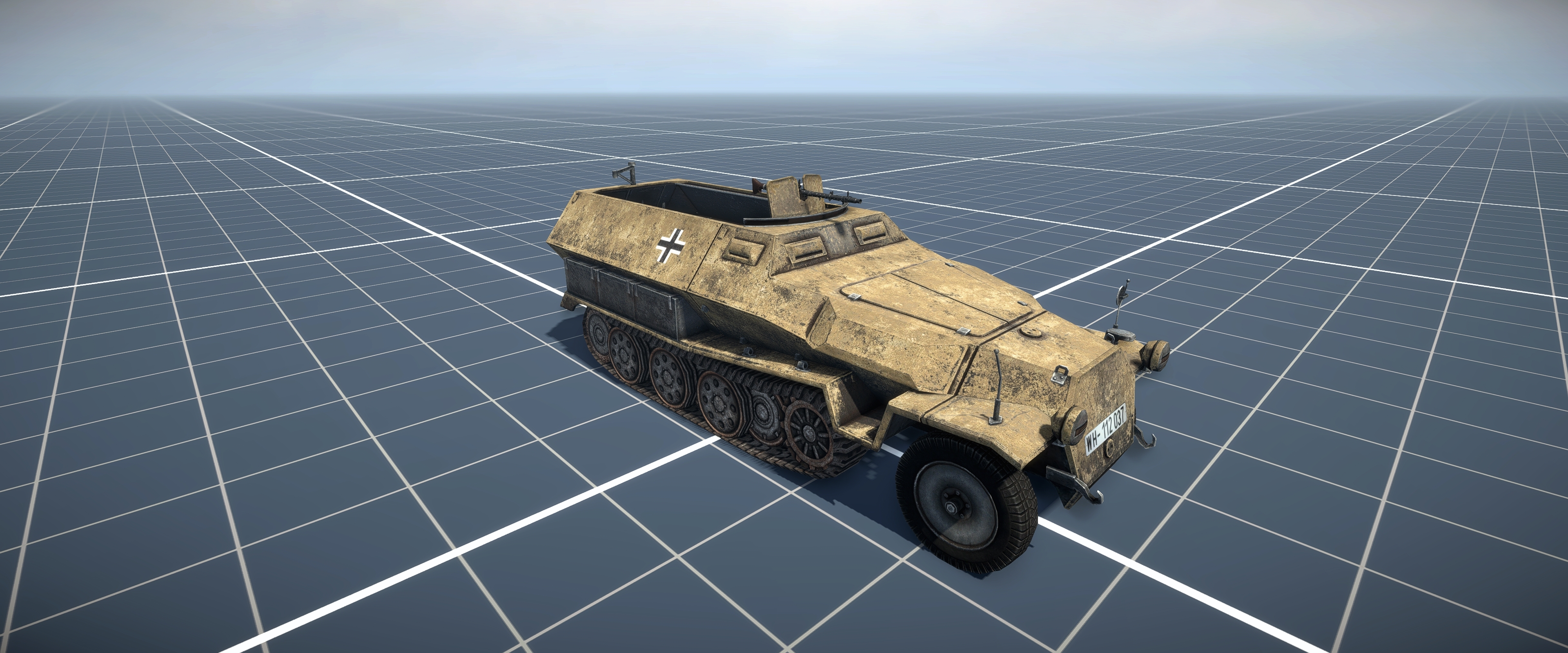
The German Wehrmacht deployed the Sd.Kfz. 251 (Sonderkraftfahrzeug 251), better known to history simply as the "Hanomag."It was conceived not as an offensive war machine, but as an armoured battlefield taxi a rolling steel sanctuary engineered to transport mechanized infantry (Panzergrenadiers) directly into the storm of combat alongside the Panzers.
Rather than building a fully tracked hull which was expensive, heavy, and mechanically complex engineers at Büssing-NAG and Hanomag opted for a half-track layout based on the 3-ton Borgward HLkl6 tractor chassis. The front wheels provided steering on roads, while the rear tracks engaged automatically to tackle difficult cross-country obstacles.
The standard troop carrier variant (Sd.Kfz. 251/1) featured two long bench seats in the rear, allowing a fully equipped 10-man squad (Gruppe) to ride alongside the driver and commander.
Despite constant Allied bombing raids, German factories including Hanomag, Adler, Auto Union, and Skoda assembled over 15,250 units of the Sd.Kfz. 251 family between 1939 and 1945, with the simplified Ausf. D accounting for over 10,600 vehicles alone. While an impressive industrial achievement for Germany, it fell far short of total motorization. Only elite Panzergrenadier units were ever fully equipped with half-tracks; the vast majority of standard German infantry still marched on foot or relied on horse-drawn supply lines.
The Sd.Kfz. 251 made its operational debut during the invasion of Poland in 1939, but its tactical value was fully realized during the Fall of France (1940) and the opening moves of Operation Barbarossa in 1941.
Riding directly alongside Panzer IIIs and IVs, Panzergrenadiers dismounted right onto enemy positions under the protective fire of the vehicle’s forward-mounted 7.92 mm MG 34 (later MG 42) machine gun, which was shielded by a steel plate. A second machine gun could be mounted at the rear to fend off ambushes or low-flying air attacks.
However, as the strategic tide turned, the vehicle's structural and operational limits were laid bare. In the endless mud of the Eastern Front's Rasputitsa, the unpowered front wheels often acted like heavy rudders stuck in cement, while severe sub-zero winters frequently froze the tracks solid overnight.
Furthermore, during urban fighting like Stalingrad or amidst the dense hedgerows of Normandy, enemy troops in elevated positions easily lobbed Molotov cocktails and grenades straight into the open troop compartment.
Yet, because the basic chassis was so robust and adaptable, over 20 specialized sub-variants were fielded, successfully transforming the basic carrier into self-propelled anti-tank gun mounts like the 251/22 carrying a 7.5 cm PaK 40, flame-throwers such as the 251/16, and even mobile infrared searchlight vehicles known as the "Uhu."
The Sd.Kfz. 251 Hanomag remains one of the most recognizable armoured fighting vehicles of World War II. It succeeded brilliantly in its core objective: providing the German military with an agile, protected platform that brought infantry into lockstep with fast-moving armoured spearheads.
Its ultimate failure was not a flaw of mechanical design, but of industrial scale. Germany simply could never build enough half-tracks to motorize its entire army, creating a dangerous operational divide between elite mechanized units and traditional foot soldiers.
Rather than building a fully tracked hull which was expensive, heavy, and mechanically complex engineers at Büssing-NAG and Hanomag opted for a half-track layout based on the 3-ton Borgward HLkl6 tractor chassis. The front wheels provided steering on roads, while the rear tracks engaged automatically to tackle difficult cross-country obstacles.
The standard troop carrier variant (Sd.Kfz. 251/1) featured two long bench seats in the rear, allowing a fully equipped 10-man squad (Gruppe) to ride alongside the driver and commander.
Despite constant Allied bombing raids, German factories including Hanomag, Adler, Auto Union, and Skoda assembled over 15,250 units of the Sd.Kfz. 251 family between 1939 and 1945, with the simplified Ausf. D accounting for over 10,600 vehicles alone. While an impressive industrial achievement for Germany, it fell far short of total motorization. Only elite Panzergrenadier units were ever fully equipped with half-tracks; the vast majority of standard German infantry still marched on foot or relied on horse-drawn supply lines.
The Sd.Kfz. 251 made its operational debut during the invasion of Poland in 1939, but its tactical value was fully realized during the Fall of France (1940) and the opening moves of Operation Barbarossa in 1941.
Riding directly alongside Panzer IIIs and IVs, Panzergrenadiers dismounted right onto enemy positions under the protective fire of the vehicle’s forward-mounted 7.92 mm MG 34 (later MG 42) machine gun, which was shielded by a steel plate. A second machine gun could be mounted at the rear to fend off ambushes or low-flying air attacks.
However, as the strategic tide turned, the vehicle's structural and operational limits were laid bare. In the endless mud of the Eastern Front's Rasputitsa, the unpowered front wheels often acted like heavy rudders stuck in cement, while severe sub-zero winters frequently froze the tracks solid overnight.
Furthermore, during urban fighting like Stalingrad or amidst the dense hedgerows of Normandy, enemy troops in elevated positions easily lobbed Molotov cocktails and grenades straight into the open troop compartment.
Yet, because the basic chassis was so robust and adaptable, over 20 specialized sub-variants were fielded, successfully transforming the basic carrier into self-propelled anti-tank gun mounts like the 251/22 carrying a 7.5 cm PaK 40, flame-throwers such as the 251/16, and even mobile infrared searchlight vehicles known as the "Uhu."
The Sd.Kfz. 251 Hanomag remains one of the most recognizable armoured fighting vehicles of World War II. It succeeded brilliantly in its core objective: providing the German military with an agile, protected platform that brought infantry into lockstep with fast-moving armoured spearheads.
Its ultimate failure was not a flaw of mechanical design, but of industrial scale. Germany simply could never build enough half-tracks to motorize its entire army, creating a dangerous operational divide between elite mechanized units and traditional foot soldiers.
Vehicle Technical Specification
| Role | APC | Top Speed (km/h) | 52 |
| Crew | 9 | Reverse Speed (km/h) | 9 |
| Primary Armament | 7.92 mm MG 34 Panzermantel / 7.92 mm MG 42 machine gun |
Armour
| Location | Front (mm) | Side (mm) | Rear (mm) |
|---|---|---|---|
| Hull | 10 | 10 | 10 |
Machine Variants