
Vehicle History
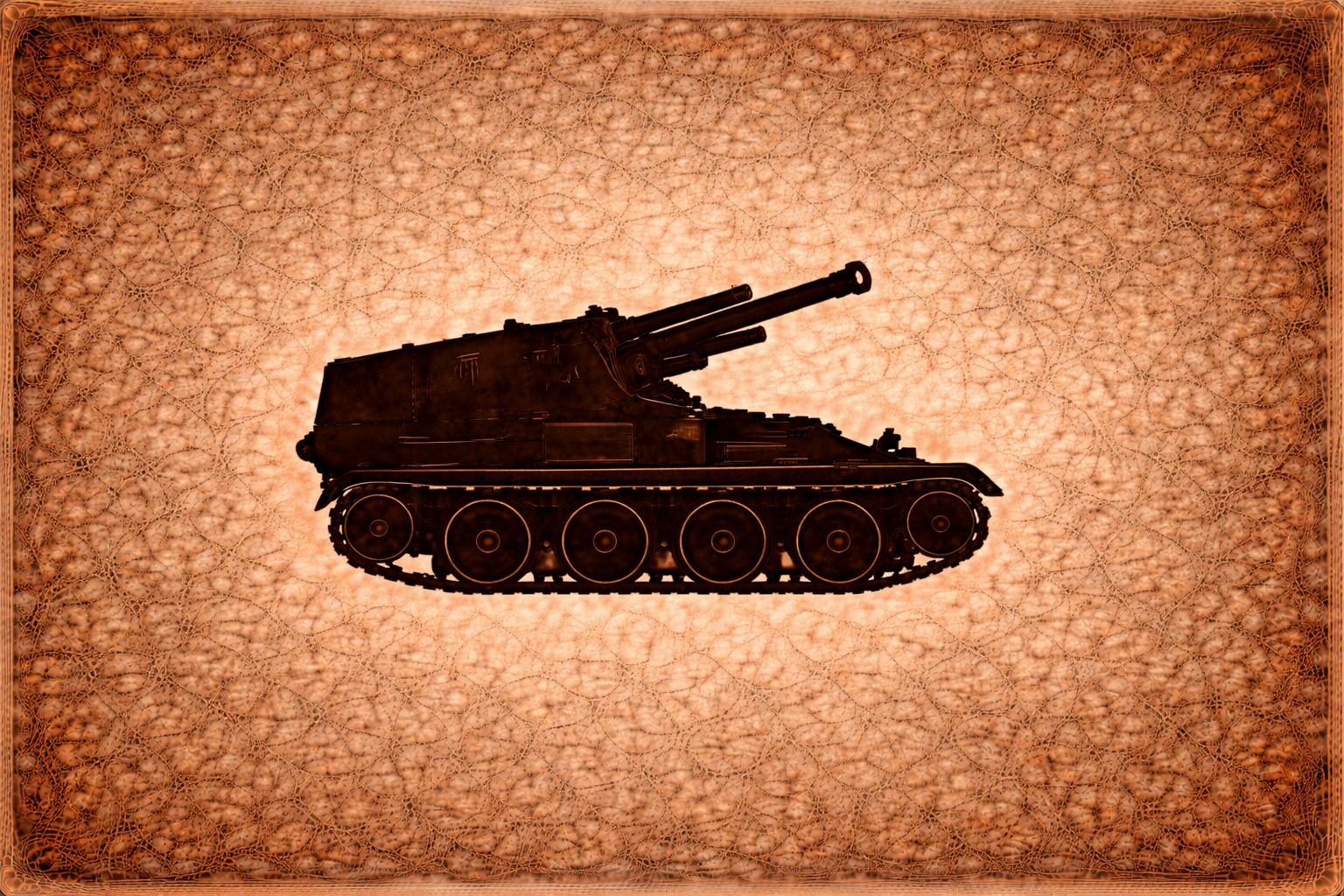
The Sturmpanzer IV (Sd.Kfz. 166), and popularly known in postwar literature by the Allied intelligence nickname Brummbär (German for "grouch" or "grumbling bear"), was a German heavy assault gun developed to provide heavily protected, short-range fire support for infantry during urban and fortified combat, entering production in 1943 and remaining in service until the war’s end in 1945. Its development stemmed from the costly close-quarters fighting of 1942, particularly at Stalingrad, where existing assault guns such as the Sturmgeschütz III lacked the destructive power required to neutralize reinforced buildings and bunker systems. In response, the Waffenprüfung 6 office commissioned Alkett to develop a fully armored, self-propelled platform capable of delivering high-explosive shells at close range while providing protection for the crew against small arms, artillery fragments, and anti-tank weapons. The design drew upon the increasingly obsolete Panzer IV chassis to carry the powerful 15 cm StuH 43 L/12 howitzer, derived from the sIG 33, within a fixed casemate that prioritized clearing enemy-held buildings, and suppressing troop concentrations at ranges with typically under 1,000 meters, where its low-velocity, high-arcing fire could deliver devastating 38 kg HE shells (or limited HEAT rounds).
Initial production began in March–April 1943 with approximately 60 vehicles built on new and rebuilt Panzer IV Ausf. G hulls, followed by successive production series that sought to address operational shortcomings, including drivetrain stress and excessive weight; later variants introduced the lighter StuH 43/1 gun, a lower-profile superstructure, an improved commander’s cupola, and a ball-mounted MG 34, reflecting incremental efforts to improve survivability and crew effectiveness without fundamentally altering the vehicle’s assault role.
Deployed in independent Sturmpanzer-Abteilungen 216, 217, 128, 219; Brummbär units first saw combat at Kursk in July 1943 with 216, which later fought on the Eastern Front before transferring to Italy, participating in the Anzio counterattack and continuing operations in the Po Valley until 1945, while 217 was committed to Normandy in 1944, fought near Caen, escaped the Falaise Pocket, later took part in the Ardennes Offensive, and was destroyed in the Ruhr Pocket; other elements were employed in intense urban fighting, including Warsaw and Budapest, where heavy direct-fire support was essential.
Although highly effective against fortifications and infantry concentrations, the Brummbär remained burdened by persistent mechanical strain, vulnerable side and rear armor, poor ventilation, and a silhouette that complicated concealment, while the logistical demands of supplying large-caliber ammunition further limited operational endurance. Consequently, while the vehicle fulfilled a vital niche in late-war German assault operations and demonstrated the tactical value of heavy direct-fire support in urban warfare, it also illustrated the structural limitations of adapting aging chassis to increasingly demanding battlefield roles under deteriorating industrial and strategic conditions.
Initial production began in March–April 1943 with approximately 60 vehicles built on new and rebuilt Panzer IV Ausf. G hulls, followed by successive production series that sought to address operational shortcomings, including drivetrain stress and excessive weight; later variants introduced the lighter StuH 43/1 gun, a lower-profile superstructure, an improved commander’s cupola, and a ball-mounted MG 34, reflecting incremental efforts to improve survivability and crew effectiveness without fundamentally altering the vehicle’s assault role.
Deployed in independent Sturmpanzer-Abteilungen 216, 217, 128, 219; Brummbär units first saw combat at Kursk in July 1943 with 216, which later fought on the Eastern Front before transferring to Italy, participating in the Anzio counterattack and continuing operations in the Po Valley until 1945, while 217 was committed to Normandy in 1944, fought near Caen, escaped the Falaise Pocket, later took part in the Ardennes Offensive, and was destroyed in the Ruhr Pocket; other elements were employed in intense urban fighting, including Warsaw and Budapest, where heavy direct-fire support was essential.
Although highly effective against fortifications and infantry concentrations, the Brummbär remained burdened by persistent mechanical strain, vulnerable side and rear armor, poor ventilation, and a silhouette that complicated concealment, while the logistical demands of supplying large-caliber ammunition further limited operational endurance. Consequently, while the vehicle fulfilled a vital niche in late-war German assault operations and demonstrated the tactical value of heavy direct-fire support in urban warfare, it also illustrated the structural limitations of adapting aging chassis to increasingly demanding battlefield roles under deteriorating industrial and strategic conditions.
Vehicle Technical Specification
| Role | SPG | Reverse Speed (km/h) | 7 |
| Crew | 5 ( 3 In game ) | Hull Traverse Speed (°/sec) | 10 |
| Primary Armament | 150 mm Stu.H 43 L/12 howitzer | Gun Traverse (°/sec) | 12 |
| Top Speed (km/h) | 40 |
Armour
| Location | Front (mm) | Side (mm) | Rear (mm) |
|---|---|---|---|
| Hull | 100 | 40 | 20 |
Ammunition Types
| Ammo Type | Penetration at 100m (mm) |
|---|---|
| 150mm HE | 46 |
| 150mm APHE | 96 |
| 150mm Smoke | 4 |