
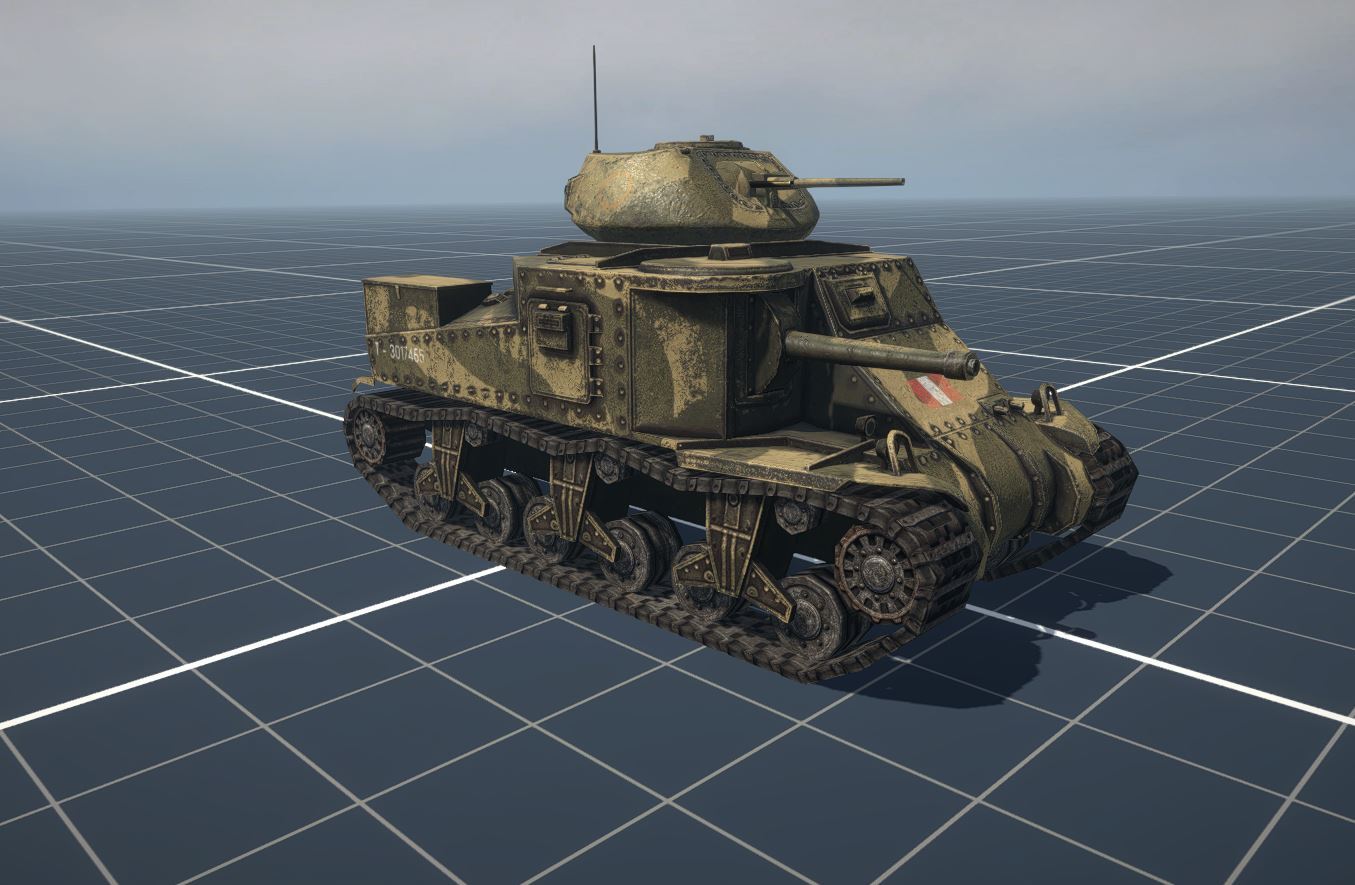

Vehicle History
The Medium Tank M3 Grant, the British Commonwealth designation for a modified version of the American Medium Tank M3 (known as the M3 Lee in U.S. service), served as a critical interim armored vehicle during World War II. Developed to meet urgent British needs after the Dunkirk evacuation in 1940 and amid growing Axis threats in North Africa, the Grant addressed key flaws in the original M3 Lee design: an excessively tall silhouette, limited traverse of the hull-mounted 75 mm main gun, radio placement in the hull requiring an extra crew member, riveted armor prone to dangerous spalling, and inadequate protection against contemporary anti-tank weapons.
British modifications produced the distinctive Grant turret, featuring a lower profile, thicker armor, a simpler split hatch instead of the machine-gun cupola, and a rear bustle to house the Wireless Set No. 19 radio next to the commander—reducing crew from seven to six. Other changes included a smoke bomb launcher (which cut 37 mm ammunition from 178 to 128 rounds), field-added desert sand shields, removal of hull machine guns for better coordination, and later adoption of welded armor to reduce spalling risks.
Production reached 1,685 units: Grant I (1,211, mostly on riveted M3/M3A2 hulls) and Grant II (464, on diesel M3A3/M3A5 hulls), built primarily by Baldwin Locomotive Works and Pressed Steel Car Company from July 1941 to late 1942 under British contracts.
The Grant proved highly effective in its combat debut at the Battle of Gazala (May 1942), where its 75 mm M2 gun—firing powerful high-explosive and armor-piercing rounds—outranged German 5 cm weapons, surprised Axis commanders, and outperformed contemporary British Crusaders against Italian armor. It played a major role at the Second Battle of El Alamein (October–November 1942), with around 600 M3 variants forming a key part of Eighth Army strength through mechanical reliability, desert mobility, and superior firepower.
After M4 Shermans arrived in late 1942, surviving Grants were redeployed to the Far East. In the Burma Campaign (1944–1945), they excelled against Japanese Type 95 Ha-Go light tanks, navigated rugged jungle terrain, and supported operations around Imphal and toward Rangoon until the war ended in September 1945.
British modifications produced the distinctive Grant turret, featuring a lower profile, thicker armor, a simpler split hatch instead of the machine-gun cupola, and a rear bustle to house the Wireless Set No. 19 radio next to the commander—reducing crew from seven to six. Other changes included a smoke bomb launcher (which cut 37 mm ammunition from 178 to 128 rounds), field-added desert sand shields, removal of hull machine guns for better coordination, and later adoption of welded armor to reduce spalling risks.
Production reached 1,685 units: Grant I (1,211, mostly on riveted M3/M3A2 hulls) and Grant II (464, on diesel M3A3/M3A5 hulls), built primarily by Baldwin Locomotive Works and Pressed Steel Car Company from July 1941 to late 1942 under British contracts.
The Grant proved highly effective in its combat debut at the Battle of Gazala (May 1942), where its 75 mm M2 gun—firing powerful high-explosive and armor-piercing rounds—outranged German 5 cm weapons, surprised Axis commanders, and outperformed contemporary British Crusaders against Italian armor. It played a major role at the Second Battle of El Alamein (October–November 1942), with around 600 M3 variants forming a key part of Eighth Army strength through mechanical reliability, desert mobility, and superior firepower.
After M4 Shermans arrived in late 1942, surviving Grants were redeployed to the Far East. In the Burma Campaign (1944–1945), they excelled against Japanese Type 95 Ha-Go light tanks, navigated rugged jungle terrain, and supported operations around Imphal and toward Rangoon until the war ended in September 1945.
Vehicle Technical Specification
| Role | Medium Tank | *op Speed (km/h) | 39 |
| Crew | 6 (4 In game ) | Reverse Speed (km/h) | 5 |
| Primary Armament | 75 mm M2 cannon | Hull Traverse Speed (°/sec) | 18 |
| Secondary Armament | 37 mm M5 cannon | Turret Traverse (°/sec) | 12 |
| Secondary Armament | 7.62 mm M1919 machine gun | Hull Gun Traverse (°/sec) | 8 |
Armour
| Location | Front (mm) | Side (mm) | Rear (mm) |
|---|---|---|---|
| Hull | 50 | 38 | 38 |
| Turret | 38 | 38 | 38 |
Ammunition Types
| Ammo Type | Penetration at 100m (mm) |
|---|---|
| 75mm AP | 88 |
| 75mm HE | 9 |
| 37mm AP | 79 |
| 37mm HE | 6 |