
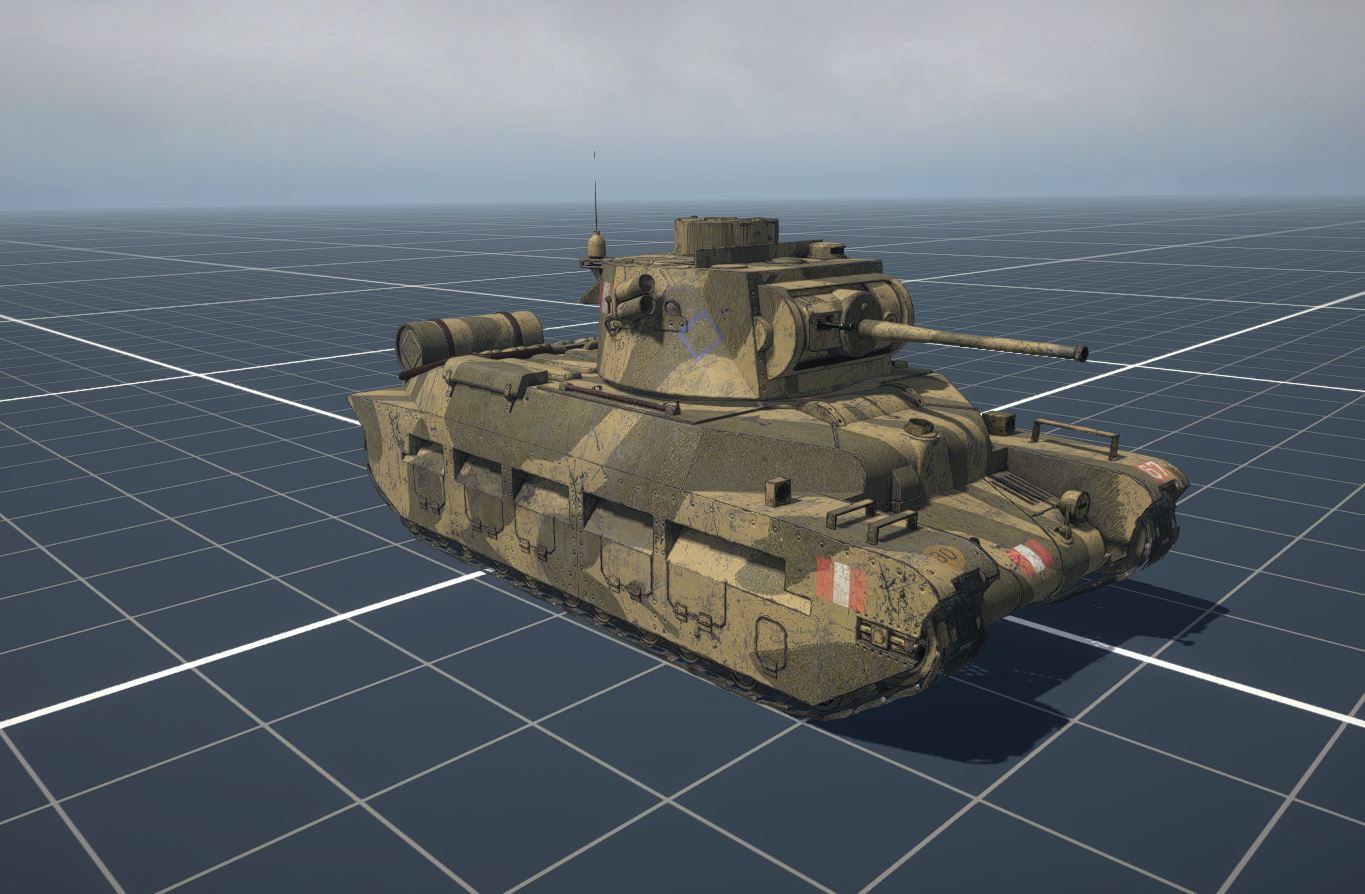
Vehicle History
The Infantry Tank Mark II, better known as the Matilda, is a British infantry tank of the Second World War. The design began as the A12 specification in 1936, as a gun-armed counterpart to the first British infantry tank, the machine gun armed, two-man A11 Infantry Tank Mark I. The Mark I was also known as Matilda, and the larger A12 was initially known as the Matilda II or Matilda senior. The Mark I was abandoned in 1940, and from then on the A12 was almost always known simply as "the Matilda".
With its heavy armour, the Matilda II was an excellent infantry support tank but with somewhat limited speed and armament. It was the only British tank to serve from the start of the war to its end, although it is particularly associated with the North African campaign. Only two were available for service by the outbreak of World War II in 1939. It was replaced in front-line service by the cheaper and lighter Infantry Tank Mk III Valentine from late 1941.
The split between the infantry tank and cruisers had its origins in the First World War division between the first British heavy tanks and the faster Whippet Medium Mark A and its successors the Medium Mark B and Medium Mark C. During the interbellum, British tank experiments generally followed these basic classifications, which were made part of the overall doctrine with the work of Major-General Percy Hobart and the influence of Captain B.H. Liddell Hart.
The first suggestion for a larger Infantry Tank was made in 1936, with specification A12. The design was produced by the Royal Arsenal, Woolwich, and Vulcan Foundry was selected as the manufacturer. A12 used a number of design elements of the A7, a medium tank that was built in limited numbers in the early 1930s whose mechanical layout was used for many following designs. With its greatly increased armour, a lack of power was seen as a problem. The solution was to use two AEC straight-six water-cooled diesel engines, used in London buses, providing up to 87 hp each. These were linked along a common shaft.
The first Matilda was produced in 1937, but only two were in service when war broke out in September 1939. Following the initial order from Vulcan Foundry, a second order was placed shortly after with Ruston & Hornsby. Some 2,987 tanks were produced by the Vulcan Foundry, John Fowler & Co. of Leeds, Ruston & Hornsby, and later by the London, Midland and Scottish Railway at Horwich Works; Harland and Wolff, and the North British Locomotive Company Glasgow. The last were delivered in August 1943.
With its heavy armour, the Matilda II was an excellent infantry support tank but with somewhat limited speed and armament. It was the only British tank to serve from the start of the war to its end, although it is particularly associated with the North African campaign. Only two were available for service by the outbreak of World War II in 1939. It was replaced in front-line service by the cheaper and lighter Infantry Tank Mk III Valentine from late 1941.
The split between the infantry tank and cruisers had its origins in the First World War division between the first British heavy tanks and the faster Whippet Medium Mark A and its successors the Medium Mark B and Medium Mark C. During the interbellum, British tank experiments generally followed these basic classifications, which were made part of the overall doctrine with the work of Major-General Percy Hobart and the influence of Captain B.H. Liddell Hart.
The first suggestion for a larger Infantry Tank was made in 1936, with specification A12. The design was produced by the Royal Arsenal, Woolwich, and Vulcan Foundry was selected as the manufacturer. A12 used a number of design elements of the A7, a medium tank that was built in limited numbers in the early 1930s whose mechanical layout was used for many following designs. With its greatly increased armour, a lack of power was seen as a problem. The solution was to use two AEC straight-six water-cooled diesel engines, used in London buses, providing up to 87 hp each. These were linked along a common shaft.
The first Matilda was produced in 1937, but only two were in service when war broke out in September 1939. Following the initial order from Vulcan Foundry, a second order was placed shortly after with Ruston & Hornsby. Some 2,987 tanks were produced by the Vulcan Foundry, John Fowler & Co. of Leeds, Ruston & Hornsby, and later by the London, Midland and Scottish Railway at Horwich Works; Harland and Wolff, and the North British Locomotive Company Glasgow. The last were delivered in August 1943.
Vehicle Technical Specification
| Role | Infantry Tank | Top Speed (km/h) | 26 |
| Crew | 3 | Reverse Speed (km/h) | 4 |
| Primary Armament | 40mm QF 2 Pounder cannon | Hull Traverse Speed (°/sec) | 38 |
| Secondary Armament | 7.92mm Besa machine guns | Turret Traverse (°/sec) | 34 |
Armour
| Location | Front (mm) | Side (mm) | Rear (mm) |
|---|---|---|---|
| Hull | 75 | 75 | 75 |
| Turret | 75 | 75 | 75 |
Ammunition Types
| Ammo Type | Penetration at 100m (mm) |
|---|---|
| 40mm AP | 89 |
| 40mm HE | 5 |